


What Is Ribuah Regel?

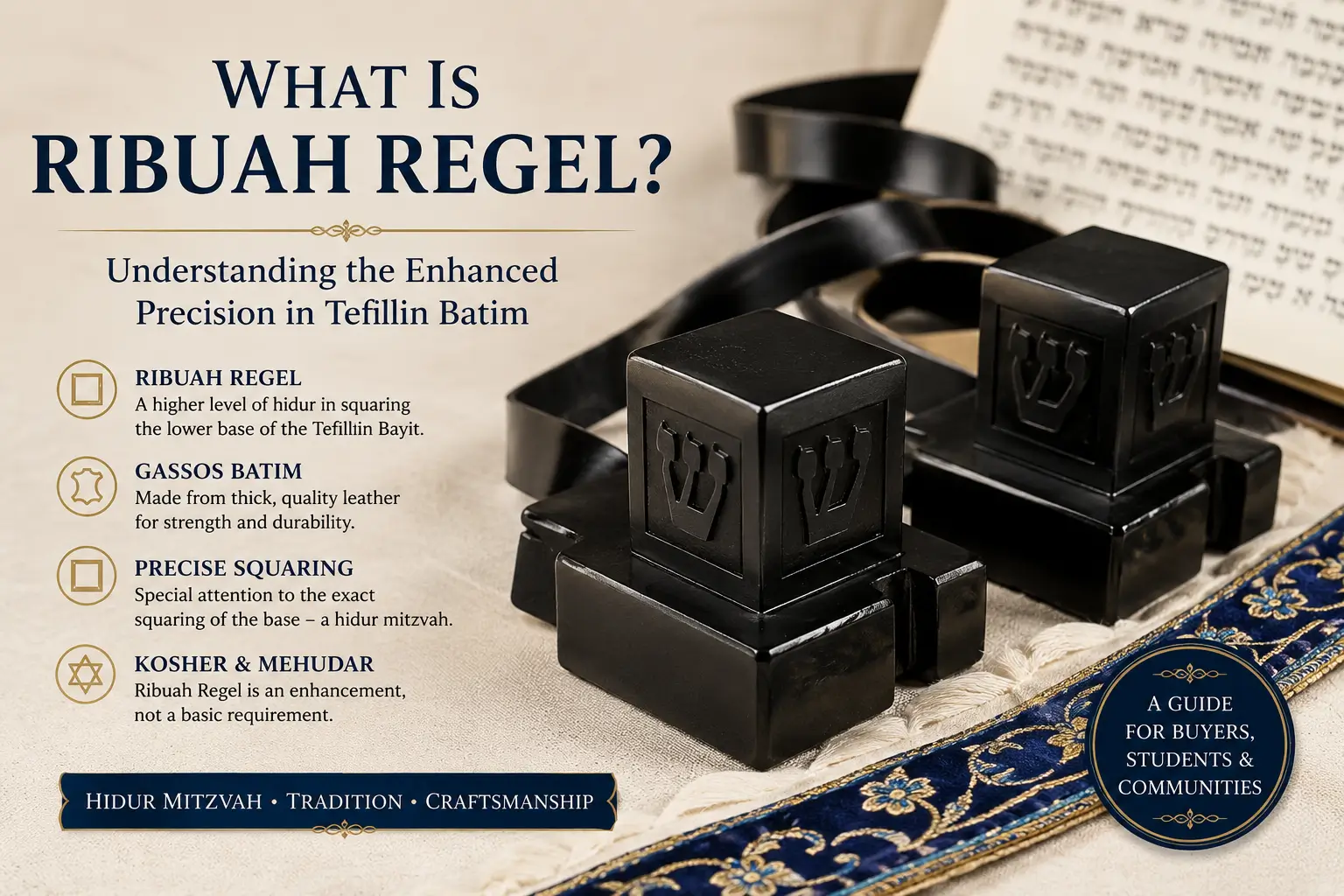
Ribuah Regel is a particular level of hidur in the construction of Tefillin Batim, referring specifically to the precise squaring of the lower base of the Bayit. The word ribuah means squaring, while regel refers to the lower portion or base of the Tefillin housing.
The distinction becomes especially relevant when comparing different grades of Gassos Tefillin. A standard Gassos Bayit already represents a substantial level of craftsmanship, generally constructed from thick leather and designed to maintain the required square form. Ribuah Regel adds an additional degree of precision to the squaring of the base, requiring specialized craftsmanship and careful attention to the geometry of the Bayit.
For buyers researching What Is Ribuah Regel?, the most important point is that it should be understood as a hiddur mitzvah, rather than as a claim that ordinary kosher Gassos Tefillin are invalid without it. Contemporary halachic discussions specifically describe Ribuah Regel as an enhancement in the Batim rather than a prerequisite for ordinary kosher Tefillin.
Why Is Squareness Important in Tefillin?
The form of the Tefillin Bayit is not merely an aesthetic matter. The Batim are subject to specific halachic requirements concerning their shape and construction, including the requirement that they be square.
This is why ribua receives so much attention when evaluating Tefillin. A beautifully finished Bayit is not necessarily a mehudar Bayit merely because it looks attractive. The craftsman must achieve the required physical form with precision and maintain that form through the construction process.
For those considering higher levels of hidur, Ribuah Regel focuses particular attention on the lower base of the Bayit. The work is considerably more demanding because the craftsman must achieve an accurate square rather than relying simply on a general visual impression.
This distinction is important when evaluating Tefillin. Hidur mitzvah is not synonymous with appearance. It can involve the quality of the leather, the construction of the Batim, the precision of the ribua, the manner in which components are prepared, and other details of craftsmanship.
Ribuah Regel and Gassos Batim
To understand Ribuah Regel properly, it helps to first understand Gassos Batim.
Gassos Tefillin are made from thick leather and are widely regarded as a preferred standard for serious daily use. At SeferTorah.Net, Gassos Batim are described as being made from Ohr Echad, or a single piece of leather, providing structural integrity and durability. The quality of the Bayit depends not only on the leather itself but also on how that leather is shaped, squared, formed, and finished.
Gassos Ribuah Regel takes this construction a step further. In addition to the qualities associated with Gassos Batim, special attention is given to the precision of the lower base. SeferTorah.Net describes this as the highest level of craftsmanship offered in its Tefillin Batim range.
The distinction can therefore be summarized simply:
- Gassos — thick-leather Batim constructed to a high standard with proper ribua.
- Gassos Ribuah Regel — Gassos Batim with an additional level of precision devoted to the squaring of the base.
The exact manufacturing method and additional features can vary between makers, so a buyer should ask the seller or their Rav or sofer exactly what is meant by a particular Ribuah Regel specification.
How Is Ribuah Regel Made?
Producing a precise Ribuah Regel Bayit requires substantially more attention to the physical shaping of the leather than simply producing a generally square housing.
The craftsman begins with the leather structure of the Bayit and carefully works the relevant surfaces until the required geometry is achieved. Sources describing the manufacturing process emphasize the additional precision, skill, and time involved in achieving the squared base. Some traditional production methods also distinguish Ribuah Regel from machine-assisted squaring by emphasizing human involvement in the shaping process.
This is one reason the term Avodat Yad sometimes appears alongside discussions of mehudar Batim. However, buyers should be careful not to treat these terms as interchangeable. “Handmade,” “Ribuah Regel,” “Mekhuvanot,” and “Ohr Echad” can describe different aspects of Tefillin construction.
A knowledgeable buyer should therefore ask precisely what a manufacturer means by each designation rather than assuming that one label automatically guarantees every other level of hidur.
What Is the Difference Between Ribuah Regel and Regular Gassos?
This is one of the most common questions from people researching higher-quality Tefillin.
Both can be fully kosher when produced according to the applicable halachic requirements. The distinction concerns the level of enhancement and craftsmanship.
Standard Gassos Batim are already constructed from thick leather and carefully formed into the required shape. Ribuah Regel places additional emphasis on achieving a precisely squared lower base.
For someone purchasing Tefillin for the first time, this distinction can be confusing because descriptions such as “Gassos,” “Ribuah Regel,” “Ohr Echad,” and “Mehudar” are often presented together.
The correct approach is to look at the complete specification of the Batim:
- What type of leather is being used?
- Is the Bayit made from Ohr Echad?
- How is the ribua achieved?
- Does the Ribuah Regel refer to the base specifically?
- Is the work performed by hand, machine, or through a combination of methods?
- Which community or minhag is the Bayit intended to serve?
- What level of certification or inspection accompanies the Tefillin?
These questions give a much clearer picture than relying on a single marketing term.
Is Ribuah Regel Required for Kosher Tefillin?
No. It is important to distinguish between basic halachic validity and hidur mitzvah.
Contemporary discussions of Tefillin quality indicate that Ribuah Regel is considered an enhancement by those who seek this additional level of precision; ordinary properly made Gassos Batim can still be considered mehudar and kosher without this additional feature.
This distinction matters because purchasing Tefillin is not simply a matter of selecting the most expensive specification available. A buyer should consider their family minhag, the guidance of their Rav, the quality of the Parshiyot, the Batim, the Retzuot, and the overall level of workmanship.
For a Bar Mitzvah family or first-time buyer, professional guidance can be particularly valuable.
Ribuah Regel as a Hidur Mitzvah
The concept of hidur mitzvah encourages a person to beautify and enhance the performance of a mitzvah where appropriate.
With Tefillin, hidur can take many forms. A buyer may place importance on the quality and writing of the Parshiyot, the craftsmanship of the Batim, the quality and preparation of the Retzuot, or specific enhancements in the construction of the housings.
Ribuah Regel belongs within this broader framework.
It represents an investment in the precision of the physical Bayit itself. For someone who wants a particularly refined level of craftsmanship and wishes to add this hiddur to their Tefillin, Ribuah Regel can be a meaningful consideration.
At the same time, it should not overshadow the fundamentals. The kashrut of the Parshiyot, proper preparation, appropriate script tradition, and competent inspection remain central to the integrity of a Tefillin set.
Who Should Consider Ribuah Regel Tefillin?
Ribuah Regel may be particularly relevant to buyers who are already familiar with Tefillin quality levels and are deliberately seeking a higher degree of hidur mitzvah.
This can include:
- A ben Torah upgrading an existing set.
- A family purchasing especially mehudar Tefillin for a Bar Mitzvah.
- Buyers who specifically value precision in Batim construction.
- Individuals whose minhag or Rav’s guidance supports this level of hidur.
- Collectors and knowledgeable Judaica buyers who want exceptional Batim craftsmanship.
For a first-time buyer, however, it is generally more useful to understand the entire Tefillin set rather than focusing on one specification in isolation.
Choosing Ribuah Regel Tefillin from SeferTorah.Net
SeferTorah.Net offers Gassos Ribuah Regel Tefillin Batim as part of its range of Tefillin products. The site’s Tefillin Batim category explains Ribuah Regel as the highest level of Batim craftsmanship in its range, emphasizing the precision required to achieve the squared base.
For buyers comparing options, this category can be explored alongside the site’s Tefillin Sets, Tefillin Parshiyot, and Tefillin Retzuot collections. Looking at the entire set is important because the level of hidur should be considered across the components rather than judged by the Batim alone.
If you are uncertain whether Ribuah Regel is appropriate for your minhag, budget, or existing Tefillin, it is advisable to consult your Rav or a knowledgeable sofer before making the decision.
Frequently Asked Questions About Ribuah Regel
What does Ribuah Regel mean?
Ribuah Regel refers to a particular level of precision in the squaring of the lower base of Tefillin Batim. It is associated with enhanced craftsmanship and is generally discussed as a hiddur in Tefillin construction.
What Is Ribuah Regel?
Ribuah Regel refers to a particular level of hidur in the construction of Tefillin Batim, specifically the precise squaring of the lower base of the Bayit. The term ribuah refers to squaring, while regel relates to the lower portion or base of the Tefillin housing. The distinction is especially relevant when comparing different grades of Gassos Tefillin and seeking an additional level of precision in the Batim.
What is the difference between Gassos and Gassos Ribuah Regel?
Gassos refers to thick-leather Tefillin Batim, while Gassos Ribuah Regel adds a particular emphasis on the precise squaring of the lower base. Ribuah Regel therefore represents an additional level of craftsmanship.
Is Ribuah Regel the same as Ohr Echad?
No. These terms describe different aspects of Batim construction. Ohr Echad refers to single-piece leather construction, while Ribuah Regel refers specifically to enhanced precision in the squaring of the base.
Is Ribuah Regel the same as Avodat Yad?
Not necessarily. Avodat Yad describes human/manual workmanship, while Ribuah Regel describes a particular level of squaring. A manufacturer should be asked exactly how each designation applies to the Batim being offered.
Does every Jewish community require Ribuah Regel?
No. Customs and approaches to Tefillin hidur vary. A person should follow their established minhag and, where appropriate, seek guidance from their Rav or posek.
Are Ribuah Regel Tefillin better than standard Gassos?
They represent an additional level of craftsmanship in the Batim, particularly concerning the squared base. That does not mean standard Gassos Tefillin are inherently non-mehudar or unsuitable. The appropriate choice depends on the buyer’s priorities and halachic guidance.
Should I buy Ribuah Regel Tefillin for a Bar Mitzvah?
It can be an appropriate choice for a family seeking a higher level of hidur, but the decision should consider the complete Tefillin set, family minhag, budget, and guidance from a Rav or knowledgeable sofer.
Does Ribuah Regel affect the Parshiyot?
Ribuah Regel concerns the construction and squaring of the Batim, not the handwritten Parshiyot. The Parshiyot remain a separate and fundamental component of the Tefillin set and should be evaluated for their own level of kashrut and hidur.
Conclusion
Understanding What Is Ribuah Regel? requires looking beyond the appearance of a pair of Tefillin. Ribuah Regel is a specialized enhancement in the construction of the Batim, centered on the precision of the squared lower base. It represents the additional craftsmanship sought by those who wish to pursue a higher level of hidur mitzvah.
At the same time, it is important to keep the distinction between halachic requirement and hiddur clear. Standard Gassos Batim can meet the requirements of kosher Tefillin without Ribuah Regel, while Ribuah Regel provides an additional level of precision for those who seek it.
For anyone comparing Tefillin, the best decision is an informed one—considering the Batim, Parshiyot, Retzuot, minhag, craftsmanship, and guidance of a trusted Rav or sofer. SeferTorah.Net provides a range of Tefillin options and components for buyers seeking to understand these distinctions and select Tefillin appropriate to their standards and tradition.