


Essential Judaica for a Bar Mitzvah

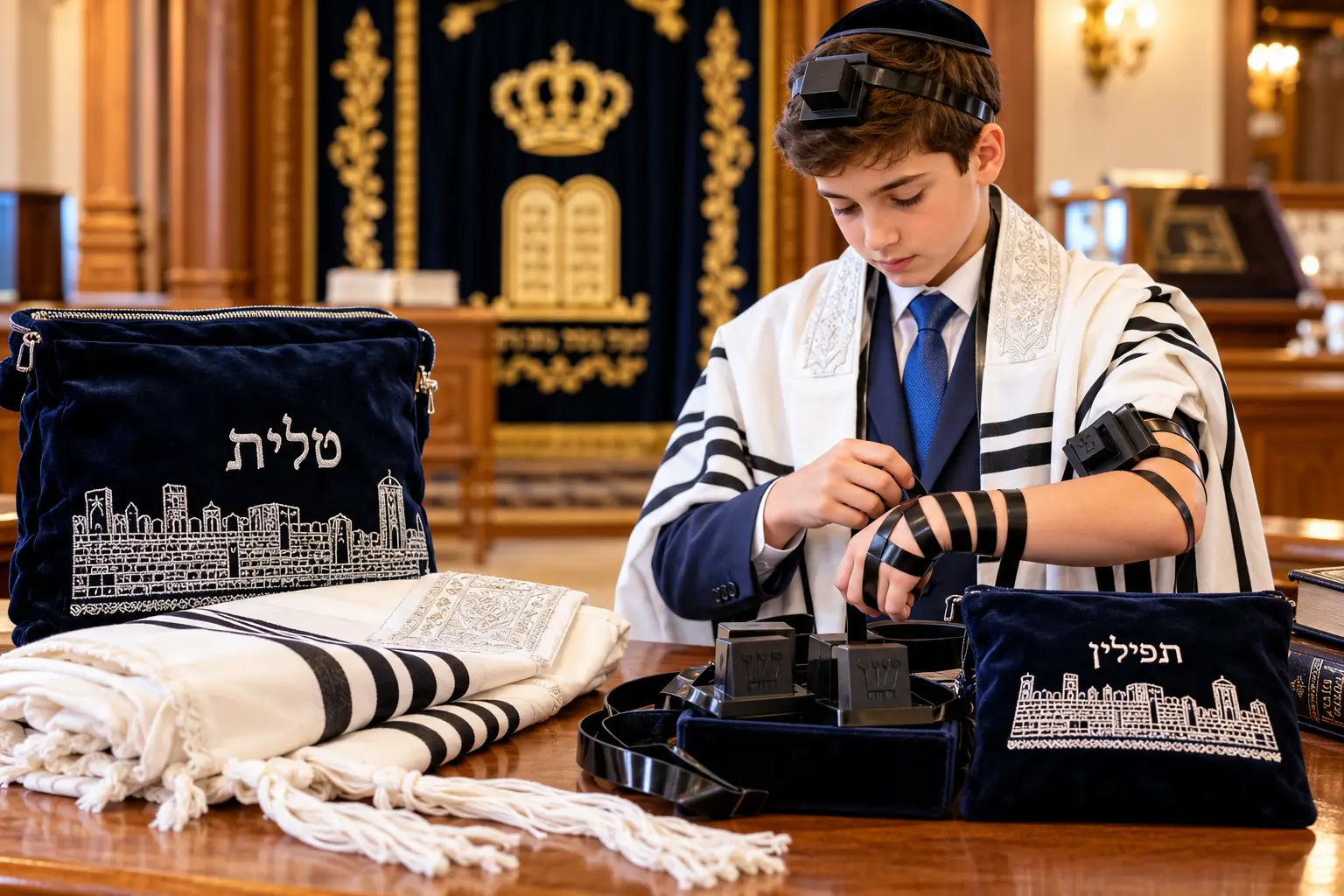
A Bar Mitzvah is more than a celebration marking a boy’s thirteenth birthday. It marks the point at which he becomes personally obligated in mitzvot and begins taking greater responsibility for Jewish religious life. For many families, this transition also means acquiring the Judaica he will use for years: Tefillin, a Tallit, Tzitzit, protective bags, and other items connected with prayer and Torah observance.
Choosing these items requires more than selecting attractive designs. Family minhag, synagogue practice, halachic requirements, sizing, craftsmanship, and the boy’s future use should all be considered.
This guide explains the essential Judaica for a Bar Mitzvah, what each item is used for, and what families should consider before purchasing.
1. Tefillin: The Central Bar Mitzvah Purchase
For a Bar Mitzvah boy, Tefillin are usually the most significant Judaica purchase associated with entering the obligation of mitzvot.
A set of Tefillin consists of Tefillin Shel Yad and Tefillin Shel Rosh. Each contains handwritten passages from the Torah on parchment prepared by a qualified Sofer STa”M. The batim, parshiyot, and retzuot all contribute to the kashrut and overall standard of the pair.
Because Tefillin contain sacred handwritten text, appearance alone should never determine a purchase. Families should first establish the appropriate tradition and halachic standard with their rabbi or qualified Sofer.
Choosing the Right Tefillin
Several factors deserve attention:
- Nusach and family tradition
- Ksav, such as Beit Yosef or another applicable tradition
- Type of batim, including Peshutim, Dakkot, or Gassot
- Quality and inspection of the parshiyot
- Retzuot and their preparation
- Size and fit
- Right- or left-handed use
- The level of hiddur appropriate for the family
Tefillin are not simply a one-day Bar Mitzvah accessory. They are intended for regular weekday use, making proper selection particularly important.
For families beginning the purchasing process, our [Tefillin Sets & Accessories] category provides a natural starting point for exploring complete sets and related items.
2. Tallit: A Garment Connected With Prayer
A Tallit is another important item to consider, but families should not assume that every Bar Mitzvah boy begins wearing a Tallit Gadol at exactly the same time.
Minhagim differ between communities. In many Ashkenazic communities, unmarried men traditionally begin wearing a Tallit Gadol after marriage, while Sephardic and some other communities have customs in which boys begin wearing one earlier. The appropriate practice should therefore be confirmed with the family’s rabbi or according to established family minhag.
When a Tallit is appropriate for the Bar Mitzvah, practical considerations include:
Size
The Tallit should be appropriate for the wearer’s build and the way he will use it. A Bar Mitzvah boy may still be growing, so purchasing solely according to age or appearance can be misleading.
Tzitzit
The four corners of the Tallit carry Tzitzit, which are central to the mitzvah. The tying and preparation should correspond to the family’s accepted halachic practice.
Atarah and Design
An Atarah can provide a practical indication of the upper edge of the Tallit and may also reflect the family’s aesthetic or communal tradition.
For families looking for a Tallit and related prayer garments, our Tallits – Prayer Shawls category can be linked naturally from this section.
3. Tzitzit and Arbah Kanfot
A Bar Mitzvah preparation list should not overlook Tzitzit, or Arbah Kanfot.
Unlike the Tallit Gadol, a Tallit Katan is commonly worn as an everyday four-cornered garment. Its purpose is connected directly to the Torah’s commandment of Tzitzit and the reminder of mitzvot associated with the fringes.
Families should pay attention to:
- Garment size
- Material
- Tzitzit strings
- Method of tying
- Family and community practice
- Comfort for everyday wear
For a young man beginning a more consistent routine of mitzvah observance, having properly prepared Tzitzit can be more meaningful than simply purchasing another ceremonial item for the Bar Mitzvah celebration.
Our [Tzitzit – Arbah Kanfot] category can therefore serve as a useful internal resource for families preparing the complete set of Judaica.
4. A Tefillin Bag and Tallit Bag
Protective storage is often overlooked when families concentrate on the primary ritual objects.
Tefillin and Tallit should be stored carefully between uses. A dedicated bag helps keep the items organized and reduces unnecessary exposure to dust, moisture, friction, and accidental damage.
A Tefillin bag should accommodate the particular set without placing excessive pressure on the batim. Likewise, a Tallit bag should allow the garment to be folded and stored appropriately.
A coordinated Tallit/Tefillin Bag Set can also make practical sense for a Bar Mitzvah boy who will carry both items regularly.
Families can explore [Tallis/Tefillin Bag Sets] when they want one organized solution rather than purchasing unrelated bags separately.
5. Tefillin Protectors and Everyday Care
The first Tefillin set a boy receives may accompany him for many years. Proper care therefore matters from the beginning.
Tefillin should not simply be placed loose inside a school bag, car, or drawer. Heat, moisture, pressure, and careless handling can affect leather components and parchment.
A protective case or thermal protector can provide an additional layer of protection, particularly when Tefillin must be transported.
Families should also establish a simple routine:
- Store Tefillin in their designated container.
- Avoid leaving them in excessive heat.
- Keep them away from moisture.
- Handle the batim carefully.
- Do not place heavy objects on top of the Tefillin.
- Follow the inspection and maintenance guidance of a qualified Sofer.
The goal is not merely preserving an expensive possession. Proper care reflects the kavod appropriate to an object used for a mitzvah.
6. Tefillin Bags, Belts and Accessories
Not every Bar Mitzvah purchase needs to be ceremonial.
Some accessories are valuable because they make daily mitzvah observance easier and more organized.
Depending on the family’s needs, this may include:
- Tefillin bags
- Tefillin belts
- Protective cases
- Thermal protectors
- Storage accessories
- Tallit bags
- Coordinated travel bags
The important principle is to distinguish between accessories that provide genuine practical value and items purchased merely because they appear attractive.
For Tefillin specifically, the underlying sacred components remain the priority. A beautifully designed bag cannot compensate for uncertainty regarding the kashrut or suitability of the Tefillin themselves.
7. What About Other Judaica Gifts?
Tefillin and Tallit are not the only meaningful Judaica associated with a Bar Mitzvah.
Relatives and friends may choose gifts that encourage continued Jewish learning and observance, such as:
- Siddurim
- Jewish books
- Tallit accessories
- Tefillin accessories
- Judaica artwork
- Tzedakah-related items
- Personalized Judaica
- Jewish educational materials
The appropriate gift often depends on the relationship between the giver and the Bar Mitzvah boy.
Parents or grandparents may traditionally take responsibility for major ritual purchases, while extended family and friends may prefer a smaller Judaica item or educational gift.
The most useful question is not simply, “What looks like a good Bar Mitzvah gift?” but rather:
“What will help this young man continue his Jewish practice after the celebration is over?”
8. Don’t Buy Tefillin or Tallit Based Only on Appearance
One of the most common mistakes when purchasing Bar Mitzvah Judaica is treating sacred objects like ordinary consumer products.
A photograph cannot tell you whether Tefillin are appropriate for a particular family tradition. A decorative Tallit cannot tell you whether its dimensions, Tzitzit, or preparation meet the requirements relevant to the wearer.
Likewise, two products that appear similar may differ substantially in their construction, materials, writing standards, or intended use.
For Tefillin, families should discuss the purchase with a qualified rabbi or Sofer before deciding on the appropriate standard. Current buying guidance similarly emphasizes confirming tradition, certification, sizing, and inspection rather than choosing based solely on product appearance.
This is particularly important when purchasing a surprise gift. A well-intentioned gift can become difficult to exchange if the Tefillin follow the wrong tradition or do not suit the recipient’s requirements.
9. Building a Practical Bar Mitzvah Judaica Set
Rather than viewing the Bar Mitzvah purchase as one large transaction, families can think in terms of a complete Judaica system.
Core Items
Tefillin
The central ritual item requiring careful halachic and technical consideration.
Tallit
When appropriate according to the family’s minhag and synagogue practice.
Tzitzit / Arbah Kanfot
For regular daily wear according to the individual’s practice.
Protection and Storage
Tefillin Bag
For organized and respectful storage.
Tallit Bag
For protecting the garment between uses.
Thermal Protector
Particularly useful when Tefillin are transported or exposed to temperature changes.
Supporting Accessories
Additional accessories can be selected according to the boy’s routine, school environment, synagogue needs, and family preferences.
Thinking this way prevents families from purchasing decorative items first and discovering later that an essential practical item was overlooked.
10. Buying Essential Judaica for a Bar Mitzvah
When purchasing Essential Judaica for a Bar Mitzvah, start with the items that have a direct role in mitzvah observance.
For Tefillin, determine the appropriate nusach, writing tradition, standard, sizing, and inspection requirements before comparing specific products. For a Tallit, establish the family’s minhag and determine the appropriate size and Tzitzit configuration.
Then consider the accessories that protect and organize these items for everyday use.
At SeferTorah.Net, families can explore Tefillin, Tallit, Tzitzit, bags, protectors, and related Judaica in one place. The goal should be to select items that are appropriate for the young man’s practice and capable of serving him well beyond the Bar Mitzvah celebration.
Frequently Asked Questions
1. What are the most essential Judaica items for a Bar Mitzvah?
For many families, the principal items are Tefillin and, where appropriate according to family minhag, a Tallit. Tzitzit and suitable storage bags are also practical parts of a young man’s regular Judaica.
2. Does every Bar Mitzvah boy need a Tallit?
Not necessarily at the same age. Customs concerning when an unmarried boy begins wearing a Tallit Gadol vary between communities. Families should follow their established minhag or consult their rabbi.
3. When should Tefillin be purchased for a Bar Mitzvah?
Families generally purchase them sufficiently in advance to allow time for selection, sizing, preparation, inspection, and instruction. It is wise not to leave the purchase until immediately before the Bar Mitzvah.
4. What should I consider when buying Tefillin for a Bar Mitzvah boy?
Consider the family’s halachic tradition, Ksav, batim, parshiyot, retzuot, inspection, sizing, handedness, and the appropriate level of hiddur. A rabbi or qualified Sofer can help establish the relevant requirements.
5. Should Bar Mitzvah Tefillin be smaller?
Some young users may require appropriately sized batim, but size should not be chosen simply because the recipient is thirteen. Proper fitting depends on the individual and the particular Tefillin. Current buying guidance specifically recommends considering the wearer’s head and arm measurements and community requirements.
6. Is a Tefillin bag necessary?
A dedicated bag is highly practical because it helps protect and organize the Tefillin during storage and transportation. It also keeps the Tefillin separate from ordinary belongings.
7. What is a good Judaica gift for a Bar Mitzvah guest or relative?
A meaningful Judaica gift can be a Tallit accessory, Tefillin accessory, Jewish book, artwork, or another item connected to Jewish learning and observance. The appropriate choice depends on the recipient and the relationship with the family.
8. Should I buy a complete Tallit and Tefillin bag set?
A coordinated set can be convenient for a Bar Mitzvah boy who regularly carries both items. The important consideration is that the bags provide appropriate protection and fit the actual Tallit and Tefillin being used.
9. How should Tefillin be stored?
Tefillin should be kept in their designated protective containers and protected from excessive heat, moisture, pressure, and careless handling. Families should follow the maintenance recommendations of their rabbi or qualified Sofer.
10. Where should I begin when buying Bar Mitzvah Judaica?
Begin with the family’s minhag and the actual requirements of the Bar Mitzvah boy’s synagogue and rabbi. Establish the requirements for Tefillin and Tallit first, then select bags, protectors, and other accessories around those primary items.
Conclusion
The best approach to Essential Judaica for a Bar Mitzvah is not to create the largest collection of Judaica, but to select the items that will become part of the young man’s Jewish life.
Tefillin require careful attention to kashrut, tradition, writing, construction, and fit. A Tallit and Tzitzit connect daily prayer and mitzvah observance with the customs of the family and community. Bags and protective accessories provide the practical support needed to preserve these sacred items through years of use.
A Bar Mitzvah marks a beginning. The Judaica chosen for that occasion should therefore be selected not merely for the ceremony itself, but for the mitzvot, learning, prayer, and Jewish life that follow it.
One thought on “Essential Judaica for a Bar Mitzvah”