


What Is Ohr Echad? | Tefillin Batim Explained

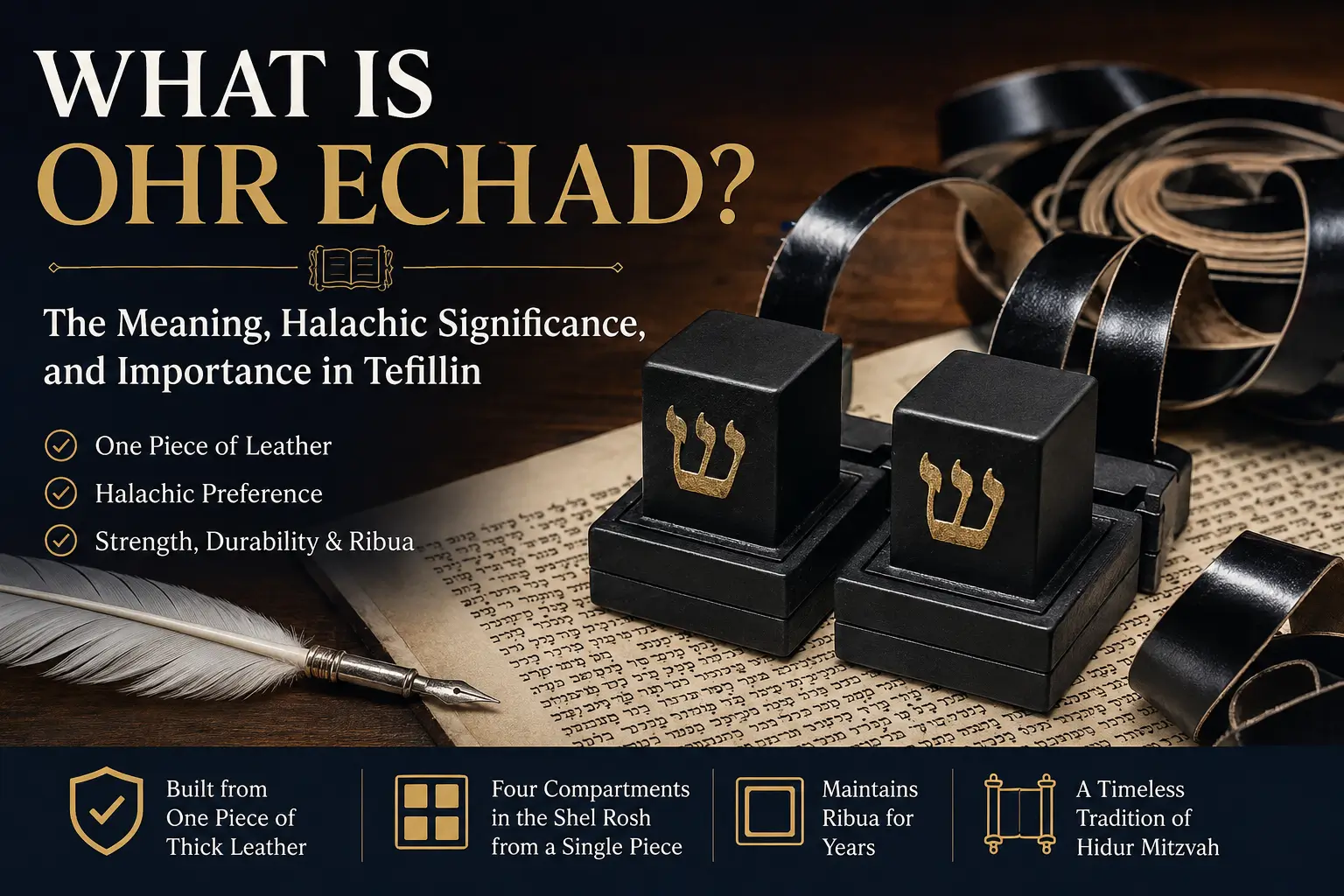
Learn what is Ohr Echad means in Tefillin, how single-piece Batim are made, why they matter, and how Gassos compare with other Tefillin grades. When shopping for Tefillin, one of the terms that frequently appears alongside Gassos Tefillin is Ohr Echad. For someone unfamiliar with the terminology of STa”M, it may sound like simply a description of the leather. In the world of Tefillin, however, Ohr Echad refers to an important aspect of how the Batim, or leather housings, are constructed.
The Hebrew words Ohr Echad (עור אחד) literally mean “one piece of leather.” The term is commonly used to describe Gassos Batim whose principal housing is formed from a single piece of thick leather rather than being assembled from multiple separate pieces. This construction is significant both from a practical standpoint and in the context of the longstanding halachic preference for Tefillin made from a single piece of leather.
Understanding what Ohr Echad means is therefore useful when comparing Tefillin quality levels, evaluating Batim, or deciding whether an upgrade to Gassos Tefillin is appropriate.
What Does Ohr Echad Mean in Tefillin?
Ohr Echad means “one piece of leather.” In the context of Tefillin Batim, it describes a construction in which the leather housing is formed from a single piece of hide.
This is particularly associated with Tefillin Gassos, where thick leather is shaped and pressed to create the familiar square form of the Batim. The Shel Rosh presents an especially demanding manufacturing challenge because the leather must ultimately form four distinct compartments while maintaining the required structure and appearance. Sources describing contemporary Gassos production explain that the leather is stretched over a form and carefully shaped and pressed into the four-compartment configuration.
The distinction is important because Tefillin are not ordinary leather boxes. Their construction involves numerous halachic requirements, including the structure of the Batim, their squareness, the separation of the compartments of the Shel Rosh, and the manner in which the leather is prepared.
Why Is One-Piece Leather Important?
The preference for Tefillin made from one piece of leather has a substantial halachic background.
The Rambam describes the Shel Rosh as having four compartments covered by a single piece of leather. Later halachic authorities discuss constructions involving separate compartments that are sewn or glued together, while also identifying the single-piece construction as preferable.
This distinction became especially important historically when thinner leather constructions required additional methods to maintain the shape of the Batim. Modern Gassos production uses substantially thicker leather, allowing skilled craftsmen to form the compartments while maintaining the necessary structure without relying on the same construction approach used for thinner Batim.
For this reason, Ohr Echad is not merely a marketing expression. It describes a meaningful construction characteristic that has both halachic and practical significance.
Ohr Echad and Gassos Tefillin
The term Ohr Echad is most commonly encountered in connection with Gassos Tefillin.
Gassos means “thick,” referring to the substantial leather used in the Batim. The thick hide gives the craftsman enough material to form the four compartments of the Shel Rosh while maintaining the structural strength required of the Bayit.
At SeferTorah.Net, Gassos Batim are described as being made from a single piece of thick leather, with the resulting construction valued for its structural integrity, ribua, durability, and long-term daily use.
The relationship can therefore be summarized simply:
Gassos describes the thick-leather grade of the Batim.
Ohr Echad describes the single-piece leather construction.
They are closely associated, but the terms describe different aspects of the Batim.
How Are Ohr Echad Tefillin Batim Made?
Producing an Ohr Echad Bayit is considerably more demanding than assembling a simple leather housing.
The leather must be prepared and shaped so that it can form the required structure of the Tefillin. In the Shel Rosh, this includes creating four separate compartments for the four Parshiyot while preserving the integrity of the single piece of leather.
Contemporary descriptions of Gassos manufacturing explain that thick leather is stretched over a mold or form and subjected to substantial pressure to achieve the required shape. The process requires careful control because the leather is thick and resistant, yet the final Batim must have precise geometry.
The leather must ultimately produce Batim that are properly shaped and maintain their ribua, or squareness.
This is one reason the manufacture of Gassos Batim is regarded as specialized craftsmanship rather than ordinary leatherwork.
What Is Ribua and Why Does It Matter?
One of the most important characteristics of a kosher Bayit is its required square form.
The halachic literature discusses the requirement that the Tefillin be square, including the structure of both the Ketzitza and the Titura. Modern guidance on purchasing Tefillin likewise emphasizes the importance of maintaining the proper shape throughout the life of the Batim.
This is where the structural advantage of thick, single-piece leather becomes especially relevant.
A properly constructed Gassos Bayit has substantial leather walls capable of maintaining their form through years of regular use. That does not mean an Ohr Echad Bayit is immune to damage. Tefillin should still be handled carefully, protected from moisture and excessive heat, and periodically examined when circumstances warrant professional inspection.
The objective is not simply to purchase a Tefillin Bayit that looks square when new. The construction should support the continued preservation of its required form.
Ohr Echad vs Peshutim and Dakos
Understanding the major Tefillin grades makes the meaning of Ohr Echad easier to appreciate.
Peshutim
Peshutim are generally constructed using separate pieces of leather that are joined together. Halachic authorities have discussed the validity of such constructions, including the question of whether joining leather pieces can satisfy the relevant requirement. Contemporary halachic sources note that constructions involving sewing or gluing may be acceptable according to certain opinions, while a single-piece construction is preferable according to other authorities.
Dakos
Dakos means “thin.” These Batim use thinner leather and represent another traditional construction category. They can be halachically appropriate when produced according to the relevant requirements and customs, but their thinner construction presents different practical considerations concerning durability and maintaining the shape of the Batim.
Gassos / Ohr Echad
Gassos Batim use thick leather and are commonly constructed as Ohr Echad. The substantial leather allows the craftsman to form durable Batim with strong structural integrity and carefully defined compartments.
For buyers seeking a long-term daily pair and who have the means to invest in a higher grade of Batim, Gassos Ohr Echad are widely regarded as a significant level of hidur in Tefillin construction.
Is Ohr Echad the Same as Miksheh?
Not necessarily.
This is an important distinction for knowledgeable Tefillin buyers.
Ohr Echad generally refers to the use of one piece of leather in the relevant Bayit construction, particularly the upper housing of the Shel Rosh.
Miksheh, in discussions of higher grades of Batim, can refer to a more comprehensive single-piece construction extending beyond the upper housing to other parts of the Bayit. Terminology can vary among manufacturers and communities, so buyers should ask exactly what portions of the Batim are included when a seller uses terms such as Ohr Echad or Miksheh.
The important point is that these terms should not automatically be treated as interchangeable labels.
Does Ohr Echad Make Tefillin Kosher?
Ohr Echad is an important construction characteristic, but it should not be treated as a substitute for evaluating the complete Tefillin.
The kashrut of Tefillin depends on many elements, including the Parshiyot, Batim, Retzuot, writing, preparation, assembly, and other halachic requirements.
A pair of Tefillin should therefore be evaluated as a complete set rather than based on one specification alone.
This is especially important when purchasing online. The buyer should consider the quality and verification of the Parshiyot, the construction and craftsmanship of the Batim, the Retzuot, the applicable minhag, and the standards of the supervising authority or sofer.
Choosing Ohr Echad Tefillin for a Bar Mitzvah
For a Bar Mitzvah family purchasing Tefillin for the first time, the terminology can quickly become overwhelming.
Families may encounter Peshutim, Dakos, Gassos, Ohr Echad, Ribuah Regel, different ksav traditions, and multiple levels of Parshiyot.
The right decision should not be based solely on the most impressive-sounding specification.
A family should first determine the boy’s minhag and ksav tradition, consult with the family’s Rav when appropriate, establish a realistic budget, and then compare the available levels of hidur within that framework.
For families seeking a Tefillin set intended to serve for many years of daily use, Gassos Ohr Echad Batim represent an important option to consider.
Shop Kosher Tefillin Batim and Gassos Ohr Echad
If you are looking to purchase or upgrade Tefillin, SeferTorah.Net offers Tefillin Batim across multiple quality grades, including Peshutim Mehudarim, Dakos, Gassos Ohr Echad, and Gassos Ribuah Regel.
Our Tefillin Batim collection is intended for buyers who want to understand the differences between construction grades rather than simply choosing a product based on appearance or price. We can also assist customers who already have suitable Parshiyot and are considering rehousing them in new Batim for restoration or upgrading purposes.
Explore our Tefillin Batim collection when you are ready to compare available options, or contact SeferTorah.Net for guidance regarding Batim, Parshiyot, Retzuot, and the appropriate combination for your minhag and needs.
Frequently Asked Questions About Ohr Echad
What is Ohr Echad?
Ohr Echad literally means “one piece of leather.” In Tefillin terminology, it generally refers to Batim constructed from a single piece of leather, particularly the thick-leather construction associated with Gassos Tefillin.
Are Ohr Echad Tefillin the same as Gassos?
They are closely related but not identical terms. Gassos describes the thick-leather grade of the Batim, while Ohr Echad describes the single-piece leather construction. Gassos Batim are commonly made as Ohr Echad.
Why is Ohr Echad considered desirable?
Single-piece construction is associated with the longstanding halachic preference for Tefillin made from one piece of leather. It also provides a structurally strong housing capable of maintaining the required form when properly manufactured and cared for.
Are Peshutim Tefillin kosher?
Certain Peshutim constructions are discussed and accepted under specific halachic approaches. However, the halachic literature also records a preference for Tefillin constructed from a single piece of leather. Buyers seeking a particular level of hidur should consult their Rav or a knowledgeable sofer.
What is the difference between Ohr Echad and Ribuah Regel?
Ohr Echad concerns the single-piece leather construction of the Batim. Ribuah Regel refers to a particular level of precision in achieving the required squareness of the Tefillin, particularly the base. They describe different aspects of Batim craftsmanship.
Does Ohr Echad guarantee that Tefillin are kosher?
No. Ohr Echad describes one aspect of Batim construction. Complete Tefillin require proper Parshiyot, Batim, Retzuot, preparation, assembly, and adherence to the applicable halachic requirements.
How long can Gassos Ohr Echad Tefillin last?
The lifespan depends on craftsmanship, frequency of use, storage, environmental exposure, and ongoing care. Thick Gassos Batim are valued for their durability and ability to maintain their structure, but no Tefillin should be assumed to remain in perfect condition indefinitely.
Should I buy Ohr Echad Tefillin for a Bar Mitzvah?
Gassos Ohr Echad can be an excellent option for a Bar Mitzvah when appropriate for the family’s minhag and budget. The decision should also consider the quality of the Parshiyot and Retzuot and, where appropriate, guidance from the family’s Rav.
Can I put existing Parshiyot into new Ohr Echad Batim?
In some cases, yes. If existing Parshiyot are suitable and the Batim require replacement or upgrading, they may potentially be rehoused. This should be evaluated by a qualified sofer or knowledgeable Tefillin professional before proceeding.
Where can I buy Gassos Ohr Echad Tefillin Batim?
SeferTorah.Net offers Gassos Ohr Echad Batim alongside other Tefillin grades, including Peshutim Mehudarim, Dakos, and Gassos Ribuah Regel. Buyers can review the available Batim and contact the team for guidance regarding their specific requirements.
Conclusion
Understanding What Is Ohr Echad is an important step for anyone researching Tefillin quality and Batim construction. The term refers to a single-piece leather construction and is most commonly associated with Gassos Tefillin.
Its importance is both practical and rooted in the halachic preference for a single-piece construction. At the same time, Ohr Echad should be understood as one component of a much larger system of Tefillin kashrut and hidur.
For a serious Tefillin purchase, look beyond terminology alone. Consider the Batim, Parshiyot, Retzuot, ksav, minhag, craftsmanship, supervision, and your own community’s standards. When those elements are evaluated together, you can make a more informed decision about a pair of Tefillin that may accompany you throughout decades of daily avodat Hashem.