


How Tefillin Parshiyot Are Written

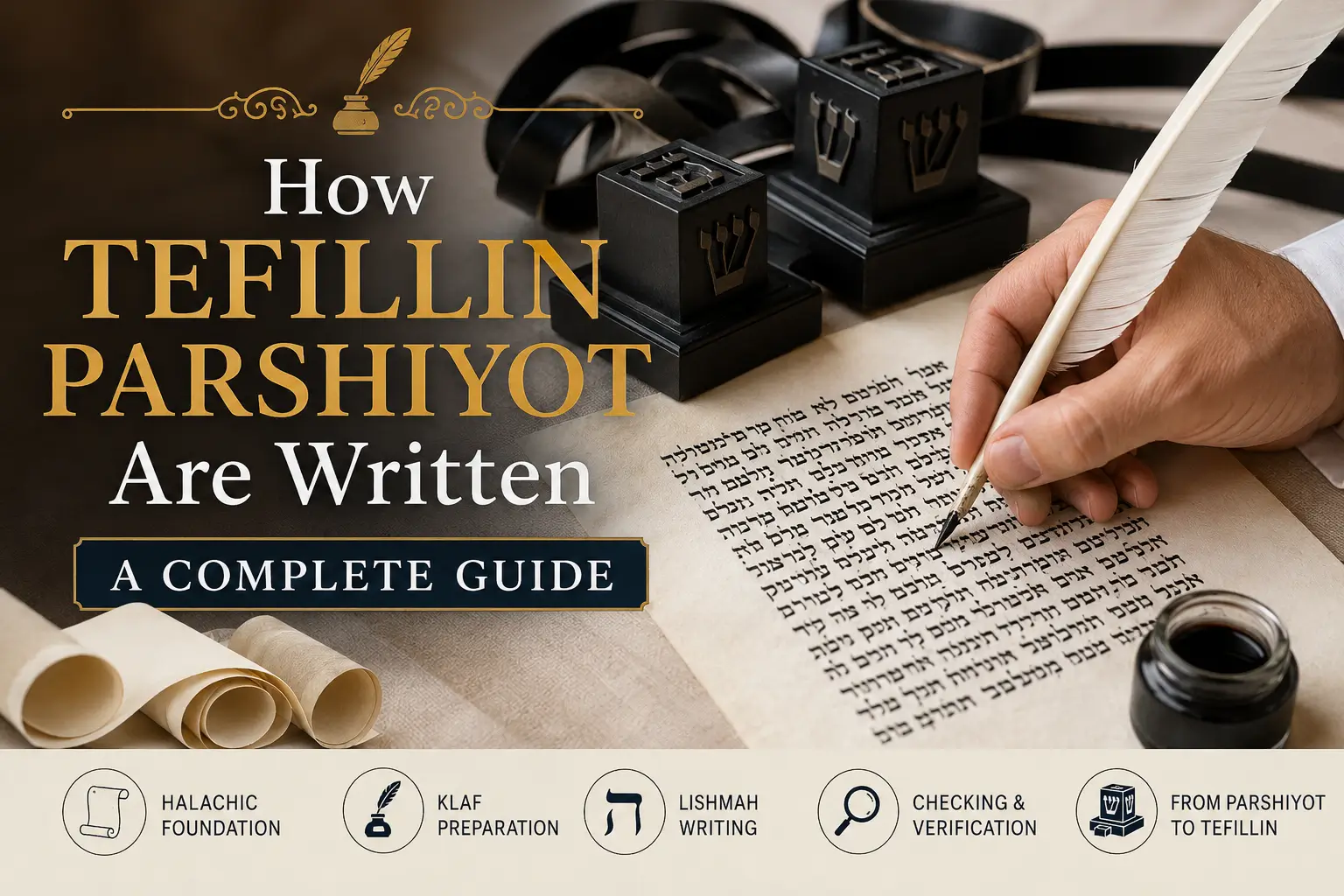
Tefillin Parshiyot are among the most sacred examples of Jewish scribal craftsmanship. Hidden inside the Batim of every pair of Tefillin are four handwritten sections of Torah, written on specially prepared parchment by a qualified Sofer STa”M. Their small size can make the finished Parshiyot appear deceptively simple, but producing kosher Tefillin Parshiyot requires precision, knowledge of Halacha, proper materials, careful writing, and a deep awareness of the sanctity of the text.
Understanding how Tefillin Parshiyot are written is therefore important not only for sofrim, but also for anyone purchasing Tefillin for daily use, a Bar Mitzvah, a wedding, or as a meaningful lifelong investment.
At SeferTorah.Net, our Tefillin Parshiyot are written by expert Sofrim trained in the laws and traditions of STa”M. Every Parshah we carry undergoes both hand-checking and bedikah b’machshev, providing two complementary forms of verification.
What Are Tefillin Parshiyot?
The word Parshiyot refers to the four Torah passages written inside Tefillin. They contain the fundamental declarations and commandments concerning the mitzvah of Tefillin and the relationship between the Jewish people, Torah, and the service of Hashem.
The four Parshiyot are:
- Kadesh — Shemot 13:1–10
- VeHayah Ki Yeviacha — Shemot 13:11–16
- Shema Yisrael — Devarim 6:4–9
- VeHayah Im Shamo’a — Devarim 11:13–21
For the Shel Yad, the four sections are written on a single piece of parchment. For the Shel Rosh, they are written on four separate pieces of parchment and placed into the four compartments of the Bayit. This distinction is an essential part of the construction of kosher Tefillin.
The Parshiyot are not printed, reproduced mechanically, or copied from an ordinary Torah book. Each letter must be written individually by hand according to the laws of STa”M.
Who Is Qualified to Write Tefillin Parshiyot?
The person who writes Tefillin Parshiyot is a Sofer STa”M—a Jewish scribe trained in the laws governing Sifrei Torah, Tefillin, and Mezuzot.
Technical handwriting ability alone is not enough. A Sofer must understand the detailed Halachic requirements governing the formation of letters, the preparation of parchment and ink, spacing, lines, columns, Divine Names, and other aspects of STa”M writing.
The spiritual dimension of the work is equally important. Tefillin Parshiyot contain sacred Names of Hashem, and their writing is performed with appropriate kavvanah, yirat shamayim, and attention to the sanctity of the mitzvah.
For this reason, when purchasing Parshiyot, buyers should consider not only the appearance of the writing but also the identity, experience, and reputation of the Sofer who wrote them.
Preparing the Klaf for Tefillin Parshiyot
Before a single letter is written, the Sofer requires properly prepared klaf, the parchment used for sacred Jewish writing.
The quality and preparation of the klaf affect the writing itself. It must be suitable for STa”M and prepared according to the relevant Halachic requirements. A Sofer works on a writing surface that allows the ink to form clear, durable letters while maintaining the necessary consistency throughout the Parshiyot.
The writing process therefore begins long before the first letter appears on the parchment. Proper preparation of the materials is part of the discipline that allows the finished Parshiyot to remain legible and usable for many years.
Writing Tefillin Parshiyot Lishmah
One of the fundamental concepts in STa”M is lishmah—performing the act specifically for the sake of the mitzvah for which it is intended.
The writing of Tefillin Parshiyot is not treated as ordinary calligraphy. The Sofer must approach the work with awareness that he is writing sacred text intended to fulfill the mitzvah of Tefillin.
This is one reason the role of the Sofer cannot be reduced to handwriting technique. A beautifully formed script does not by itself establish the full standard expected of kosher STa”M.
The combination of technical expertise, knowledge of Halacha, appropriate intention, and yirat shamayim is central to the production of meaningful and properly prepared Parshiyot.
Ksav: Why the Script Tradition Matters
Another important consideration when learning how Tefillin Parshiyot are written is the tradition of ksav.
Jewish communities have preserved different established scribal traditions, and the appropriate script is generally determined by one’s community custom and family minhag.
Ksav Beis Yosef
Ksav Beis Yosef is the traditional Ashkenazic script associated with the Beis Yosef and widely used among non-Hasidic Ashkenazic communities.
Ksav Ari
Ksav Ari, associated with the Arizal, is used extensively among Chabad and other Hasidic communities and among communities following related nusach and scribal traditions.
Ketav Sefaradi
Ketav Sefaradi represents the traditional Sephardic scribal tradition used by communities of Edot HaMizrach and other Sephardic communities.
These scripts are not simply different fonts. Specific letter formations distinguish the traditions, which is why a buyer should know which ksav is appropriate before ordering Tefillin Parshiyot.
SeferTorah.Net currently offers Parshiyot in Ksav Beis Yosef, Ksav Ari, and Ketav Sefaradi, with Ketav Alter Rebbi available by special request.
If there is uncertainty about which ksav is appropriate, the correct approach is to consult one’s Rav or community authority rather than selecting a script based solely on appearance.
The Precision Required in Every Letter
A major part of understanding how Tefillin Parshiyot are written is appreciating how much Halachic significance can rest on the formation of a single letter.
The Sofer must maintain proper letter shapes, spacing, line structure, margins, and other requirements throughout the writing. Letters must remain distinguishable from one another, and problems such as touching letters or altered formations can potentially affect the kashrut of the writing.
The writing must also remain consistent. A Parshah may contain thousands of individual strokes and letter formations, yet the finished work must appear as a coherent and carefully controlled manuscript.
This is why mehudar Parshiyot are evaluated not merely by whether the text is technically readable, but also by the clarity, consistency, beauty, quality of the klaf, quality of the ink, and caliber of the Sofer.
Hand-Checking and Computer Checking
At SeferTorah.Net, every Parshah carried in the current Tefillin Parshiyot collection undergoes both hand-checking and computer-based checking.
These two processes serve different purposes.
Bedikah b’machshev uses specialized software to identify potential textual problems, including letter-level discrepancies and certain spacing or textual irregularities.
Computer verification, however, does not replace the judgment of a qualified Sofer.
Hand-checking allows an experienced Sofer to examine the writing with knowledge of Halacha and the practical standards of STa”M. A machine can compare characters and detect patterns; it cannot replace the human expertise required to evaluate the physical writing and its Halachic context.
For this reason, SeferTorah.Net treats both forms of checking as part of its standard rather than offering computer checking as a substitute for professional human inspection.
What Makes Tefillin Parshiyot Mehudar?
Not every kosher Parshah is identical in its level of hidur mitzvah.
Among the factors considered when evaluating more mehudar Parshiyot are:
- The yirat shamayim and expertise of the Sofer
- Consistency and clarity of the letters
- Precision of letter formation
- Uniform spacing and margins
- Quality and preparation of the klaf
- Quality of the ink
- The relevant ksav tradition
- Careful hand-checking
- Computer-assisted verification
A truly mehudar Parshah reflects attention to all of these elements rather than one isolated feature.
The concept of hidur mitzvah does not mean that a less elaborate appearance is automatically invalid. Rather, it concerns the enhancement and beautification of the mitzvah beyond the basic requirements of kashrut.
From Parshiyot to Complete Tefillin
Tefillin Parshiyot are only one component of a complete pair of Tefillin. They must ultimately be placed into appropriate Batim, together with properly prepared Retzuot.
The Batim must meet their own detailed Halachic requirements, including the construction and ribua of the housings. SeferTorah.Net offers separate Tefillin Batim in different traditions, including Ashkenaz, Arizal, Chabad, and Sephardic options.
This makes it particularly important to match the Parshiyot, Batim, and Retzuot to the buyer’s tradition and the requirements of the intended set.
For buyers building or upgrading a pair, SeferTorah.Net also offers Tefillin Sets and individual components, allowing customers to select Parshiyot and Batim appropriate to their needs rather than treating every Tefillin set as interchangeable.
Buying Tefillin Parshiyot From SeferTorah.Net
For someone purchasing Tefillin Parshiyot, the most important question should not simply be, “What do they look like?” A knowledgeable buyer should ask:
- Who wrote the Parshiyot?
- Which ksav were they written in?
- Are they appropriate for my minhag?
- What type of klaf was used?
- Have they been hand-checked?
- Have they undergone computer checking?
- What level of hidur is represented?
- Are they intended for existing Batim or a complete Tefillin set?
SeferTorah.Net’s Tefillin Parshiyot collection includes handwritten Parshiyot in the major script traditions and states that every Parshah carried is both hand-checked and computer-checked.
For buyers who are uncertain about the appropriate ksav, level of hidur, or compatibility with existing Batim, contacting the SeferTorah.Net team before purchasing is preferable to making an assumption based solely on photographs or product descriptions.
Frequently Asked Questions
How are Tefillin Parshiyot written?
Tefillin Parshiyot are handwritten on specially prepared klaf by a qualified Sofer STa”M according to detailed Halachic requirements. The Sofer writes the four prescribed Torah sections using the appropriate ksav, with proper intention and attention to letter formation, spacing, and other requirements.
What are the four Parshiyot in Tefillin?
The four Parshiyot are Kadesh, VeHayah Ki Yeviacha, Shema, and VeHayah Im Shamo’a. In the Shel Yad they are written together on one parchment, while in the Shel Rosh they are written on four separate pieces of parchment.
What is klaf?
Klaf is specially prepared animal parchment used for sacred Jewish writing. For Tefillin, the parchment must meet the relevant requirements of STa”M and be suitable for the writing of the Parshiyot.
What does lishmah mean when writing Tefillin?
Lishmah means performing the act with the specific intention that it is being done for the mitzvah for which it is intended. The writing of Tefillin Parshiyot is therefore undertaken with the appropriate religious intention rather than as ordinary writing or calligraphy.
What is the difference between Ksav Beis Yosef, Ksav Ari, and Ketav Sefaradi?
They are established Jewish scribal traditions with differences in the formation of particular Hebrew letters. Ksav Beis Yosef is widely associated with Ashkenazic communities, Ksav Ari with Chabad and many Hasidic traditions, and Ketav Sefaradi with Sephardic and Edot HaMizrach communities. The appropriate tradition should follow one’s minhag and, where necessary, the guidance of a Rav.
Are Tefillin Parshiyot computer-checked?
Computer checking can identify various textual and spacing issues, but it does not replace professional human inspection. SeferTorah.Net states that its Parshiyot undergo both computer checking and hand-checking by a Sofer.
How long do Tefillin Parshiyot last?
Properly written and cared-for Parshiyot can remain usable for many years, but their condition should not be assumed indefinitely. Periodic inspection by a qualified Sofer is important, particularly when Tefillin have been exposed to moisture, heat, or other conditions that may affect the parchment or ink.
Can I buy Tefillin Parshiyot separately?
Yes. Tefillin Parshiyot can be purchased separately when replacing or upgrading the Parshiyot in an existing pair, provided the Parshiyot are appropriate for the Batim and the buyer’s ksav and minhag. SeferTorah.Net offers Parshiyot as an individual category alongside its Tefillin Batim and complete Tefillin sets.
How do I choose the right Tefillin Parshiyot?
Begin with your community’s ksav and minhag, then consider the Sofer, klaf, level of hidur, checking procedures, and compatibility with your Batim. If you are uncertain, consult your Rav or contact a knowledgeable STa”M professional before purchasing.
Conclusion
Learning how Tefillin Parshiyot are written reveals why these small handwritten sections demand such extraordinary precision. From the preparation of the klaf and the formation of every individual letter to lishmah writing, established ksav traditions, professional checking, and eventual placement inside the Batim, every stage contributes to the integrity of the mitzvah.
For observant buyers, the purchase of Parshiyot should therefore be approached with the same care given to the mitzvah itself. Understanding the Sofer, ksav, checking process, level of hidur, and compatibility with one’s Tefillin allows a buyer to make an informed decision grounded in Halacha and tradition.
SeferTorah.Net provides Tefillin Parshiyot in major scribal traditions and maintains a standard of both hand and computer checking. For those seeking Parshiyot for a new Tefillin set, a Bar Mitzvah, or an existing pair of Batim, the appropriate choice should ultimately reflect one’s minhag, Halachic standards, and personal commitment to hidur mitzvah.