


Matching Torah Ornaments for Your Synagogue

Matching Torah Ornaments for Your Synagogue
A synagogue’s Torah ornaments are more than decorative accessories. They form part of the visual expression of kavod haTorah—the honor given to the Sefer Torah—and can also reflect the congregation’s minhag, artistic tradition, and approach to Hidur Mitzvah.
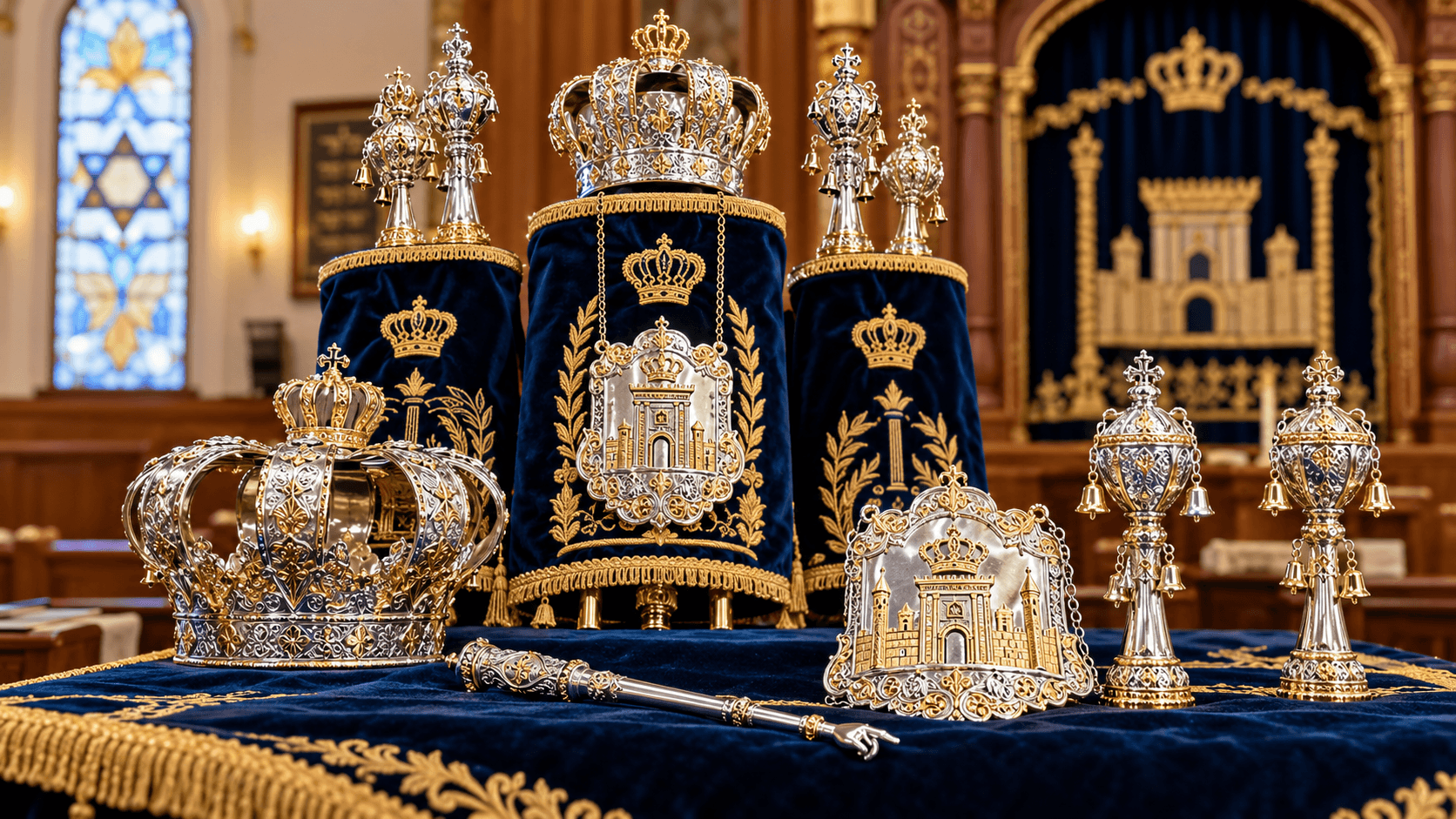
When a synagogue has several Sifrei Torah, selecting Matching Torah Ornaments for Your Synagogue can create a coherent appearance while still allowing each Torah to retain its own character. The process requires more than choosing pieces that look similar. Proportions, materials, craftsmanship, usability, and the existing Torah fittings should all be considered together.
A well-planned set may include a Torah crown, rimonim, breastplate, and yad, depending on the synagogue’s customs and the particular Torah case or mantle being used. Understanding how these elements work together makes it easier for a synagogue committee, rabbi, or donor to make an informed selection.
Why Matching Torah Ornaments Matter
Torah ornaments traditionally serve both practical and ceremonial purposes. They can protect certain parts of the Torah, identify its position within the synagogue, and contribute to the dignity of the Torah reading.
When several ornaments are visually coordinated, the result can be especially appropriate for a synagogue with multiple Torah scrolls displayed or used together.
Matching does not necessarily mean that every item must be identical. In fact, a coordinated collection can be more appropriate when the pieces share important characteristics such as:
- Similar metal finishes
- Complementary decorative motifs
- Consistent proportions
- Related craftsmanship
- Compatible colors and stones
- A shared artistic or regional style
The objective is harmony rather than uniformity.
Understanding the Main Torah Ornaments
Before purchasing a coordinated set, it is important to understand the role of each ornament.
Torah Crowns
A Torah crown, or Keter Torah, is placed above the upper portion of a Sefer Torah. Crowns vary considerably in design, size, materials, and decorative traditions.
For a synagogue purchasing a crown, the dimensions of the Torah and the existing Atzei Chayim should be considered. A crown that is visually impressive but disproportionate to the Torah may not produce the desired result.
Rimonim
Rimonim are ornaments traditionally placed on the upper ends of the Torah rollers. They are available in numerous designs, from relatively restrained forms to elaborate silver pieces decorated with bells, engraving, or other ornamental details.
When coordinating rimonim with a Torah crown, consider whether the decorative language is consistent. Similar engraving patterns, metal finishes, or motifs can create a unified appearance.
For congregations looking for complementary Torah accessories, Rimonim can be considered alongside other Torah ornaments.
Torah Breastplates
A Torah breastplate, or Hoshen, hangs on the front of the Torah in traditions where it is used. The breastplate may incorporate symbolic motifs, Hebrew inscriptions, stones, or other decorative elements.
Because it occupies a central visual position, the breastplate often becomes one of the strongest elements in a coordinated Torah ornament collection.
Its dimensions should also work with the Torah mantle and the structure of the Torah itself.
Torah Pointers
The Yad, or Torah pointer, is used during Torah reading to follow the text without touching the parchment directly.
A Torah pointer can coordinate with the other ornaments through its metal finish, decorative motif, or craftsmanship. It does not necessarily need to be an exact visual copy of the crown or breastplate.
A carefully selected Torah Pointer can complete the collection while remaining practical for regular Torah reading.
Matching Materials: Silver, Gold and Other Finishes
Material is one of the first decisions to consider when coordinating Torah ornaments.
Silver has a long-established place in Judaica craftsmanship and is commonly used for Torah ornaments. Gold or gold-toned details can provide a different visual character, while combinations of metals may create contrast.
The important consideration is consistency.
For example, a silver Torah crown paired with silver rimonim and a silver breastplate can establish a traditional appearance. Alternatively, a collection may combine silver with carefully selected gold-colored details.
The decision should consider the synagogue’s existing Judaica rather than treating each ornament as an isolated purchase.
Matching Does Not Mean Ignoring Minhag
Jewish communities have different traditions concerning the appearance and use of ritual objects. Ashkenazic, Sephardic, Chabad, Hasidic, and other communities may have distinctive customs and artistic preferences.
Therefore, a synagogue should not select ornaments solely because a particular style is fashionable.
The congregation’s minhag and existing practices should be considered first.
Where a specific halachic or communal question arises, the appropriate rabbi or halachic authority should guide the decision.
This is particularly important when replacing existing Torah fittings or commissioning ornaments for a newly acquired Sefer Torah.
How to Create a Coordinated Torah Ornament Set
A practical approach is to begin with the ornament that will have the greatest visual presence.
For many projects, this may be the Torah crown or breastplate.
Once the primary piece has been selected, the remaining ornaments can be chosen according to:
1. Decorative Motif
Look for repeated design elements such as crowns, floral patterns, geometric details, Jerusalem motifs, or Hebrew inscriptions.
2. Metal Finish
Try to maintain a consistent finish when the goal is a traditional matching set.
3. Proportion
The size of the ornament should correspond with the dimensions of the Torah.
4. Craftsmanship
Hand chasing, engraving, embossing, and other techniques can create different visual effects. Combining unrelated styles may make a collection appear assembled rather than intentionally coordinated.
5. Practical Use
A synagogue should remember that these are working ritual objects. Ease of handling, secure fitting, durability, and appropriate construction matter alongside appearance.
Matching Torah Ornaments for Multiple Sifrei Torah
Synagogues with multiple Sifrei Torah face a slightly different challenge.
One option is to give each Torah its own coordinated set. Another is to use related designs across the collection while allowing each Torah to have a distinctive ornament.
For example, a synagogue might choose the same general metal and craftsmanship for several Torahs while varying the decorative motif.
This can be particularly meaningful when individual Torahs have been donated or dedicated in memory of different members of the community.
The goal is to establish visual continuity without erasing the history associated with each Sefer Torah.
Coordinating Torah Ornaments With Mantles and Ark Décor
Torah ornaments should also be considered alongside the synagogue’s other Judaica.
A highly ornate breastplate may look different depending on the Torah mantle beneath it. Likewise, a crown should relate visually to the colors and style used elsewhere in the synagogue.
For this reason, committees should review the complete setting before making a final purchase.
Related Torah Mantles can help establish a consistent visual language between the Torah ornaments and the textile elements used during services.
The same principle applies to the Parochets – Holy Ark Curtains. The Ark curtain, Torah mantles, and ornaments do not have to be identical, but their colors, motifs, and level of ornamentation should feel compatible.
Choosing Torah Ornaments for a New Synagogue
A new synagogue has an opportunity to establish its Judaica style from the beginning.
Before purchasing, create a simple specification that includes:
- Number of Sifrei Torah
- Torah dimensions
- Existing Atzei Chayim
- Preferred metal
- Community minhag
- Desired decorative style
- Budget
- Intended donor or dedication
- Maintenance requirements
This prevents individual purchases from becoming visually inconsistent later.
It is also useful to think about future additions. If the synagogue expects to acquire additional Torahs, selecting a timeless design language can make future ornaments easier to coordinate.
Torah Ornaments as a Form of Hidur Mitzvah
The concept of Hidur Mitzvah encourages beautifying a mitzvah. In the context of a synagogue, beautifully made ritual objects can contribute to the dignity with which the community approaches its sacred practices.
However, Hidur Mitzvah should not be reduced to price or visual extravagance.
A thoughtful choice considers craftsmanship, suitability, tradition, practical use, and the honor appropriate to the Sefer Torah.
This is why synagogue committees should approach ornament selection as both a Judaica purchasing decision and a religious-cultural decision.
Shop Coordinated Torah Ornaments at SeferTorah.Net
For congregations planning a new Torah presentation, replacing existing ornaments, or preparing a dedication, SeferTorah.Net offers a range of Torah-related Judaica from which a coordinated collection can be assembled.
Explore Torah Ornaments to compare styles and consider complementary Rimonim, Torah Crowns, Torah Breastplates, and Torah Pointers.
When selecting multiple pieces, consider the Torah’s dimensions, the synagogue’s existing Judaica, the community’s traditions, and the desired relationship between each ornament. For a synagogue project or larger order, obtaining guidance before finalizing the selection can also help ensure that the individual pieces work together as intended.
Frequently Asked Questions
1. What are the main Torah ornaments used in a synagogue?
Common Torah ornaments include Rimonim, Torah crowns, Torah breastplates, and Torah pointers. The specific combination depends on community custom, the Torah’s construction, and the synagogue’s practices.
2. Do Torah ornaments need to match exactly?
No. Matching does not necessarily mean identical. Ornaments can coordinate through similar materials, motifs, finishes, and craftsmanship while retaining individual designs.
3. What material is traditionally used for Torah ornaments?
Silver is widely used in Torah ornament craftsmanship. Gold, gold-toned finishes, and combinations of materials are also found. The appropriate choice depends on the synagogue’s tradition, existing Judaica, and design requirements.
4. How do I choose a Torah crown that fits my Sefer Torah?
The crown should be proportionate to the Torah and compatible with its construction and rollers. Measurements should be taken before ordering rather than selecting a crown based only on photographs.
5. Should the Torah breastplate match the Torah crown?
A matching or complementary design can create a unified presentation. However, the pieces do not have to be identical. Similar motifs, materials, and craftsmanship can provide visual continuity.
6. Can a Torah pointer match the other Torah ornaments?
Yes. A Yad can be selected to complement the crown, rimonim, or breastplate through its metal finish and decorative style. It should also remain comfortable and practical for Torah reading.
7. Should all Sifrei Torah in a synagogue have matching ornaments?
Not necessarily. A synagogue may choose coordinated designs for multiple Torahs while allowing individual Torahs to retain distinctive ornaments, especially when they have different histories or were donated by different families.
8. Should Torah ornaments match the Torah mantle?
They can be coordinated with the mantle’s color, embroidery, and overall style. Exact matching is not required, but the combination should be visually appropriate and respectful.
9. What should a synagogue consider before buying Torah ornaments?
Consider the Torah’s dimensions, community minhag, ornament materials, craftsmanship, design, practical use, existing Judaica, and whether the pieces are intended for a dedication or long-term synagogue use.
10. Where can I buy matching Torah ornaments?
SeferTorah.Net offers Torah ornaments including crowns, rimonim, breastplates, and Torah pointers. Congregations can review related pieces and select a combination suited to their Torah and synagogue setting.
Conclusion
Choosing Matching Torah Ornaments for Your Synagogue requires more than finding several attractive Judaica pieces. The most successful collection considers the Sefer Torah itself, community tradition, proportions, craftsmanship, practical use, and the overall character of the synagogue.
Whether the project involves a new Torah dedication, replacing older ornaments, or coordinating several Sifrei Torah, a thoughtful approach allows the individual pieces to work together while preserving the dignity and tradition associated with the Torah.
For synagogue committees and donors, the goal should be a collection that is visually harmonious, appropriate to the community, and worthy of the sacred object it accompanies.