


Silver vs Gold Torah Ornaments

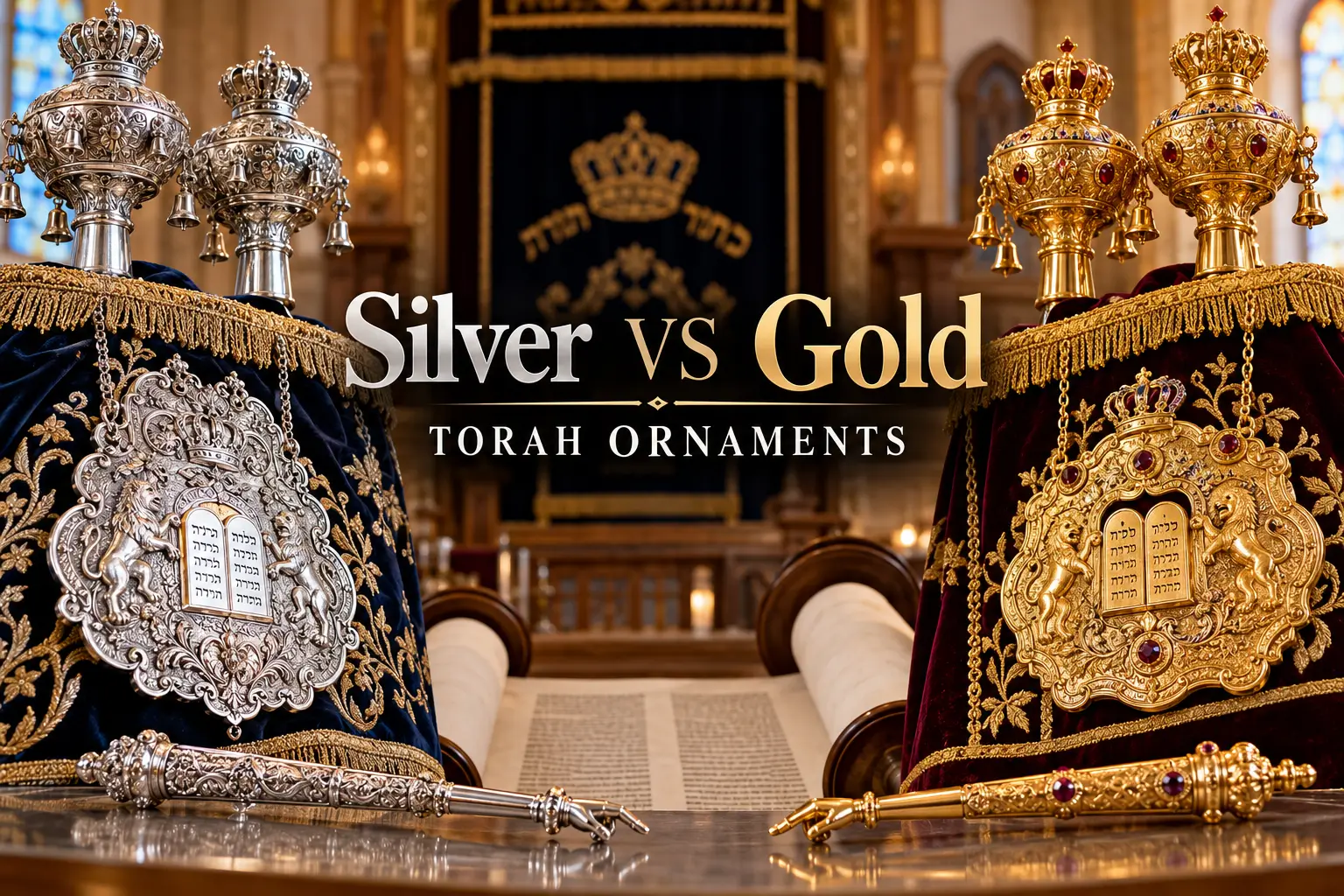
Torah ornaments are among the most visible expressions of kavod haTorah in a synagogue. Rimonim, Torah crowns, breastplates, and other decorative elements do more than enhance the appearance of a Sefer Torah. They reflect a community’s traditions, its approach to hidur mitzvah, and the importance it places on honoring the Torah during public reading and synagogue life.
One of the most common questions when selecting Torah ornaments is whether silver or gold is the better choice. The answer is not simply a matter of which metal looks more impressive. Material, craftsmanship, synagogue minhag, existing Torah furnishings, durability, maintenance, budget, and the intended use all deserve consideration.
Understanding Silver vs Gold Torah Ornaments therefore requires looking beyond color and price. Silver and gold have long histories in Jewish ceremonial art, and each offers distinct practical and aesthetic characteristics.
The Role of Torah Ornaments in Jewish Tradition
A Sefer Torah is itself sacred because of the Torah text written upon its parchment. Torah ornaments are accessories used to honor and protect the scroll; they are not what makes the Sefer Torah kosher.
This distinction is important.
The kashrut of a Sefer Torah depends on matters such as the parchment, writing, letters, ink, layout, and the qualifications and procedures involved in its production. Decorative accessories belong to the broader category of kavod haTorah and hidur mitzvah.
Over centuries, Jewish communities developed distinctive traditions for adorning their Torah scrolls. These may include:
- Rimonim
- Torah crowns
- Torah breastplates
- Torah pointers
- Torah mantles
- Decorative cases and related accessories
The precise combination varies by community and tradition. A synagogue may also have established furnishings that were donated as part of a previous dedication, creating an aesthetic and historical continuity that should be considered when purchasing new pieces.
Silver vs Gold Torah Ornaments: What Is the Difference?
The fundamental difference between silver and gold Torah ornaments is material, but the practical differences extend considerably further.
Silver Torah Ornaments
Silver has a particularly long history in Jewish ceremonial objects. It has been widely used for Torah ornaments, Kiddush items, candlesticks, Havdalah objects, and other forms of Judaica.
Silver offers several advantages:
- A traditional appearance associated with Jewish ceremonial art
- Strong visual contrast against many Torah mantles
- Detailed engraving and chasing can be highly effective on silver
- It can complement existing silver synagogue furnishings
- Tarnish can often be removed through appropriate professional cleaning
Silver is also particularly well suited to detailed decorative work. Hand chasing, engraving, filigree, repoussé, and other techniques can create considerable depth without relying on excessive ornamentation.
For many congregations, silver represents a balance between traditional appearance, craftsmanship, durability, and cost.
Gold Torah Ornaments
Gold occupies a different position. It is historically associated with precious ceremonial objects and has long been regarded as a material of exceptional value.
Gold has several practical characteristics that distinguish it from silver:
- It does not tarnish in the same manner as silver
- It has a distinctive warm appearance
- It can provide a striking contrast against darker Torah mantles
- Its material value can be substantially greater
- Gold-plated or gold-finished objects require different considerations from solid gold pieces
An important distinction is therefore necessary when discussing gold Torah ornaments. “Gold” does not automatically mean solid gold. Some Judaica may be gold plated, gold finished, or constructed from another metal with a gold surface.
When purchasing an ornament described as gold, the buyer should determine exactly what the product is made from rather than relying solely on its appearance.
Does Halacha Require Silver or Gold?
There is no general requirement that Torah ornaments must be made from gold rather than silver.
The central halachic concern remains the Torah scroll itself and the requirements governing its writing, construction, and treatment. Decorative ornaments are associated with honoring the Torah and enhancing its presentation.
The concept of hidur mitzvah is relevant here. Jewish tradition recognizes the value of beautifying mitzvot, but beauty does not necessarily mean choosing the most expensive material available.
A synagogue may choose silver because it reflects its minhag, because it matches existing furnishings, or because the craftsmanship available in silver better suits the intended design. Another community may choose gold because of its particular ceremonial tradition or because it is creating a significant dedication.
Where a community has a specific minhag or a Rav’s guidance concerning its synagogue furnishings, that tradition should be respected.
Craftsmanship Matters More Than the Metal Alone
When comparing Silver vs Gold Torah Ornaments, it is easy to focus exclusively on the material. Yet the quality of the workmanship can have a greater impact on the character of the finished piece.
Two ornaments made from the same metal can differ substantially in:
- Weight
- Construction
- Engraving
- Chasing
- Relief work
- Decorative detail
- Surface finishing
- Structural durability
- Quality of fittings
- Overall proportions
Traditional Judaica craftsmanship can involve techniques such as hand chasing and repoussé, in which the metal is carefully shaped and worked to create dimensional designs.
This is especially relevant when purchasing Torah ornaments for a synagogue. The ornament will be viewed at close range by congregants and also from a distance during Torah reading. Good proportions and carefully executed details therefore matter.
The goal should not simply be to select the most elaborate object. Rather, the ornament should be appropriate to the dignity of the Sefer Torah and the character of the congregation.
Choosing Silver Torah Ornaments for a Synagogue
Silver can be an excellent choice for communities seeking a traditional and versatile appearance.
When considering silver ornaments, look at the complete Torah presentation rather than the ornament in isolation.
For example, consider:
The Torah Mantle
The color and embroidery of the mantle affect how silver appears. Silver can provide strong contrast against deep blue, burgundy, black, purple, and other darker fabrics.
You may wish to coordinate the ornament with the existing [Torah Mantles] used by the synagogue.
Existing Judaica
If a synagogue already uses silver Kiddush cups, candlesticks, breastplates, or other ceremonial pieces, silver Torah ornaments can create visual continuity.
Maintenance
Silver naturally develops tarnish over time. This is not necessarily a defect, but it means that proper care is part of ownership.
Harsh polishing, abrasive materials, or inappropriate chemicals can damage decorative surfaces. Valuable or intricately worked pieces should be handled carefully and, when necessary, professionally cleaned.
Choosing Gold Torah Ornaments
Gold can be particularly appropriate for a significant synagogue dedication or a ceremonial collection intended to have a distinctive visual presence.
However, buyers should establish exactly what type of gold construction is being offered.
Ask:
- Is the ornament solid gold?
- Is it gold plated?
- What is the underlying metal?
- How is the finish applied?
- How should the surface be cleaned?
- Are replacement or repair services available?
- Does the ornament coordinate with the synagogue’s existing Torah accessories?
These questions are more useful than simply asking whether an ornament “looks gold.”
For a congregation purchasing an important dedication piece, documentation about materials and construction can also be valuable for future generations.
Coordinating Torah Ornaments as a Complete Set
Torah ornaments should generally be considered as part of a complete ceremonial presentation.
A synagogue may have several related elements, including:
- Torah crown
- Rimonim
- Torah breastplate
- Torah pointer
- Torah mantle
The pieces do not necessarily have to be identical, but they should work together visually and functionally.
For example, an ornate silver breastplate paired with a simple gold crown may create a deliberately mixed aesthetic, but it may also appear inconsistent if the pieces were selected without considering proportion and design.
If the goal is a unified presentation, examine the relationship between the [Torah Crowns], [Rimonim], and [Torah Breastplates] before purchasing individual pieces.
This is especially important when replacing only one component of an existing Torah ornament set.
Silver vs Gold Torah Ornaments for Torah Dedications
Torah dedications often carry a significance beyond an ordinary Judaica purchase.
A family, donor, synagogue, or community may dedicate ornaments in memory of a loved one, in honor of a milestone, or as part of a broader Torah dedication.
In such cases, the selection should take into account:
- The synagogue’s minhag
- The style of the existing Torah furnishings
- The intended donor inscription
- The size of the Sefer Torah
- The design and proportions of the ornaments
- Long-term maintenance
- The intended ceremonial use
A dedication piece should also remain appropriate for the synagogue after the original donor or family is no longer involved. Traditional design and sound craftsmanship can therefore be more meaningful than following a temporary decorative trend.
How to Choose Between Silver and Gold
There is no universal answer to which metal is “better.”
A practical decision can begin with five questions.
1. What is the synagogue’s tradition?
Existing minhag and communal practice should carry significant weight.
2. What does the existing Torah set look like?
New ornaments should complement, rather than compete with, the Torah mantle and other accessories.
3. What level of craftsmanship is desired?
Look closely at construction, engraving, chasing, fittings, proportions, and finish.
4. How will the ornaments be maintained?
Silver requires attention to tarnish, while gold and gold finishes have their own care requirements.
5. What is the purpose of the purchase?
A synagogue may be buying a complete set, replacing one damaged component, preparing for a dedication, or purchasing a meaningful gift. Each situation can call for a different approach.
When there is uncertainty about a community’s religious practice or minhag, consultation with the appropriate Rav is preferable to treating a general online buying guide as a source of halachic ruling.
Explore Torah Ornaments at SeferTorah.Net
For a synagogue or individual looking for Torah ornaments, the right choice begins with understanding the intended use, tradition, materials, and craftsmanship.
SeferTorah.Net offers a selection of ceremonial Judaica designed for communities and individuals seeking meaningful ways to honor the Torah. Our [Torah Ornaments] collection includes options for different styles and synagogue settings.
When selecting a Torah crown, Rimonim, breastplate, or pointer, consider the complete presentation of your Sefer Torah rather than evaluating a single item by appearance alone.
If you are unsure which style or material is appropriate for your existing Torah furnishings, contacting the SeferTorah.Net team before purchasing can help you compare available options according to your requirements, tradition, and budget.
Caring for Torah Ornaments
Proper care helps preserve both the appearance and usefulness of ceremonial Judaica.
Silver
Silver may tarnish naturally when exposed to air and certain environmental conditions. Store silver ornaments in a clean, dry environment and avoid abrasive cleaning methods.
Gold
Gold itself is relatively resistant to tarnishing, but finishes, plating, decorative stones, soldered components, and other materials may require special care.
All Torah Ornaments
Handle ornaments carefully during installation and removal. Do not place unnecessary pressure on delicate decorative elements.
For valuable or historically significant pieces, professional cleaning and restoration may be preferable to aggressive home polishing.
Frequently Asked Questions – Silver vs Gold Torah Ornaments
1. Are silver or gold Torah ornaments required by Halacha?
No general halachic requirement dictates that Torah ornaments must be silver or gold. Their purpose is associated with honoring and beautifying the Torah, while the kashrut of the Sefer Torah itself depends on its parchment, writing, construction, and related halachic requirements.
2. Are gold Torah ornaments better than silver?
Not necessarily. The appropriate choice depends on the synagogue’s tradition, design, craftsmanship, budget, and existing Torah furnishings. Material alone does not determine the quality or appropriateness of a Torah ornament.
3. Why is silver commonly used for Judaica?
Silver has a long history in Jewish ceremonial art and is well suited to detailed engraving, chasing, and other traditional metalworking techniques. It also provides a classic appearance that complements many Torah mantles and synagogue furnishings.
4. Do silver Torah ornaments tarnish?
Yes. Silver naturally tarnishes over time because of chemical reactions with the surrounding environment. Proper storage and appropriate cleaning can help maintain its appearance.
5. Does “gold Torah ornament” always mean solid gold?
No. A product described as gold may be solid gold, gold plated, or have another type of gold-colored finish. Buyers should confirm the material and construction before purchasing.
6. Can silver and gold Torah ornaments be used together?
They can be, depending on the design and synagogue tradition. However, combining different metals should be intentional so that the crown, Rimonim, breastplate, pointer, and mantle form a coherent presentation.
7. What should I consider when buying Torah ornaments?
Consider the synagogue’s minhag, the size and style of the Sefer Torah, existing ornaments, material, craftsmanship, durability, maintenance requirements, and intended use. For a significant dedication, the donor’s wishes and long-term suitability should also be considered.
8. What are the main Torah ornaments?
Common Torah ornaments include Rimonim, Torah crowns, Torah breastplates, and Torah pointers. Their use and design can vary between communities and traditions.
9. Can Torah ornaments be dedicated in someone’s honor or memory?
Yes. Torah-related objects are commonly donated or dedicated in honor or memory of individuals and families. The synagogue should determine the appropriate form of dedication and inscription.
10. Should I ask a Rav before purchasing Torah ornaments?
If the question involves a specific minhag, synagogue practice, or halachic concern, consulting the appropriate Rav is advisable. A Judaica specialist can provide product and craftsmanship guidance, while a Rav can address questions of religious practice and communal custom.
Conclusion
The choice between Silver vs Gold Torah Ornaments is ultimately about more than selecting a metal. It involves tradition, kavod haTorah, craftsmanship, synagogue aesthetics, practical care, and the purpose for which the ornament is being acquired.
Silver offers a long-established place in Jewish ceremonial craftsmanship, while gold provides a distinctive and valuable alternative. Neither should be chosen simply because it appears more expensive or impressive. The better choice is the one that appropriately serves the synagogue, respects its traditions, complements the Sefer Torah, and reflects the level of craftsmanship desired.
For those exploring Torah crowns, Rimonim, breastplates, pointers, and related ceremonial Judaica, SeferTorah.Net provides a range of options for meaningful Torah presentation and dedication.