


Ksav Beis Yosef vs Ksav Ari: Understanding the Difference in Tefillin Script

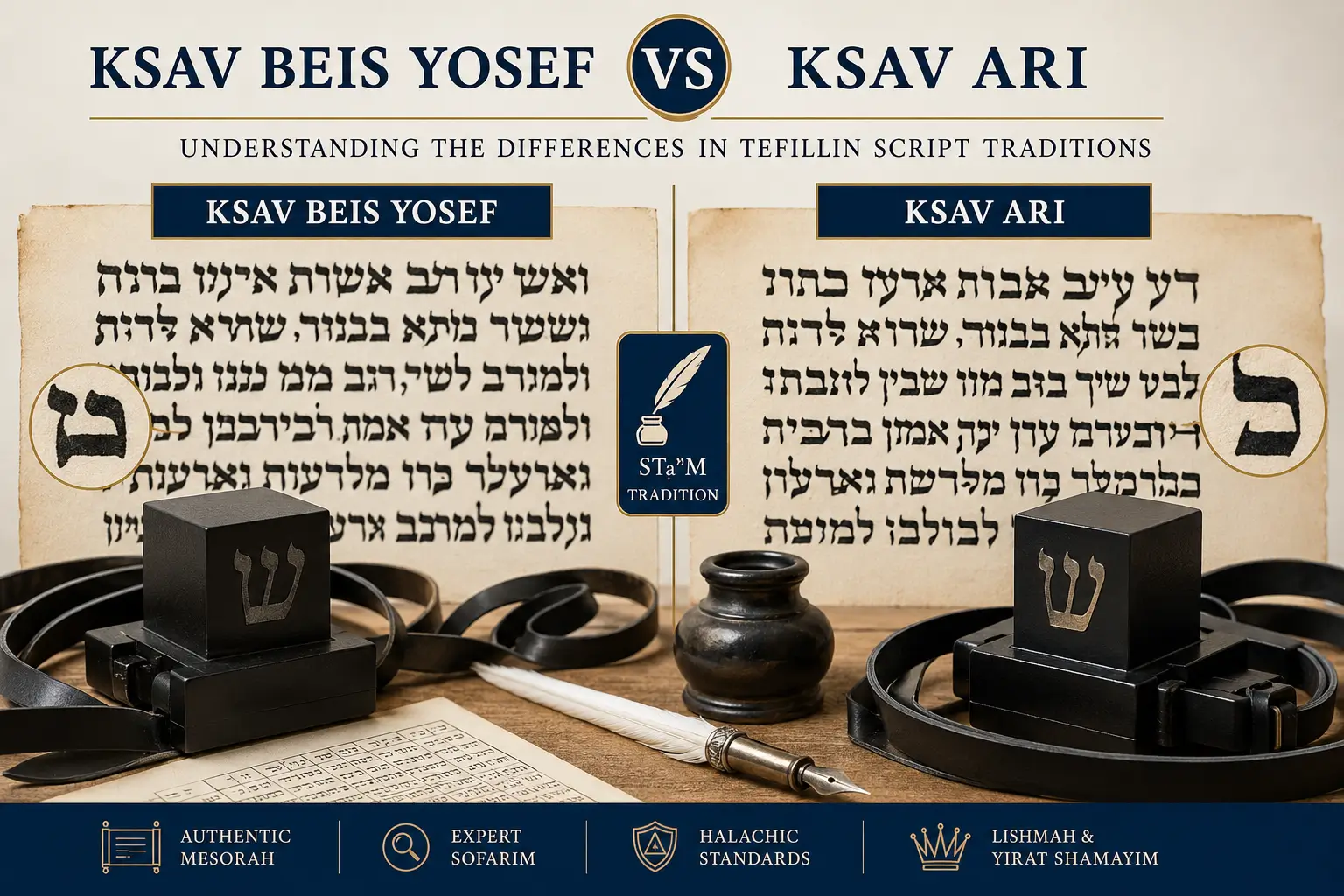
When purchasing Tefillin, the Batim and Retzuot are only part of the decision. The Parshiyot inside the Tefillin must also be written according to an appropriate Jewish scribal tradition. For many buyers, this raises an important question: Ksav Beis Yosef vs Ksav Ari — what is the difference, and which script should you choose?
Ksav Beis Yosef and Ksav Ari are two established traditions of Hebrew STa”M writing. The differences are found primarily in the precise formation of particular letters and details of scribal style. These distinctions are not simply matters of typography or personal artistic preference. For an observant Jew purchasing Tefillin Parshiyot, the appropriate ksav is generally connected to family tradition, community minhag, and the guidance of one’s Rav or posek.
At SeferTorah.Net, our Tefillin Parshiyot are available in major script traditions, including Ksav Beis Yosef, Ksav Ari, and Ketav Sefaradi, with both hand-checking and computer-based bedikah b’machshev forming part of our stated quality standard.
What Is Ksav Beis Yosef?
Ksav Beis Yosef, also commonly referred to as Ktav Beit Yosef, is one of the principal traditions of Ashkenazic STa”M writing. The name is associated with the Beis Yosef, Rabbi Yosef Karo, whose halachic works became foundational to Jewish law.
For Tefillin, Ksav Beis Yosef is widely associated with the scribal tradition followed by many non-Hasidic Ashkenazic communities. It has distinctive forms for certain Hebrew letters, and a properly trained sofer STa”M must know these formations rather than simply reproducing an ordinary printed Hebrew typeface.
The importance of using the appropriate script becomes particularly clear when purchasing Parshiyot. The objective is not merely to obtain legible Hebrew writing. STa”M writing follows established mesorah and halachic requirements governing the form of the letters.
What Is Ksav Ari?
Ksav Ari, also known as Ksav Arizal, is a scribal tradition associated with Rabbi Yitzchak Luria, the Arizal. It became particularly influential within Chassidic communities and is closely associated with Chabad and other communities that follow traditions influenced by the Arizal.
The differences between Ksav Ari and Ksav Beis Yosef can be subtle to an untrained observer. Certain letter formations differ, but the overall appearance remains recognizably within the traditional world of Hebrew STa”M writing.
For someone unfamiliar with the subject, it can therefore be tempting to assume that the two scripts are interchangeable. That is not the right way to approach the question. The choice of ksav should be connected to the buyer’s minhag and mesorah, rather than simply to which script appears more attractive.
Chabad and other Chassidic communities commonly use Ksav Ari, while Ksav Beis Yosef remains widespread among many Ashkenazic communities. General references on Tefillin similarly identify Beit Yosef, Arizal, and Sephardic/Vellish traditions as distinct established scribal styles.
Ksav Beis Yosef vs Ksav Ari: What Is the Actual Difference?
The most important distinction is the formation of individual Hebrew letters.
Both traditions follow the fundamental requirements of STa”M writing, but certain letters are formed differently according to the respective mesorah. A knowledgeable sofer must therefore be trained specifically in the ksav he is writing.
This is why a person should not select Tefillin Parshiyot simply because the script looks familiar. The question is whether the Parshiyot were written by a competent sofer according to the tradition appropriate for the person who will wear them.
The underlying mitzvah remains the same. The four Parshiyot are:
- Kadesh
- Vehayah Ki Yeviacha
- Shema
- Vehayah Im Shamoa
They must be written in the prescribed order, with the required standards of kesivah, parchment, ink, and letter formation. The laws governing Tefillin writing are detailed in the halachic literature, including requirements concerning klaf, ink, letter formation, and the order of the passages.
Which Communities Use Ksav Beis Yosef?
Ksav Beis Yosef is strongly associated with many Ashkenazic communities, particularly those whose mesorah follows the non-Chassidic Ashkenazic tradition.
That does not mean that every Jewish person of Ashkenazic background should automatically select Ksav Beis Yosef without further consideration. Family and community practice can matter, and there are situations in which a Rav or posek should be consulted.
When purchasing Tefillin for a Bar Mitzvah, this is especially important. Parents should determine the family’s established minhag before ordering Parshiyot rather than making the decision solely based on price or appearance.
Which Communities Use Ksav Ari?
Ksav Ari is particularly associated with Chabad and Chassidic communities, as well as communities and individuals whose scribal tradition follows the Arizal.
The relationship between Ksav Ari and different Sephardic or Nusach Sefard communities can be more nuanced than a simple Ashkenaz-versus-Sephardic distinction. For this reason, a buyer should not assume that “Sephardic” automatically means Ksav Ari or that every person who davens Nusach Sefard follows exactly the same ksav.
This is one reason knowledgeable Judaica suppliers should ask about the buyer’s community and family tradition before recommending Parshiyot.
Is One Script More Kosher Than the Other?
This is an important question, but it should not be reduced to saying that one script is universally “more kosher.”
Ksav Beis Yosef and Ksav Ari are established scribal traditions, and the relevant concern is whether the Parshiyot were written correctly according to the applicable halachic and scribal standards.
For an individual buyer, the more appropriate question is usually:
Which ksav reflects my family’s or community’s mesorah?
The answer may depend on one’s minhag, Rav, community, and the particular Tefillin tradition being followed.
Halachic literature also emphasizes that Tefillin writing is itself a significant component of the mitzvah, with detailed requirements governing who may write, how the passages are written, and the materials used.
Does Ksav Affect the Tefillin Batim?
No. Ksav and Batim are separate components of the Tefillin.
The Batim are the leather housings that contain the Parshiyot, while the ksav refers to the scribal form in which those Parshiyot are written.
This distinction is important when comparing complete Tefillin sets. A buyer may be choosing between different Batim grades—such as Peshutim Mehudarim, Dakos, Gassos, or Gassos Ribuah Regel—while separately considering the appropriate ksav for the Parshiyot. SeferTorah.Net’s Tefillin collection specifically distinguishes these components and quality levels.
Choosing Tefillin Parshiyot: What Should You Consider?
When selecting Parshiyot, script tradition is only one consideration.
A knowledgeable buyer should also consider:
1. Your Minhag
First determine which ksav your family and community traditionally follow. If there is uncertainty, ask your Rav or posek.
2. The Sofer
The expertise, reputation, yirat shamayim, and familiarity of the sofer with the relevant ksav are important considerations. A person should not assume that every sofer writes every script tradition to the same standard.
3. The Klaf
The quality and preparation of the parchment matter. Tefillin Parshiyot are written on klaf, and the processing and suitability of the parchment are governed by halachic requirements.
4. Checking and Verification
Computer checking can identify certain textual and letter-level problems, but it does not replace the judgment of a knowledgeable sofer. SeferTorah.Net therefore states that its Parshiyot undergo both hand-checking and bedikah b’machshev.
5. Level of Hidur
Beyond basic kashrut, buyers may seek a greater level of hidur mitzvah. Letter clarity, consistency, spacing, parchment quality, ink, and the caliber of the sofer can all become relevant considerations.
Buying Tefillin Parshiyot from SeferTorah.Net
For buyers comparing Ksav Beis Yosef vs Ksav Ari, choosing the correct script should be part of a broader Tefillin decision rather than an isolated question.
SeferTorah.Net offers Tefillin Parshiyot in major script traditions, including Ksav Beis Yosef, Ksav Ari, and Ketav Sefaradi. The site’s stated standard includes both hand-checking by a sofer and computer-based verification, with options intended to accommodate different community traditions and levels of hidur.
If you are purchasing Tefillin for a Bar Mitzvah, replacing existing Parshiyot, upgrading an existing set, or sourcing components for restoration, it is worthwhile to confirm your required ksav before placing an order.
Explore our Tefillin Parshiyot collection and related Tefillin Sets to compare available options. For questions involving your specific minhag or halachic circumstances, consult your Rav or posek.
Frequently Asked Questions
What is the difference between Ksav Beis Yosef and Ksav Ari?
They are two established Hebrew scribal traditions used in STa”M writing. They differ primarily in the formation of certain Hebrew letters and are associated with different community and mesorah traditions.
Is Ksav Beis Yosef Ashkenazic?
Ksav Beis Yosef is strongly associated with the traditional Ashkenazic scribal style and is widely used among many non-Hasidic Ashkenazic communities.
Is Ksav Ari only for Chabad?
No. Ksav Ari is strongly associated with Chabad and Chassidic communities, but the broader history of its use is more varied. A person’s appropriate ksav should be determined according to their community and family tradition.
Is Ksav Ari more mehudar than Ksav Beis Yosef?
Neither should simply be described as universally more kosher or more mehudar. Hidur can involve many aspects of STa”M production, while the appropriate ksav is primarily connected to one’s mesorah and minhag.
Can I choose Ksav Ari because I like how it looks?
The visual appearance should not normally be the deciding factor. For Tefillin Parshiyot, the more important question is which scribal tradition corresponds to your family and community practice.
Which ksav should I choose for my Bar Mitzvah Tefillin?
Start by determining the ksav traditionally used by your family or community. If there is uncertainty, ask your Rav or posek before purchasing the Parshiyot.
Are Ksav Beis Yosef and Ksav Ari both used for Tefillin?
Yes. Both are established traditions of STa”M writing. The appropriate choice depends on the relevant community and mesorah.
Does the ksav affect the Tefillin Batim?
No. The ksav refers to the writing tradition of the Parshiyot, while the Batim are the leather housings containing them. These are separate components of the Tefillin.
Are SeferTorah.Net Parshiyot checked by hand and computer?
According to SeferTorah.Net’s stated product standard, its Parshiyot undergo both hand-checking by the sofer and computer-based bedikah b’machshev.
Should I ask a Rav before choosing between Ksav Beis Yosef and Ksav Ari?
If your family or community tradition is unclear, consulting a Rav or knowledgeable posek is the appropriate approach. The choice of ksav should reflect established minhag rather than simply personal preference.
Conclusion
The question of Ksav Beis Yosef vs Ksav Ari is ultimately a question of mesorah, community practice, and the standards used in producing the sacred Parshiyot of Tefillin. Although the visual differences between the scripts may appear subtle, they represent distinct scribal traditions developed and preserved within the Jewish world.
For the buyer, the goal should not be to find the script that merely looks better. The goal is to obtain Parshiyot written by a knowledgeable sofer, on appropriate klaf, according to the correct scribal tradition, with the level of care and verification appropriate to the mitzvah.
When there is uncertainty about which ksav belongs to your family or community, consult your Rav or posek. Once that question is settled, you can evaluate the sofer, Parshiyot, Batim, Retzuot, and desired level of hidur with greater confidence.