


Bedikah b’Machshev Explained

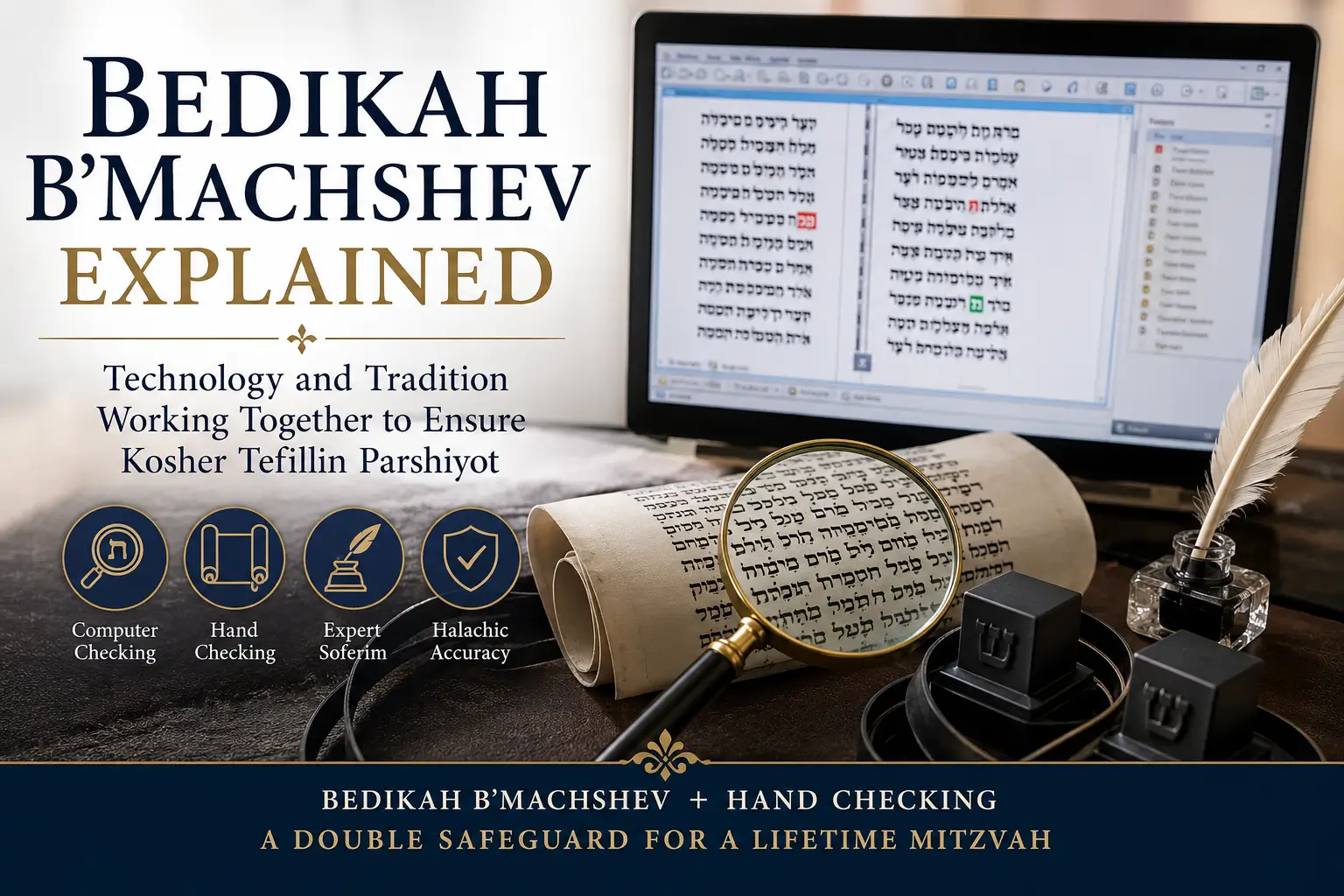
Bedikah b’Machshev Explained: For anyone purchasing or maintaining Tefillin Parshiyot, one of the most important quality questions is how the handwritten text has been checked. Bedikah b’Machshev, literally computer-based checking, is a method of examining handwritten STa”M for textual and certain structural errors using specialized software.
It is important, however, to understand exactly what computer checking does—and what it does not do. A computer can compare the letters appearing in a scanned manuscript against a computerized version of the required text and identify discrepancies that may be difficult for the human eye to notice. It can assist in identifying missing or extra letters, incorrect letter sequences, spacing concerns, and other textual irregularities.
At SeferTorah.Net, computer checking is not viewed as a replacement for the expertise of a sofer. Rather, it works together with careful human inspection. As part of our Tefillin Parshiyot standard, the Parshiyot we carry undergo both bedikah b’machshev and hand-checking by sofrim. These two methods provide different forms of verification and should be understood as complementary rather than competing approaches.
Why Computer Checking Matters for Tefillin Parshiyot
The four Parshiyot contained in Tefillin must be written with exceptional precision. Every letter has significance, and a textual discrepancy can potentially affect the kosher status of the Parshah.
This is where Bedikah b’Machshev Explained becomes particularly relevant to a prospective Tefillin buyer. Computer-based verification provides an additional level of scrutiny beyond visual inspection. Specialized software can compare the written text against the expected text and flag discrepancies for further examination.
The purpose is not simply to produce a computer-generated certificate or create the appearance of technical sophistication. The value lies in giving the sofer another tool with which to identify possible problems.
The computer, however, does not determine every halachic question. It cannot replace the judgment of a knowledgeable, G-d-fearing sofer who understands the laws of STa”M and the particular requirements of the relevant ksav.
How Does Bedikah b’Machshev Work?
The precise technology can vary according to the checking system being used, but the basic principle is straightforward.
The handwritten Parshiyot are examined using specialized computer software capable of recognizing the Hebrew letters and comparing the scanned writing with the prescribed text. When the system detects a potential discrepancy, the result can be reviewed by the appropriate human examiner.
Among the issues that computer checking can help identify are:
- Missing or additional letters
- Incorrect letter sequences
- Certain textual discrepancies
- Spacing and alignment irregularities
- Potential problems that may escape an initial visual review
The computer therefore acts as an additional layer of verification. It does not transform the checking process into an entirely automated procedure.
This distinction is fundamental. Bedikah b’Machshev Explained properly means understanding computer checking as a tool within the broader STa”M checking process—not as a substitute for Torah knowledge, halachic judgment, or the responsibility of the sofer.
Computer Checking and Hand-Checking: Why Both Matter
A common misconception is that computer checking makes manual checking unnecessary. The opposite is closer to the standard described by experienced STa”M professionals: the two methods address different aspects of verification.
A computer is exceptionally useful at performing systematic comparisons. It does not become tired, lose concentration, or overlook a repeated textual discrepancy because of fatigue. Once a potential difference is identified, however, human expertise remains essential.
The hand-checking process allows a qualified sofer to examine the writing with an understanding of Halacha l’ma’aseh, letter formation, spacing, the relevant scribal tradition, and other considerations that cannot be reduced to a computerized comparison.
The SeferTorah.Net standard therefore requires both forms of checking for the Parshiyot it carries. The company’s Tefillin documentation specifically describes computer checking and hand-checking as mandatory and inseparable elements of its quality standard.
What Can a Computer Not Determine?
Understanding Bedikah b’Machshev Explained also requires understanding its limitations.
A computer may recognize the shape of a letter, but questions of halachic validity can involve matters beyond simple recognition. The quality and form of individual letters, the circumstances of their writing, the condition of the klaf, the ink, and questions of lishmah can require knowledgeable human evaluation.
For example, the software may flag a letter as unusual, but determining whether that letter is actually acceptable according to the applicable halachic standards is not necessarily a matter for the computer to decide.
Similarly, the spiritual and halachic qualifications of the sofer cannot be established through software. Yirat Shamayim, proper kavvanah, and knowledge of the laws of STa”M remain essential parts of the sacred craft.
This is why SeferTorah.Net emphasizes the combination of computer verification with examination by knowledgeable sofrim rather than presenting technology as an independent replacement for traditional checking.
Does Every Tefillin Parshah Need Computer Checking?
There is an important distinction between what is technologically available and what a particular community or buyer requires.
Computer checking has become an important additional safeguard in the production and verification of STa”M, but the presence of computer checking should not be considered the only measure of the quality of a Parshah.
A buyer should also ask:
- Who wrote the Parshiyot?
- Is the sofer experienced in the relevant ksav?
- Were the Parshiyot hand-checked?
- Were they computer-checked?
- What level of hidur is represented?
- What type of klaf was used?
- What is the tradition of the writing?
- What documentation or guidance accompanies the purchase?
At SeferTorah.Net, the answer regarding its Parshiyot is particularly clear: the company’s published standard requires both hand-checking and bedikah b’machshev.
Bedikah b’Machshev and Different Ksav Traditions
Tefillin Parshiyot are not all written in an identical scribal style. The appropriate ksav is generally connected to the buyer’s community and minhag.
Common traditions include:
Ksav Beis Yosef
Ksav Beis Yosef is associated with the Ashkenazic STa”M tradition and is widely used among non-Hasidic Ashkenazic communities.
Ksav Ari
Ksav Ari, associated with the Arizal, is used extensively among Chabad and many Hasidic communities and among communities following related nusach traditions.
Ketav Sefaradi
Ketav Sefaradi reflects the traditional scribal practices of Sephardic and Edot HaMizrach communities.
Computer checking does not eliminate the importance of these distinctions. The checking process must be understood in relation to the actual text and scribal tradition being examined. SeferTorah.Net offers Parshiyot in major ksav traditions and advises buyers to consider their community’s minhag when selecting the appropriate writing.
What Should You Look for When Buying Tefillin Parshiyot?
A knowledgeable buyer should look beyond the phrase “computer checked.”
Computer verification is valuable, but it is only one component of a trustworthy Tefillin purchase.
Consider the complete picture:
The Sofer: The experience, training, reputation, and yirat shamayim of the sofer are fundamental.
The Ksav: The Parshiyot should correspond to the appropriate community tradition.
The Klaf: Properly prepared parchment contributes to the quality and longevity of the Parshiyot.
The Ink: The ink must be prepared appropriately for STa”M and maintained as part of the integrity of the writing.
The Checking: Ask whether the Parshiyot were both hand-checked and computer-checked.
The Level of Hidur: Buyers seeking mehudar Parshiyot should understand what distinguishes the available levels rather than relying solely on marketing terminology.
These considerations are consistent with the broader SeferTorah.Net approach to Parshiyot, where the quality of the sofer, letter formation, klaf, ink, and both forms of checking are considered together.
Shop Tefillin Parshiyot with Both Forms of Checking
For families purchasing Tefillin for a Bar Mitzvah, individuals replacing existing Parshiyot, and sofrim sourcing components, the checking process deserves careful attention.
SeferTorah.Net offers Tefillin Parshiyot in major ksav traditions, with every Parshah subjected to both hand-checking and bedikah b’machshev according to the company’s published standard. Buyers can therefore consider not only the writing tradition and level of hidur, but also the verification process behind the Parshiyot.
If you are uncertain which ksav, quality level, or Parshiyot option is appropriate for your family or community, it is sensible to consult your Rav or posek and discuss the available options with a knowledgeable STa”M provider.
Expert Guidance Before Purchasing
Tefillin are intended to accompany a person throughout a lifetime of daily mitzvah observance. For that reason, choosing Parshiyot should not be reduced to comparing prices or selecting the first product described as “kosher.”
A meaningful purchase considers the entire chain of preparation: the sofer, the ksav, the klaf, the ink, the level of hidur, and the checking process.
Bedikah b’Machshev Explained in this context is ultimately a lesson in how modern technology can serve an ancient scribal tradition. Computer verification adds a valuable layer of scrutiny, while the knowledge and responsibility of the sofer remain indispensable.
For buyers who want to understand the differences between Tefillin Parshiyot and the available quality levels, SeferTorah.Net can provide guidance based on the buyer’s minhag, intended use, and requirements.
Frequently Asked Questions
What does Bedikah b’Machshev mean?
Bedikah b’Machshev means computer-based checking. In STa”M, specialized software is used to compare handwritten sacred text against the required text and identify potential textual or structural discrepancies for further review.
Is computer checking enough to make Tefillin Parshiyot kosher?
No. Computer checking is an additional verification method, not a substitute for qualified human inspection and halachic expertise. SeferTorah.Net requires both computer checking and hand-checking for the Parshiyot it carries.
What is the difference between computer checking and hand-checking?
Computer checking provides systematic computerized comparison of the written text, while hand-checking allows an experienced sofer to evaluate the writing using knowledge of STa”M, halachic requirements, letter formation, and scribal traditions.
Why are both types of checking useful?
Each method has different strengths. Computer software can identify certain textual discrepancies systematically, while a qualified sofer provides the human judgment required for questions that cannot be resolved through computerized text comparison alone.
Does Bedikah b’Machshev replace the sofer?
No. The sofer remains essential. Computer software is a tool used within the checking process and cannot replace the halachic knowledge, experience, responsibility, and yirat shamayim required of a qualified sofer.
Are all Tefillin Parshiyot written in the same Ksav?
No. Major traditions include Ksav Beis Yosef, Ksav Ari, and Ketav Sefaradi. The appropriate tradition depends on community minhag and should be confirmed with a Rav or knowledgeable authority when necessary.
Should I ask whether Parshiyot were computer-checked before buying Tefillin?
Yes. It is a reasonable quality question. You should also ask about hand-checking, the sofer, ksav, klaf, ink, and the overall level of hidur rather than treating computer checking as the sole measure of quality.
Does SeferTorah.Net computer-check its Tefillin Parshiyot?
According to SeferTorah.Net’s published Tefillin standards, every Parshah it carries undergoes both hand-checking and bedikah b’machshev. The company describes these as mandatory and inseparable parts of its quality standard.
Can existing Tefillin Parshiyot be replaced?
Yes. If the Batim remain suitable but the Parshiyot need replacement, replacement Parshiyot can be sourced according to the required ksav and desired level of quality. SeferTorah.Net specifically offers Parshiyot separately for such situations.
Conclusion
Bedikah b’Machshev Explained is not simply a discussion about using computers in the ancient craft of STa”M. It is about combining modern verification technology with the knowledge, responsibility, and halachic sensitivity of trained sofrim.
For Tefillin Parshiyot, computer checking can provide an important additional safeguard, while hand-checking remains essential for human judgment and halachic evaluation. When selecting Parshiyot, knowledgeable buyers should therefore consider the complete picture: the sofer, ksav, klaf, ink, level of hidur, and verification process.
For a mitzvah performed every weekday, these details deserve careful consideration. Choosing appropriately checked Parshiyot is one part of ensuring that the Tefillin accompanying a person throughout daily life reflect the standards of Torah, Halacha, and kavod haMitzvah.