


Torah Crowns Explained: Meaning, History & Use

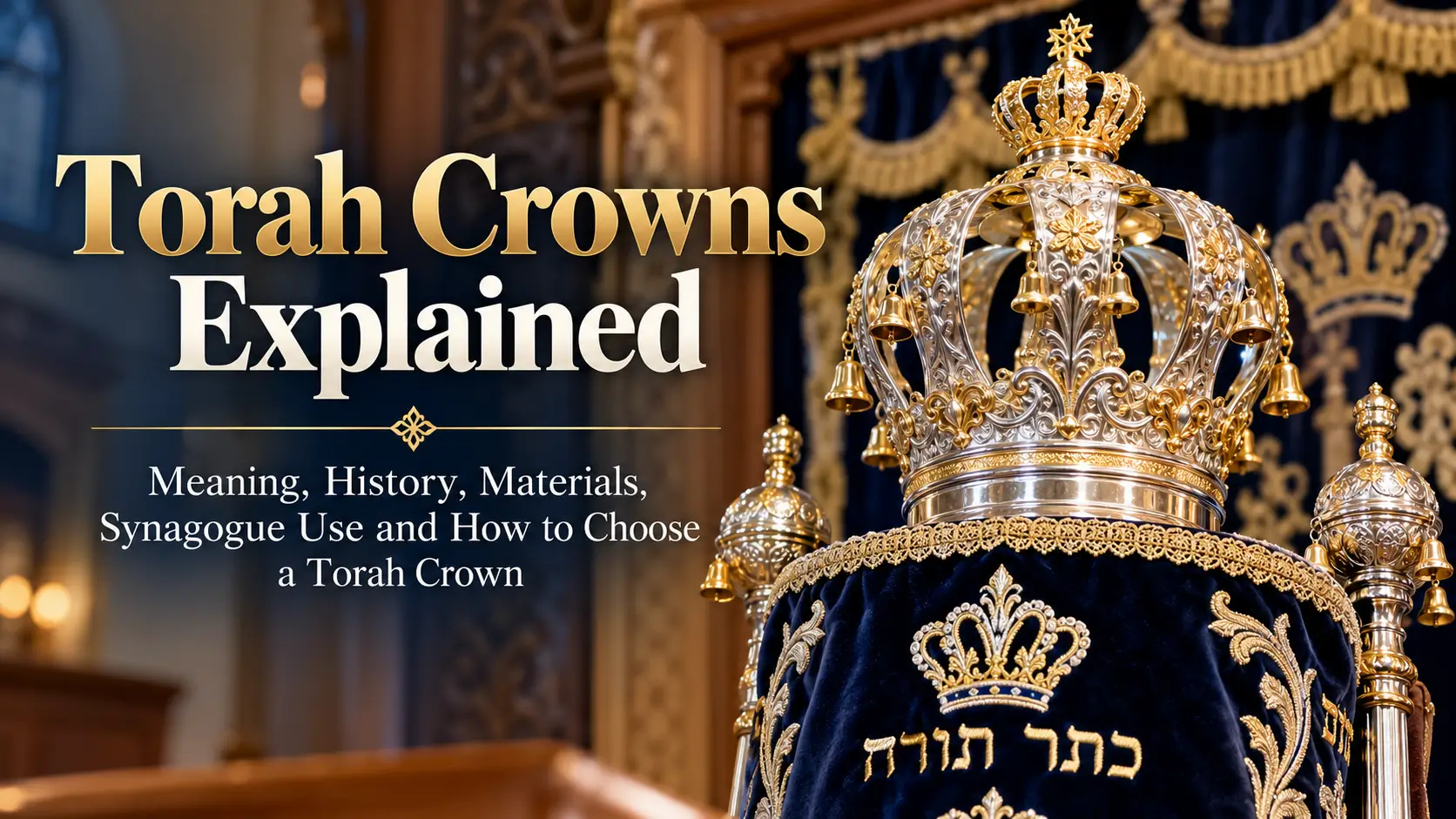
A Torah crown, commonly called a Keter Torah, is one of the most recognizable ornaments placed upon a Sefer Torah. Its symbolism is rooted in the concept of the Torah as the spiritual crown of the Jewish people, while its physical form reflects centuries of Jewish artistic tradition and synagogue practice.
For a synagogue, family, or donor considering a Torah crown, understanding what the ornament represents is more important than simply choosing a decorative piece. The crown must be appropriate for the Torah, compatible with its fittings, and consistent with the customs and aesthetic of the community.
This guide to Torah Crowns Explained examines their meaning, history, construction, practical use, and the considerations that should guide a purchase or dedication.
What Is a Torah Crown?
A Torah crown is an ornamental crown placed above the upper portion of a Torah Scroll, particularly on Torah Scrolls that use Atzei Chayim with a suitable upper structure.
The crown is not part of the parchment itself and does not affect the kosher status of the Sefer Torah. Rather, it is an expression of Kavod HaTorah—honor shown to the Torah.
The symbolism is closely connected with the idea expressed in Jewish tradition that the Torah represents a crown. The physical crown therefore serves as a visible reminder of the Torah’s central place within Jewish life.
A Torah crown may be made from silver, gold-plated metal, sterling silver, nickel, or other materials used in Judaic craftsmanship. Some are relatively restrained in design, while others feature elaborate ornamentation, engraving, filigree, or symbolic motifs.
Understanding Torah Crowns Explained properly therefore requires distinguishing between the religious significance of the crown and the artistic traditions surrounding its manufacture.
The Symbolism Behind a Torah Crown
The crown represents honor and dignity rather than an additional ritual requirement.
Jewish tradition frequently uses the imagery of a crown when discussing Torah. Pirkei Avot famously speaks of three crowns, including the Keter Torah, the crown of Torah. A physical Torah crown reflects this broader symbolic association.
In a synagogue, the crown can therefore communicate several ideas at once:
- Honor for the Sefer Torah
- Reverence for Torah learning
- Continuity of Jewish tradition
- Communal identity
- The generosity of a donor or family
- The importance of the Torah within synagogue life
This is also why Torah ornaments are often selected with considerable care. The objective is not simply visual decoration. The ornament should be appropriate to the sacred object it accompanies.
Are Torah Crowns Required for a Sefer Torah?
A Torah crown is not required for a Sefer Torah to be kosher.
The halachic requirements governing the Torah Scroll itself concern matters such as the parchment, writing, letters, ink, layout, and the qualifications and procedures involved in writing and checking the scroll. The crown is an external ornament and does not determine whether the Torah Scroll is kosher.
Its importance lies primarily in Kavod HaTorah and communal tradition.
Different Jewish communities have developed different customs concerning Torah ornaments. Some communities use crowns prominently, while others emphasize different combinations of a Torah mantle, breastplate, rimmonim, and other ornaments.
For this reason, a synagogue should consider its existing minhag and consult appropriate rabbinic guidance when introducing or replacing Torah ornaments.
Torah Crowns and Other Torah Ornaments
A Torah crown is one part of a larger system of traditional Torah ornaments.
Torah Crowns
The crown sits above the Torah Scroll and provides the visual “Keter” associated with the Torah.
Rimonim
Rimonim are ornamental finials traditionally placed on the upper ends of the Atzei Chayim. Their name derives from the Hebrew word for pomegranates, although their designs vary considerably.
Torah Breastplates
The Hoshen, or Torah breastplate, hangs over the front of the Torah mantle. It may contain symbolic elements, inscriptions, or decorative work.
Torah Mantles
A Torah Mantle protects and covers the Torah Scroll when it is not being read. Mantles may be traditional, modern, embroidered, or designed specifically for a particular congregation.
Torah Pointers
A Yad, or Torah pointer, is used by the reader to follow the text without touching the parchment directly.
These pieces can be coordinated as a complete set. For a congregation furnishing or refurbishing a Torah, considering the relationship between the crown, Rimonim, breastplate, mantle, and pointer can produce a more coherent traditional presentation.
Materials Used for Torah Crowns
Material is one of the major considerations when selecting a Torah crown.
Sterling Silver
Sterling silver is particularly associated with fine Judaica and allows detailed engraving, chasing, repoussé, and other forms of metalwork.
Silver also develops a natural patina over time. Proper maintenance can preserve its appearance while allowing the piece to retain the character associated with traditionally crafted Judaica.
Gold and Gold-Plated Finishes
Gold and gold-plated Torah ornaments can provide a different visual character and may be selected for special dedications or to coordinate with existing synagogue Judaica.
When considering gold finishes, it is useful to determine the underlying metal, plating method, thickness, and recommended care rather than judging the piece only by its appearance.
Nickel and Other Metals
Nickel and other durable metals can be used to create Torah crowns with detailed ornamental designs while providing a different price and maintenance profile from sterling silver.
The material should be considered together with construction, weight, fittings, craftsmanship, and compatibility with the Torah.
How Torah Crowns Are Crafted
Traditional Judaic metalwork includes techniques such as hand chasing, engraving, repoussé, filigree, and hand finishing.
These techniques can produce significant differences between apparently similar ornaments.
A hand-worked crown may contain variations that reflect the craftsmanship of the artisan rather than manufacturing inconsistency. Engraved Hebrew inscriptions, floral patterns, crowns, lions, Jerusalem motifs, and other traditional designs may also carry particular cultural significance.
For a synagogue purchasing a Torah crown, ask about:
- The material used
- Dimensions and weight
- Construction method
- Attachment mechanism
- Compatibility with the Torah
- Cleaning and maintenance requirements
- Whether the design coordinates with existing ornaments
This is an important part of Torah Crowns Explained because the practical characteristics of the crown matter just as much as its appearance.
Choosing a Torah Crown for a Synagogue
Selecting a Torah crown should begin with the Torah itself and the synagogue’s existing tradition.
Consider the Size
Torah Scrolls vary in height and construction. A crown designed for one Torah may not be suitable for another.
Before purchasing, measure the relevant dimensions and confirm compatibility with the existing Atzei Chayim and fittings.
Consider the Existing Ornaments
If the Torah already has Rimonim, a breastplate, mantle, and other ornaments, consider how the new crown will relate to them.
A crown does not need to be identical to every other ornament, but significant differences in scale, finish, or style may affect the overall presentation.
Consider Community Tradition
Ashkenazic, Sephardic, Chabad, and other Jewish communities may have different artistic and ceremonial traditions.
A synagogue should therefore consider its own minhag rather than assuming that one particular ornament style is universally preferred.
Consider Maintenance
Metal ornaments are exposed to handling, storage conditions, and environmental factors. Before purchasing, understand how the material should be cleaned and stored.
Harsh polishing or inappropriate chemical cleaners can damage certain finishes.
Torah Crowns as Dedications and Gifts
A Torah crown can also serve as a meaningful dedication.
Synagogues and families may dedicate Torah ornaments in memory of a loved one, in honor of an occasion, or as part of a synagogue’s support for its Torah collection.
When a crown is dedicated, the inscription should be carefully reviewed before production. Hebrew spelling, names, dates, and wording deserve particular attention because an engraved dedication becomes part of the physical history of the synagogue.
A dedication can also be coordinated with other Torah ornaments, such as Rimonim, a Torah Breastplate, or a new Torah Mantle.
Explore Torah Crowns at SeferTorah.Net
For congregations and families looking to purchase a Torah crown, SeferTorah.Net provides access to Torah ornaments intended for synagogue and Torah use.
Our Torah Crowns collection can be considered alongside related categories such as Rimonim, Torah Breastplates, Torah Pointers, Torah Mantles, Sefer Torah Scrolls, and Atzei Chayim Torah Rollers.
When selecting an ornament, the goal should be to find an appropriate combination of craftsmanship, materials, dimensions, tradition, and intended use.
If you are purchasing a crown for a specific Sefer Torah, it is useful to have the Torah’s measurements available before ordering so that compatibility can be confirmed.
Frequently Asked Questions
1. What is the purpose of a Torah crown?
A Torah crown, or Keter Torah, is an ornament placed above a Sefer Torah as an expression of Kavod HaTorah. It symbolizes the Torah as a spiritual crown and forms part of traditional synagogue Judaica.
2. Is a Torah crown required for a kosher Torah Scroll?
No. A Torah crown is an external ornament and is not a requirement for the kosher status of a Sefer Torah. The kosher status depends on the halachic requirements governing the parchment, writing, letters, ink, and related aspects of the Torah Scroll.
3. What is a Keter Torah?
Keter Torah literally means “crown of Torah.” The term can refer to the symbolic concept of Torah as a crown and, in Judaica usage, to the physical crown placed on a Torah Scroll.
4. What materials are Torah crowns made from?
Torah crowns may be made from sterling silver, gold or gold-plated materials, nickel, and other metals. The appropriate choice depends on the synagogue’s preferences, existing ornaments, budget, craftsmanship, and maintenance requirements.
5. Can a Torah crown be used with any Sefer Torah?
Not necessarily. Torah Scrolls differ in dimensions and construction. The crown must be suitable for the particular Torah and its fittings. Measurements should be confirmed before purchasing.
6. What is the difference between a Torah crown and Rimonim?
Both are Torah ornaments, but they serve different decorative roles. A crown sits above the Torah, while Rimonim are traditionally placed on the upper ends of the Atzei Chayim.
7. Can a Torah crown be dedicated in memory of someone?
Yes. Torah ornaments are commonly used as meaningful synagogue dedications. The dedication inscription should be reviewed carefully for accurate Hebrew names, wording, and dates.
8. How should a Torah crown be cleaned?
Cleaning depends on the material and finish. Silver, plated surfaces, and other metals may require different care. Avoid using abrasive products unless specifically recommended for the particular material.
9. Should a Torah crown match the Torah mantle?
It does not necessarily have to match exactly. However, considering the crown together with the mantle, Rimonim, breastplate, and other ornaments can create a unified traditional presentation.
10. Where can I buy a Torah crown?
A Torah crown can be purchased from established Judaica suppliers specializing in synagogue and Torah ornaments. When purchasing online, review the dimensions, material, construction, fittings, and compatibility with your Sefer Torah rather than selecting solely on appearance.
Conclusion
Torah Crowns Explained is ultimately a subject about more than decorative Judaica. The Keter Torah represents the honor given to the Sefer Torah and occupies an important place within the visual tradition of the synagogue.
For a congregation, the right crown should be considered in relation to the Torah’s dimensions, existing ornaments, community minhag, craftsmanship, material, and long-term care. Whether selected for an existing Sefer Torah, a synagogue renovation, or a meaningful dedication, the crown should complement the dignity of the Torah it accompanies.
For related Torah ornaments and synagogue Judaica, explore the Torah Crowns, Rimonim, Torah Breastplates, Torah Pointers, Torah Mantles, and Atzei Chayim Torah Rollers categories at SeferTorah.Net.