


Torah Breastplates Hoshen: A Complete Guide

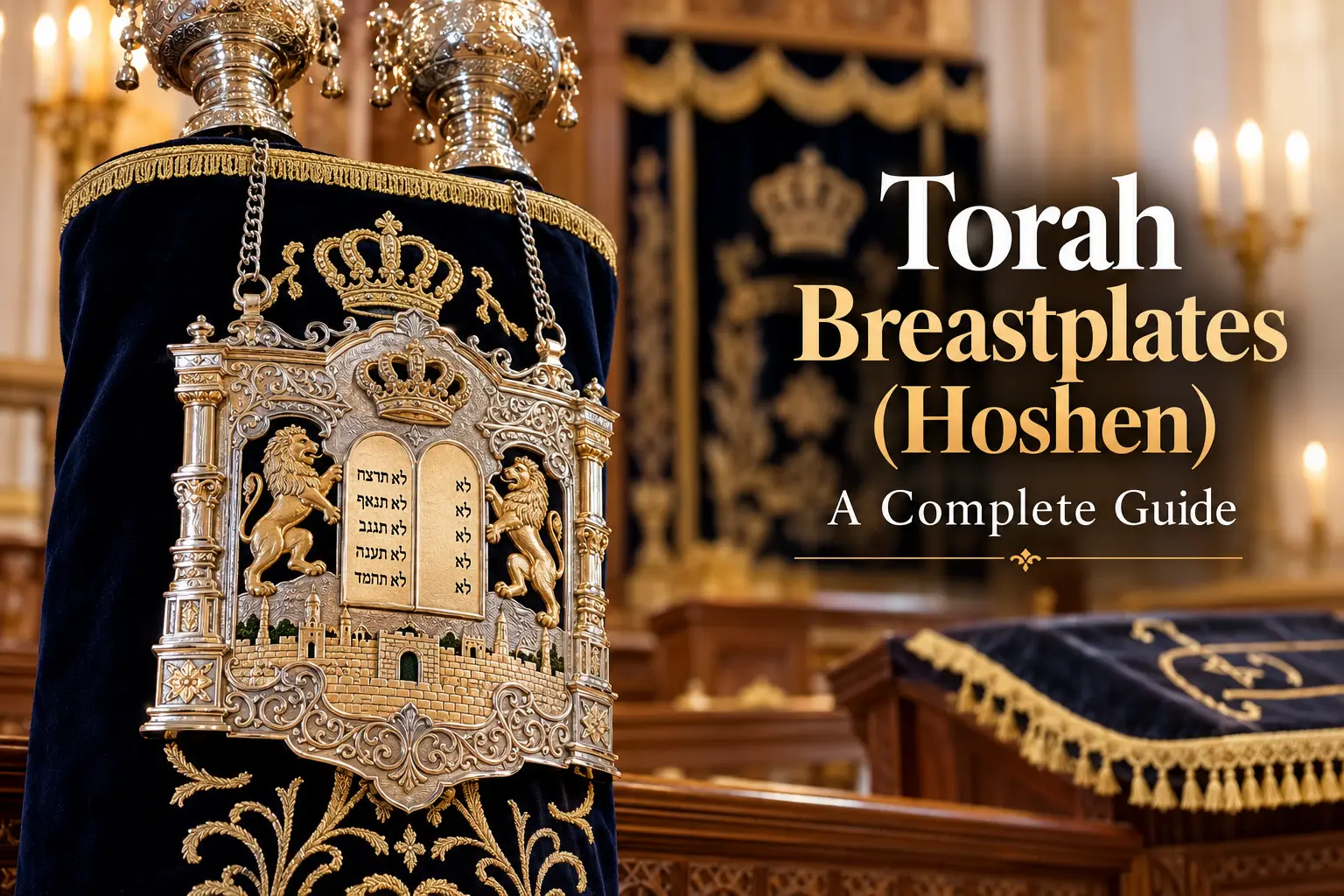
Torah Breastplates Hoshen: A Complete Guide
A Torah Breastplate, or Hoshen, is one of the principal ornaments placed upon a Sefer Torah. Beyond its decorative function, it forms part of the visible expression of Kavod HaTorah—the honor accorded to the Torah Scroll. In many synagogues, the Hoshen is carefully selected to complement the Torah mantle, Rimonim, and other sacred furnishings while reflecting the community’s traditions and aesthetic character.
For someone purchasing a Torah Breastplate, however, appearance is only one consideration. The design, materials, craftsmanship, dimensions, method of attachment, and relationship to the rest of the Torah ornaments all deserve attention.
This guide explains what a Hoshen is, how it relates to the Sefer Torah, traditional design elements, and what to consider when selecting one for a synagogue, Torah dedication, or Judaica collection.
What Is a Torah Breastplate (Hoshen)?
A Hoshen is a decorative Torah ornament traditionally placed over the front of the Sefer Torah when the scroll is dressed for public use. In many Ashkenazic communities, it is positioned over the Torah mantle and hangs on the front of the scroll.
The Hebrew term Hoshen is associated with the breastplate worn by the Kohen Gadol in the Mishkan and Beit HaMikdash. The Torah ornament used today should not be confused with the actual priestly garment described in the Torah. Rather, the name reflects a longstanding Jewish tradition of using the term for a breastplate-like ornament associated with the Torah.
The Hoshen commonly bears decorative motifs, Hebrew inscriptions, symbolic designs, or architectural elements. Some examples incorporate crowns, lions, the Tablets of the Covenant, Jerusalem imagery, or other traditional Judaic motifs.
Its primary setting is the dressed Sefer Torah, where it becomes part of the overall visual arrangement that may also include a Torah mantle, Rimonim, and Torah crown.
The Role of the Hoshen in Kavod HaTorah
Jewish tradition places profound importance on treating a Sefer Torah with appropriate honor. The physical adornments associated with the Torah are therefore not merely ornamental accessories.
The principle of Kavod HaTorah helps explain why communities invest considerable care in Torah mantles, Rimonim, crowns, breastplates, and other Judaica. These objects help establish a dignified setting for the Torah and distinguish the Sefer Torah from ordinary objects.
The concept of Hidur Mitzvah—beautifying a mitzvah—also provides an important framework for understanding the care devoted to sacred objects. The goal is not simply visual richness. Rather, beauty can be used in the service of honoring the mitzvah and creating an appropriate environment for Torah reading and synagogue worship.
At the same time, a Hoshen is not what makes the Torah Scroll itself kosher. The Sefer Torah must meet its own halachic requirements concerning the klaf, writing, letters, parchment, ink, and the work of a qualified Sofer STa”M.
This distinction is important when purchasing Torah ornaments: the Hoshen contributes to the dignity and presentation of the Torah, while the kosher status of the Torah Scroll itself is determined by its halachic requirements.
Traditional Design Elements Found on Torah Breastplates
Torah Breastplates Hoshen can vary considerably in design. Some are restrained and traditional, while others feature elaborate metalwork, engraving, repoussé, or ornamental detailing.
Common motifs include:
Crowns
A crown can symbolize the honor and supremacy of Torah. Crown imagery may also visually coordinate the Hoshen with the Torah Crowns placed above the Torah Scroll.
Lions
Lions have a long history in Jewish art and symbolism. They may appear as decorative guardians or as references to traditional Jewish imagery, including the biblical association of Judah with the lion.
Tablets of the Covenant
Representations of the Luchot are frequently found in Judaica and synagogue ornamentation. When used on a Hoshen, they immediately identify the object with Torah and its teachings.
Jerusalem Motifs
Jerusalem, the Western Wall, and architectural representations associated with the Holy City are common themes in Jewish ceremonial art. A Jerusalem motif can connect the ornament visually with the Jewish people’s historical and spiritual connection to the city.
Hebrew Inscriptions
Some Torah Breastplates include Hebrew words, verses, names, dedication information, or other inscriptions. When commissioning a personalized piece, the exact wording and spelling should be reviewed carefully before production.
Torah Breastplates and Other Torah Ornaments
A Hoshen is generally most effective when considered as part of a complete Torah ornament set rather than as an isolated object.
A traditionally dressed Sefer Torah may be accompanied by several related items.
Torah Mantles
The Torah Mantle provides the primary covering for the scroll. The Hoshen is often placed over the front of the mantle, creating a layered presentation.
For communities replacing or upgrading a complete Torah covering, consider coordinating the Hoshen with the appropriate Traditional Mantles, Modern Mantles, or High Holiday Mantles.
Rimonim
Rimonim are finial ornaments placed on the upper ends of the Atzei Chayim. Their design, metal finish, and decorative vocabulary can be coordinated with the Hoshen.
See the Rimonim category when selecting complementary Torah ornaments.
Torah Crowns
A Torah crown is positioned above the scroll and may be designed to complement the Hoshen and Rimonim.
Torah Pointers
The Yad, or Torah pointer, is used by the reader to follow the text without touching the parchment directly. Although it serves a different practical purpose from the Hoshen, its metalwork and finish can be coordinated with the other Torah ornaments.
Choosing the Right Torah Breastplate for a Synagogue
Selecting a Hoshen should begin with the needs and traditions of the community.
Consider the Existing Torah Ornaments
If the Sefer Torah already has a mantle, Rimonim, or crown, examine their materials, colors, motifs, and proportions. A new Hoshen should complement these elements rather than appear unrelated.
For a new synagogue installation, it may be appropriate to select the Torah mantle and ornaments as a coordinated set.
Consider the Material
Torah Breastplates may be produced using materials such as silver, nickel, brass, or other metals, depending on the design and maker.
The important consideration is not simply the material name. Examine the construction, surface treatment, detailing, weight, durability, and workmanship.
Consider the Size and Proportion
A Hoshen should be appropriately proportioned to the Torah Scroll on which it will be used. A very small ornament may appear visually lost on a large mantle, while an excessively large or heavy piece may be impractical.
Before ordering, confirm the dimensions and intended method of attachment.
Consider the Community’s Minhag
Jewish communities have different traditions concerning synagogue furnishings and Torah adornment. Ashkenazic and Sephardic communities may differ in their customary styles, materials, and presentation.
When a synagogue follows a particular minhag, it is sensible to consider that tradition alongside the preferences of the congregation and guidance from its rabbinic leadership.
Buying Torah Breastplates for a Torah Dedication
A Torah dedication is an especially meaningful occasion for commissioning a Hoshen.
A synagogue, family, or donor may choose a Torah Breastplate as part of a larger dedication that includes a mantle, Rimonim, crown, or other Torah accessories.
Personalization may include:
- Donor names
- Family names
- Synagogue names
- Hebrew dates
- Dedication inscriptions
- Memorial information
Because inscriptions become part of a sacred object, they should be reviewed carefully before production. Hebrew spelling, names, dates, and wording should be confirmed in advance.
For larger synagogue projects, it is also useful to consider the entire presentation of the Sefer Torah rather than purchasing individual ornaments without regard to one another.
Caring for a Torah Breastplate
Proper care helps preserve both the appearance and craftsmanship of a Hoshen.
Metal ornaments should be handled carefully and stored in a manner that prevents unnecessary scratching, bending, or impact. Aggressive cleaning products should not be applied without knowing how they will affect the particular metal or finish.
If the Hoshen includes delicate engraving, stones, plating, enamel, or other decorative elements, cleaning methods should be selected accordingly.
It is also important to inspect how the breastplate is attached to the Torah mantle. A loose attachment can result in unnecessary movement or damage to the ornament or textile.
When in doubt, consult an experienced Judaica professional before attempting restoration or polishing.
Why Buy Torah Breastplates from a Judaica Specialist?
A Torah Breastplate is not an ordinary decorative accessory. It is part of the visual and ceremonial presentation of a sacred Torah Scroll.
When choosing a Hoshen, buyers should be able to understand its dimensions, materials, construction, design details, and intended use. This is particularly important for synagogues purchasing ornaments for a new Torah, replacing existing pieces, or preparing for a dedication.
At SeferTorah.Net, Torah Breastplates can be considered alongside other traditional Torah ornaments, including Rimonim, Torah Crowns, Torah Pointers, and Torah Mantles. This makes it easier to develop a coordinated presentation appropriate for the Sefer Torah and the synagogue.
For a congregation seeking a complete Torah ornament arrangement, explore the Torah Ornaments collection and related Judaica categories before making a final selection.
Frequently Asked Questions About Torah Breastplates Hoshen
1. What is a Torah Breastplate called in Hebrew?
A Torah Breastplate is commonly called a Hoshen. The term is related to the Hebrew word used for the breastplate of the Kohen Gadol, although the modern Torah ornament is not the same garment described in the Torah.
2. What is the purpose of a Torah Breastplate?
The Hoshen is a decorative Torah ornament placed on the front of a dressed Sefer Torah. It contributes to the dignified presentation of the Torah and is associated with Kavod HaTorah and the broader concept of beautifying sacred objects.
3. Is a Hoshen required for a kosher Sefer Torah?
The Hoshen does not determine whether a Sefer Torah is kosher. The kosher status of a Torah Scroll depends on halachic requirements concerning the parchment, writing, letters, ink, and related aspects of STa”M. The breastplate is an ornament used in the Torah’s presentation.
4. Is the Torah Hoshen the same as the Kohen Gadol’s breastplate?
No. Although the term Hoshen connects the two concepts, the Torah ornament used in synagogues today should not be understood as the actual priestly breastplate described for the Kohen Gadol.
5. What materials are used for Torah Breastplates?
Depending on the maker and design, Torah Breastplates may be made from various metals and may incorporate engraving, chased work, repoussé, decorative motifs, stones, or other artistic elements. The construction and finish should be considered along with the material itself.
6. Can a Torah Breastplate be personalized?
Yes. Some Hoshen designs can accommodate names, dedication information, Hebrew dates, memorial inscriptions, or other details. Hebrew wording should be carefully checked before production.
7. Should a Hoshen match the Torah mantle?
It does not necessarily have to match exactly, but coordination is often desirable. The Hoshen, mantle, Rimonim, crown, and other ornaments can be selected to create a visually coherent presentation of the Sefer Torah.
8. What should I consider when buying a Torah Breastplate?
Consider the dimensions, material, craftsmanship, design, attachment method, existing Torah ornaments, synagogue minhag, and intended use. For a dedication, also consider whether personalization or coordination with other Torah ornaments is appropriate.
9. How should a Torah Breastplate be cleaned?
Cleaning depends on the metal and decorative finish. Avoid abrasive or unsuitable cleaning products, particularly on engraved, plated, or embellished pieces. When the correct method is uncertain, consult a Judaica specialist before cleaning.
10. Can I buy a Torah Breastplate as part of a larger Torah ornament set?
Yes. A Hoshen can be selected together with Rimonim, Torah Crowns, Torah Pointers, and Torah Mantles to create a coordinated set for a synagogue or Torah dedication.
Conclusion
Torah Breastplates Hoshen represent an important element of traditional Torah adornment. Their significance is best understood within the broader framework of Kavod HaTorah, Hidur Mitzvah, Jewish craftsmanship, and synagogue tradition.
A thoughtful selection considers more than appearance. Materials, proportions, craftsmanship, community minhag, existing Torah ornaments, and the intended use of the Sefer Torah all deserve attention.
Whether a synagogue is preparing for a new Torah dedication, replacing an existing ornament, or assembling a complete set of Torah accessories, a well-chosen Hoshen can contribute meaningfully to the dignified presentation of the Sefer Torah.