


Common Mistakes When Buying Judaica

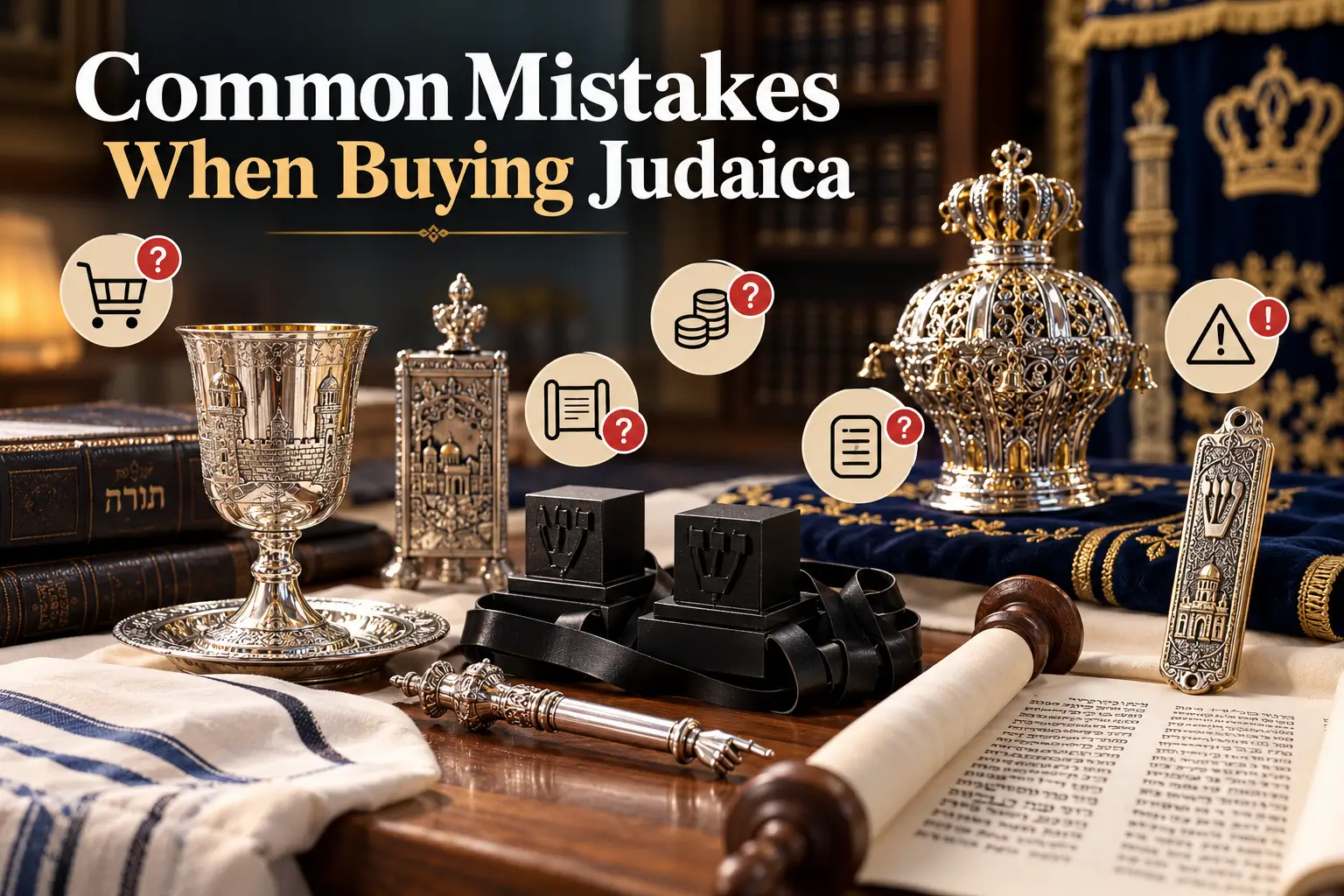
Buying Judaica is not simply a matter of selecting an attractive object. A Sefer Torah, pair of Tefillin, Mezuzah, silver Kiddush cup, or Torah ornament may serve a religious purpose, reflect a family’s minhag, or become part of a synagogue’s communal life for generations. Each type of item has different requirements, and understanding those differences helps buyers make informed decisions.
One of the most common mistakes when buying Judaica is assuming that appearance, price, or a seller’s general assurances are enough to establish suitability. For ritual objects governed by Halacha, questions about status, materials, craftsmanship, and tradition may be just as important as design.
This guide explains what to consider before purchasing Judaica, how to distinguish ritual requirements from aesthetic preferences, and which questions to ask when buying for personal use, a Bar Mitzvah, a wedding, or a synagogue.
1. Confusing Decorative Judaica with Halachically Suitable Items
Not every Judaica product has the same religious function. Some objects are primarily decorative, while others are used to fulfill a mitzvah or support a religious practice.
A silver Torah pointer, for example, helps guide the reader during the public reading of the Sefer Torah. Its material and ornamentation may reflect craftsmanship and communal taste, but those features do not make the pointer a kosher ritual item in the same sense as a Sefer Torah, Tefillin, or Mezuzah.
By contrast, a Mezuzah scroll must meet specific halachic requirements. Its appearance alone cannot establish that it is kosher. The same principle applies to Tefillin and a Sefer Torah, which require appropriate preparation, writing, and inspection.
Before purchasing, ask what role the object serves. Is it decorative, functional, or intended to fulfill a mitzvah? For items with halachic requirements, confirm their suitability through reliable documentation and an appropriately qualified authority.
2. Choosing Tefillin or Mezuzot Based on Appearance Alone
Tefillin and Mezuzot contain handwritten passages from the Torah. Their religious suitability depends on factors that are not necessarily visible from the outside.
What to check when buying Tefillin
Tefillin involve several components, including the batim (housings), retzuot (straps), and parshiyot (parchment passages). The quality and suitability of the complete set depend on more than the exterior finish.
Buyers should ask about the source and inspection of the parshiyot, the construction of the batim, the condition and suitability of the straps, and the standards under which the set was prepared. Terms such as Gassot and Dakot describe different types of Tefillin housings, but a label alone does not establish the suitability of the entire set.
For a Bar Mitzvah, allow enough time to obtain appropriate guidance and ensure that the Tefillin meet the family’s requirements.
What to check when buying a Mezuzah
A Mezuzah case protects and displays the scroll, but the case and the scroll are separate components. An elaborate silver or handcrafted case does not establish that the parchment inside is kosher.
Ask whether the scroll is included, what information is available about its preparation and checking, and how it should be stored and installed. If you are unsure which standard or custom applies, consult a qualified Sofer STa”M or rabbinic authority.
3. Overlooking the Buyer’s Minhag and Community Tradition
Jewish communities preserve different customs regarding the writing of sacred texts, ritual practice, and certain aspects of Judaica. These differences can affect what a buyer should select.
For example, Ksav Beis Yosef, Ksav Ari, and other writing traditions may be relevant when choosing STa”M items. The appropriate choice can depend on the user’s community and established practice. It should not be treated as a purely aesthetic preference.
Ashkenazic, Sephardic, and Chabad communities may also have different customary preferences for particular ritual items. These differences should be considered carefully rather than reduced to broad assumptions about what every member of a community uses.
Before ordering, clarify the intended user’s custom with a knowledgeable rabbi or qualified Sofer. This is especially important when buying Tefillin, Mezuzot, or other items whose religious use depends on specific standards.
4. Assuming a Higher Price Guarantees Better Suitability
Price can reflect many things: precious metals, hand engraving, decorative complexity, manufacturing methods, materials, and the cost of skilled labor. It does not automatically establish that an item is appropriate for a particular religious purpose.
A more expensive Mezuzah case does not necessarily contain a more suitable scroll. Likewise, an ornate Torah ornament is not automatically more practical for a congregation than a simpler design.
For STa”M items, buyers should understand what the quoted price includes. Does it cover the complete item, inspection, accessories, or only a particular component? Are relevant certifications or written details available?
For decorative Judaica, compare materials, dimensions, finish, workmanship, and maintenance requirements. The goal is to understand what you are purchasing rather than using price as the only measure of value.
5. Failing to Check Materials and Craftsmanship
Judaica is made from a wide range of materials, including sterling silver, silver-plated metal, nickel, brass, wood, parchment, and textiles. Similar-looking products may have very different construction and maintenance requirements.
Understand the material
When purchasing silver Judaica, ask whether the item is solid sterling silver, silver-plated, or finished using another process. These distinctions affect durability, tarnishing, cleaning, and the possibility of future restoration.
For example, silver-plated Torah pointers may require gentler polishing than solid sterling silver pieces because repeated abrasive cleaning can wear away the silver layer.
Examine the construction
For Torah ornaments, inspect the visible joins, attachments, chains, finials, and decorative elements. For items intended for frequent communal use, consider how securely they are assembled and how easily they can be handled and stored.
A product description should clearly distinguish materials and explain relevant care requirements. If the construction is unclear, ask the seller before purchasing.
6. Ignoring Size, Fit, and Intended Use
An item can be attractive and well made yet unsuitable for its intended setting because of its dimensions or design.
For example, Torah ornaments must be appropriate for the Sefer Torah and its associated fittings. A Torah pointer should be comfortable to handle during reading. A Mezuzah case needs to accommodate the scroll correctly without damaging it.
When purchasing for a synagogue, confirm the measurements and compatibility of the item with existing equipment. If the object is intended as a gift, find out whether the recipient already has the relevant accessories or follows a particular custom.
For Tefillin and tallit-related purchases, the user’s needs and customary practice should guide the choice. Avoid assuming that one size or design will suit everyone.
7. Not Asking About Inspection, Documentation, or Provenance
Buyers should know what evidence is available to support a product’s description. This is particularly important for STa”M items, where religious suitability cannot be established by photographs alone.
When buying a Sefer Torah, Tefillin, or Mezuzah, ask about the preparation and checking process, the responsible Sofer or qualified authority where applicable, and any documentation supplied with the item.
Terms such as Lishmah refer to performing relevant writing with the required intention under halachic standards. Such requirements should be explained accurately and in context, not used as vague marketing claims.
For antique or collectible Judaica, provenance may also matter. Ask what is known about the item’s origin, age, materials, previous restoration, and condition. If historical or religious claims are important to the purchase, seek evidence rather than relying on an unsupported description.
Documentation should be relevant to the specific item. A general statement about a seller’s experience is not a substitute for information about the product being purchased.
8. Forgetting About Maintenance and Long-Term Care
Judaica may be used weekly, daily, seasonally, or only on special occasions. Its care requirements depend on the materials and the way it is used.
Silver objects can tarnish and may need occasional cleaning. Silver-plated items can be damaged by aggressive polishing. Textiles require suitable storage to protect them from moisture, dust, and pests. Parchment requires careful handling and appropriate environmental conditions.
Before purchasing, consider whether the item needs specialized cleaning, periodic inspection, protective storage, or professional repair.
For sacred parchment, do not attempt to repair damaged letters or make halachic judgments based on appearance. A qualified Sofer or appropriate rabbinic authority should assess concerns about a Sefer Torah, Tefillin, or Mezuzah.
A little planning before the purchase can prevent avoidable maintenance problems later.
9. Buying Judaica Online Without Reviewing the Product Details
Online shopping makes Judaica accessible to buyers in different countries, but product descriptions must be reviewed carefully. Photographs may not show scale, material thickness, surface finish, or the full contents of a set.
Before placing an order, check:
- Exact dimensions and materials.
- Whether the product includes all pictured components.
- Whether a scroll, case, accessories, or storage bag is sold separately.
- Shipping costs, delivery estimates, and return conditions.
- Any relevant documentation or care instructions.
- Whether the product description answers your questions about intended use.
For valuable or custom-made items, contact the seller before ordering. Ask for clarification about dimensions, construction, personalization, and delivery arrangements.
For halachically sensitive items, obtain the necessary information before purchase rather than assuming that a product image or general description settles every question.
10. Treating Judaica as an Ordinary Gift Without Considering Its Purpose
Judaica is often given for Bar Mitzvahs, weddings, housewarmings, synagogue dedications, and other meaningful occasions. A thoughtful gift reflects both the recipient’s needs and the significance of the occasion.
A Torah pointer or silver Kiddush cup may be suitable as a decorative or functional gift. Tefillin, Mezuzot, and other items intended for religious use require additional consideration because the recipient’s customs and practical needs matter.
When choosing a gift, consider asking a family member or rabbi about the recipient’s preferences. For synagogue dedications, consult the congregation about its existing equipment, design preferences, and any relevant communal standards.
Personalization can add meaning, but confirm spelling, inscriptions, measurements, and production timelines before approving a custom order.
Buying Judaica from SeferTorah.Net
Selecting Judaica becomes easier when product information helps you understand the item’s purpose, materials, design, and intended use.
At SeferTorah.Net, buyers can explore Judaica and synagogue-related products for personal use, family occasions, and communal settings. Before choosing an item, review the product description and confirm any details that matter to your particular requirements.
Explore the Torah Pointers collection to compare Yad designs and finishes, or browse the SeferTorah.Net store for additional Judaica and synagogue accessories.
When purchasing Torah ornaments, consider how the design will fit your congregation’s existing equipment and how the item will be handled and maintained. When purchasing STa”M items, ask the relevant questions about preparation, checking, and suitability for your custom.
If you need clarification about materials, dimensions, included components, or product care, contact the seller before placing your order. An informed purchase is more likely to meet your needs and remain useful over time.
Frequently Asked Questions About Buying Judaica
1. What should I check before buying Judaica?
Start by identifying the item’s purpose. For decorative objects, compare materials, dimensions, craftsmanship, and maintenance requirements. For items used to fulfill a mitzvah, such as Tefillin or Mezuzot, confirm the relevant halachic requirements and obtain guidance from a qualified authority when necessary.
2. How can I tell whether Tefillin or a Mezuzah is kosher?
Appearance alone cannot establish kosher status. Ask about the preparation and checking of the parchment, the relevant construction requirements, and any documentation available for the specific item. Consult a qualified Sofer STa”M or rabbinic authority if you need confirmation of its suitability.
3. Does expensive Judaica mean better quality?
Not necessarily. Price may reflect precious metals, labor, design, or decorative complexity, but it does not automatically establish religious suitability or practical value. Compare the actual materials, construction, included components, and intended use before deciding.
4. Should I consider my family’s Jewish custom when buying Judaica?
Yes, especially for ritual items whose use may depend on established minhag or halachic practice. Writing traditions and other customs can affect the appropriate choice. Ask a knowledgeable rabbi or qualified Sofer when you are uncertain which option is suitable.
5. What is the difference between decorative Judaica and STa”M items?
Decorative Judaica includes objects such as Torah ornaments, Kiddush cups, and certain ceremonial accessories. STa”M refers to Sefer Torah, Tefillin, and Mezuzot, sacred texts written according to specific halachic requirements. Decorative appearance and craftsmanship matter in both categories, but STa”M items have additional requirements relating to their preparation and suitability.
6. What should I look for when buying silver Judaica?
Check whether the item is sterling silver, silver-plated, or made with another finish. Review its dimensions, construction, decorative details, and cleaning instructions. These factors influence its appearance, maintenance, durability, and potential for restoration.
7. Is it safe to buy Judaica online?
Online purchasing can be convenient when the seller provides clear product descriptions, dimensions, material details, shipping terms, and relevant documentation. For custom, expensive, or halachically sensitive items, ask questions before ordering and confirm any details that cannot be established from photographs.
8. What makes a good Judaica gift for a Bar Mitzvah?
The right gift depends on the recipient’s needs, customs, and the family’s plans. Tefillin require particular care because suitability and community practice matter. Other options, such as a Kiddush cup or Torah-related accessory, should be chosen according to the recipient’s preferences and intended use.
9. Should I buy Torah ornaments as a matching set?
A matching set can create a coordinated appearance, but compatibility with the congregation’s existing Sefer Torah and fittings is more important. Confirm dimensions, attachment methods, materials, and practical handling requirements before purchasing a complete set.
10. Who should I ask if I am unsure whether a Judaica item is suitable?
For questions about halachic requirements, consult a qualified rabbi or Sofer STa”M as appropriate. For questions about materials, dimensions, construction, or maintenance, ask the seller or manufacturer. Some purchases require both types of guidance.
Conclusion
Avoiding common mistakes when buying Judaica begins with asking the right questions. Understand the item’s purpose, confirm relevant halachic requirements, consider your family’s or community’s minhag, and examine materials, construction, documentation, and long-term care.
A beautiful object is most useful when it also meets the needs for which it was purchased. Whether you are choosing a Sefer Torah, Tefillin, Mezuzah, silver Kiddush cup, or synagogue ornament, informed decisions help protect your investment and respect the item’s place in Jewish life.
Take time to review product details, seek qualified guidance where needed, and choose Judaica that suits its intended purpose. This approach helps make the purchase more meaningful and supports the responsible preservation of Jewish ritual objects for years to come.