


What Is Written Inside a Mezuzah?

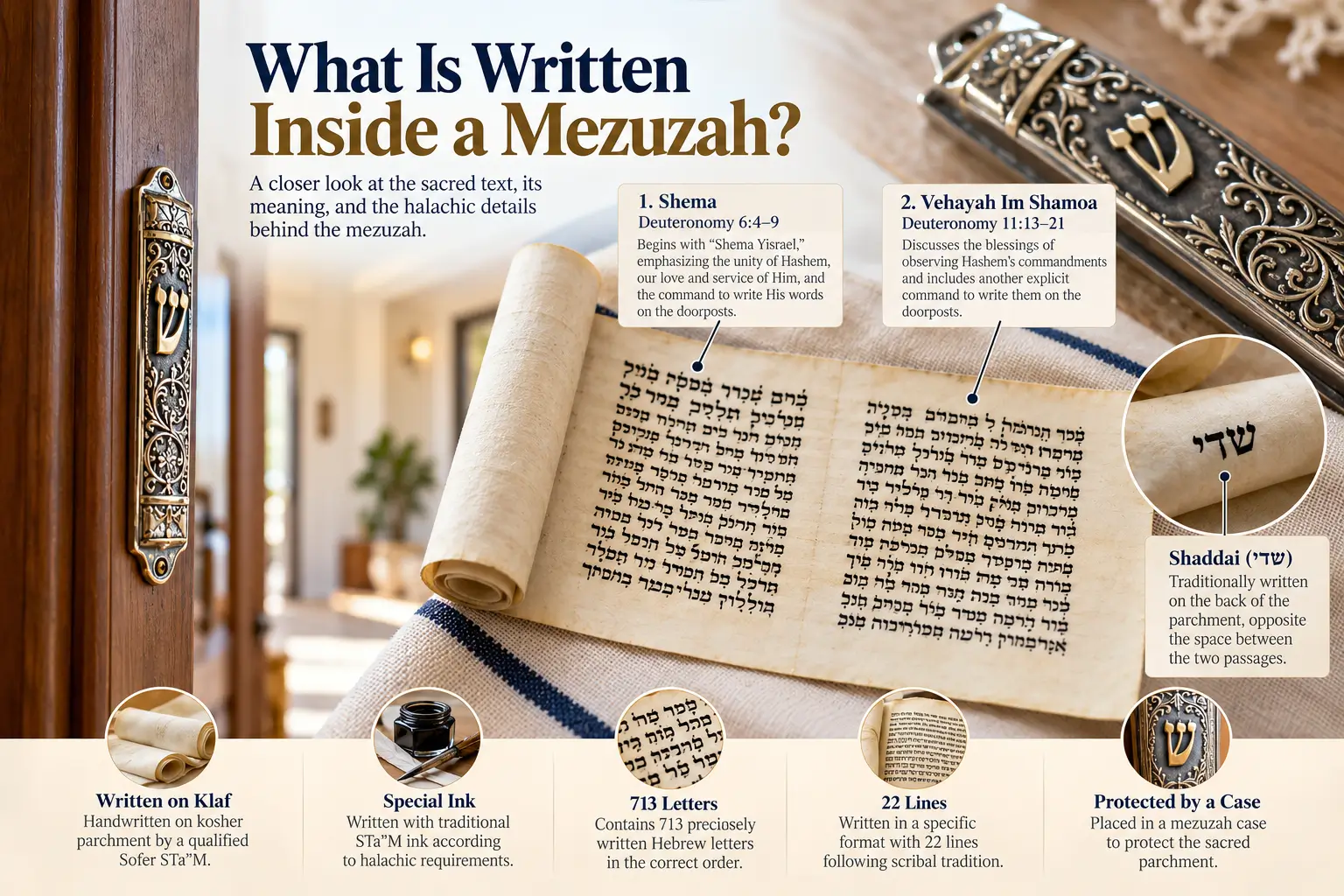
A mezuzah is often recognized by the decorative case attached to a Jewish doorway, but the case itself is not the essential part of the mitzvah. At its heart is a carefully handwritten parchment scroll containing specific passages from the Torah.
So, what is written inside a mezuzah? The answer is precise: two Torah passages, taken from the Book of Deuteronomy—Shema (Deuteronomy 6:4–9) and Vehayah Im Shamoa (Deuteronomy 11:13–21). These passages contain the Torah’s command to place its words upon the doorposts of the home and gates.
Writing these passages is not simply a matter of copying Hebrew text. A kosher mezuzah must be handwritten by a qualified Sofer STa”M, on properly prepared parchment, using the required script, ink, spacing, and order. A single missing, malformed, or incorrectly written letter can affect the halachic status of the entire scroll.
What Text Is Written Inside a Mezuzah?
A kosher mezuzah contains two sections of the Torah.
1. Shema — Deuteronomy 6:4–9
The first passage begins:
“Shema Yisrael, Hashem Elokeinu, Hashem Echad” — “Hear, O Israel, the Lord is our God, the Lord is One.”
It continues with the commandment to love Hashem with all one’s heart, soul, and might. It then instructs the Jewish people to teach these words to their children, speak of them throughout daily life, and ultimately:
“U’chtavtam al mezuzot beitecha u’visharecha” — to write them upon the doorposts of the house and upon the gates.
This first section therefore connects the mezuzah directly to fundamental Jewish beliefs: the unity of Hashem, love of Hashem, Torah education, and the constant integration of Torah into everyday life.
2. Vehayah Im Shamoa — Deuteronomy 11:13–21
The second passage begins with “Vehayah im shamoa tishme’u”, describing the consequences of faithfully serving Hashem and observing His commandments.
It discusses serving Hashem with the heart and soul, the relationship between mitzvah observance and the blessings of the Land, and the warning against turning toward idolatry. It concludes with another explicit command:
“U’chtavtam al mezuzot beitecha u’visharecha” — “And you shall write them on the doorposts of your house and on your gates.”
Together, these two passages form the actual Torah text of the mezuzah.
Why Are These Two Passages Written in a Mezuzah?
The choice of these passages is not arbitrary.
Both contain the Torah’s instruction concerning the mezuzah, while also expressing central principles of Jewish life: recognition of Hashem’s unity, love and service of Hashem, acceptance of mitzvot, teaching Torah to one’s children, and awareness of the relationship between Jewish observance and everyday life.
The mezuzah therefore serves as more than a physical marker on a doorway. The words written on the parchment are intended to place these principles visibly and continually at the threshold of Jewish life.
The Tur, discussing the laws of mezuzah, emphasizes the importance of writing these two sections and affixing them to the doorposts. He also connects the mezuzah with remembering the unity of Hashem when entering and leaving the home.
Is “Shaddai” Written Inside the Mezuzah?
This is one of the most common questions about the mezuzah.
The primary Torah text on the parchment consists of the two passages described above. In addition, there is a longstanding custom to write the Divine Name Shaddai (שדי) on the outside/back of the parchment, corresponding to the space between the two passages. Rambam records this as an established custom.
After the parchment is rolled, the name is positioned so that it may be associated with the exterior of the rolled scroll.
It is important to distinguish between the sacred writing on the parchment and markings on the mezuzah case. A decorative case may display the Hebrew letter Shin (ש), representing the beginning of Shaddai, but the case itself is not what makes a mezuzah kosher. The scroll is the essential component.
How Is a Mezuzah Scroll Written?
Knowing what is written inside a mezuzah is only part of understanding what makes it kosher.
A mezuzah must be handwritten by a qualified Sofer, rather than printed or mechanically reproduced. The writing uses special black ink and the traditional Ktav Ashuri script associated with Torah, tefillin, and mezuzah writing.
The parchment is prepared from an animal designated for kosher use, and the Sofer prepares the surface before beginning the writing.
The parchment is also ruled. The customary format consists of 22 lines, and the placement of the words follows an established scribal tradition. Rambam records the custom of beginning the final line with “al ha’aretz.”
These details demonstrate why a mezuzah should never be treated simply as a decorative Hebrew inscription.
Why Every Letter of a Mezuzah Matters
A mezuzah contains hundreds of individual Hebrew letters, and each letter has requirements governing its shape, position, and relationship to the surrounding letters.
A commonly cited count is 713 letters. Traditional halachic sources emphasize that the letters must be written correctly and in the proper order.
This is particularly important because Hebrew letters in STa”M writing are not interchangeable artistic forms. The precise shape of a letter can have halachic significance.
For example, letters that touch each other improperly, letters that are missing essential features, incorrect word forms, or writing outside the required order can create serious problems.
This is one reason purchasing a mezuzah from a reliable source matters more than simply choosing an attractive case.
What Is Klaf and Why Is It Important?
The parchment used for a mezuzah is called klaf.
Klaf is not ordinary writing paper. The parchment must be prepared according to the laws applicable to STa”M writing. The Sofer writes directly onto this prepared surface with the appropriate ink and script.
Because the parchment itself is part of the mitzvah, its preparation and condition matter.
A mezuzah may look perfectly normal from the outside while having a problem with the parchment, ink, lettering, or another aspect of the writing. This is why the expertise of the Sofer and the reliability of the seller are essential considerations when purchasing a mezuzah.
For readers looking for different scribal traditions, SeferTorah.Net offers Mezuzah Scrolls, including options such as Ketav Ari Mezuzah Scrolls, Ketav Bet Yosef Mezuzah Scrolls, Ketav Sefaradi Mezuzah Scrolls, and Ketav Alter Rebbe Mezuzah Scrolls.
What Are the Different Mezuzah Writing Traditions?
Different Jewish communities follow established traditions regarding the formation of STa”M letters.
Among the traditions encountered in mezuzah writing are Ketav Bet Yosef, Ketav Ari, Ketav Sefaradi, and the writing tradition associated with the Alter Rebbe.
These are not merely differences in handwriting style. The form of individual Hebrew letters follows traditional models transmitted through Jewish scribal practice.
For this reason, when purchasing a mezuzah, it is appropriate to consider the tradition followed by your family or community. A reputable Judaica provider should be able to explain which writing tradition is being offered rather than treating all mezuzot as identical.
Does the Mezuzah Case Have Anything Written on It?
The mezuzah case protects the parchment from physical damage and can also serve an aesthetic purpose.
Many traditional cases display the Hebrew letter Shin, referring to Shaddai, one of the Divine Names associated with the mezuzah. Some modern cases have other decorative designs, Hebrew lettering, or artistic motifs. The decoration on the case, however, does not determine whether the parchment inside is kosher.
This distinction is important when shopping for a mezuzah.
A beautiful Silver Mezuzah Case or handcrafted case can enhance the appearance of a doorway, but the most important question remains: What is written inside the mezuzah, and was it written according to halachic requirements?
How Should You Choose a Mezuzah?
When purchasing a mezuzah, consider both the scroll and the case.
1. Verify the source of the scroll
Ask who wrote the mezuzah and whether the Sofer is qualified and reliable.
2. Know the writing tradition
If your family or community follows a particular STa”M tradition, select a mezuzah consistent with that tradition.
3. Look beyond the case
The decorative case is visible, but the kosher status of the mitzvah depends on the parchment and its writing.
4. Consider inspection
A mezuzah can develop problems through physical damage, moisture, environmental exposure, or other causes. Having mezuzot checked by a qualified Sofer is an important part of responsible mezuzah care.
5. Choose appropriate protection
Once you have selected the scroll, protect it with an appropriate case. SeferTorah.Net offers several styles through its Mezuzah Cases collection, including Glass Cases, Silver Cases, Stone & Ceramic Cases, Metal Cases, Plastic/Acrylic, and Wood Cases.
Why Buy a Mezuzah Scroll From a Trusted Judaica Source?
A mezuzah is a sacred STa”M item, not simply a decorative product.
The difference between a properly written scroll and an invalid one may not be visible to someone without specialized knowledge. A missing letter, malformed letter, incorrect spacing, or other scribal issue can affect the status of the mezuzah.
For this reason, buyers should pay attention to the source, scribal tradition, parchment, writing quality, and inspection process rather than choosing solely on appearance or price.
At SeferTorah.Net, shoppers can explore Mezuzah Scrolls alongside protective cases and other Judaica products, making it easier to select a mezuzah according to their community’s traditions and practical needs.
Frequently Asked Questions
What is written inside a mezuzah?
A kosher mezuzah contains two Torah passages: Deuteronomy 6:4–9, beginning with Shema Yisrael, and Deuteronomy 11:13–21, beginning with Vehayah Im Shamoa.
Is the entire Torah written inside a mezuzah?
No. Only these two specific Torah passages are written on the mezuzah parchment.
Is the name Shaddai written inside a mezuzah?
Shaddai is traditionally written on the exterior/back of the parchment. It is not one of the two Torah passages that make up the primary text of the mezuzah.
How many letters are in a mezuzah?
A traditional mezuzah is commonly described as containing 713 letters. Because each letter has halachic requirements, accurate scribal writing is essential.
Who can write a mezuzah?
A mezuzah should be written by a qualified Sofer STa”M who is knowledgeable in the laws and practices governing sacred scribal writing.
Can a printed mezuzah be kosher?
A printed reproduction does not fulfill the requirement for a handwritten mezuzah. The sacred text must be written according to the applicable laws of STa”M.
What is Ketav Ari?
Ketav Ari is a traditional form of Hebrew scribal script associated with the Ari and widely used within particular Jewish communities. It differs in certain letter forms from other accepted STa”M traditions.
What is Ketav Bet Yosef?
Ketav Bet Yosef is a major traditional scribal script associated with Rabbi Yosef Karo and is widely used for Torah, tefillin, and mezuzah writing among many Ashkenazic communities.
Why is the mezuzah written on parchment?
The mezuzah is a sacred handwritten scroll and requires parchment prepared according to the laws of STa”M. It is not intended to be written on ordinary paper.
Does the mezuzah case need to have a Hebrew letter on it?
No particular decorative marking on the case makes the mezuzah kosher. The essential mitzvah is the properly written parchment inside. The Shin commonly seen on cases reflects the traditional association with the Divine Name Shaddai.
Conclusion
Understanding what is written inside a mezuzah reveals why this small scroll requires such careful craftsmanship and halachic attention.
The mezuzah contains two specific passages from the Torah—Shema and Vehayah Im Shamoa—written by a qualified Sofer on properly prepared parchment. Every letter, word, line, and aspect of the writing follows an established tradition of STa”M practice.
The decorative case has its place, particularly in protecting the parchment and expressing the beauty of the mitzvah, but it is the scroll itself that carries the sacred text.
Whether you are purchasing a mezuzah for a new home, replacing an existing scroll, or selecting mezuzot for a synagogue or community, understanding the writing tradition and halachic requirements is an important first step. Choosing a trustworthy source ensures that the focus remains where it belongs: on the integrity of the mitzvah and the sacred words written within the mezuzah.