


How Mezuzah Scrolls Are Written

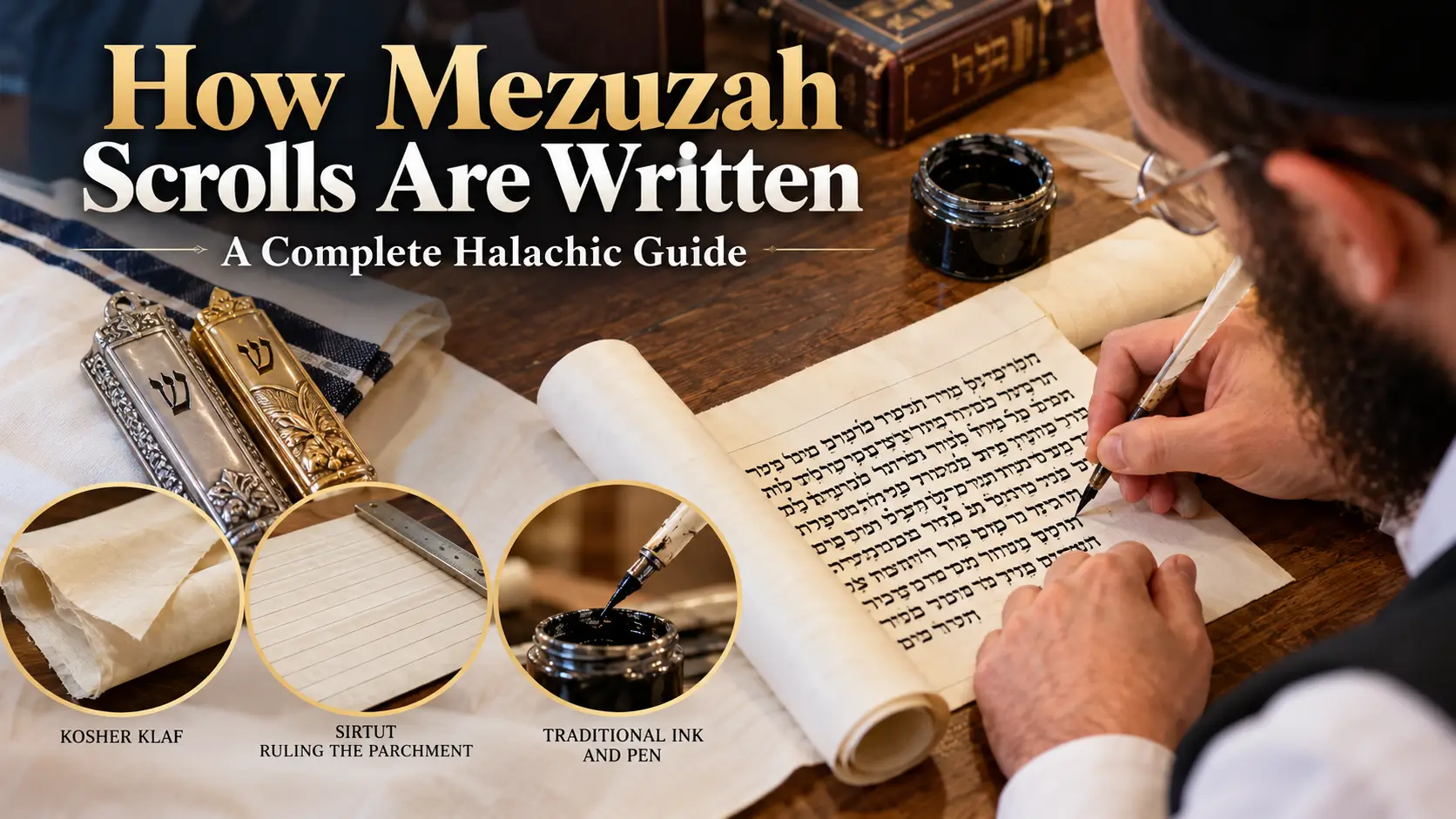
A mezuzah is much more than the decorative case attached to a Jewish doorway. The essential mitzvah is fulfilled through the handwritten scroll inside the case, containing two passages from the Torah: Shema and V’hayah im shamoa. Because the scroll must meet detailed requirements of Jewish law, the process of creating one involves specialized parchment, traditional scribal techniques, precise Hebrew lettering, and careful inspection.
Understanding how mezuzah scrolls are written helps explain why a genuine kosher mezuzah cannot simply be printed, photocopied, or produced by an ordinary calligrapher. It must be written according to the laws of STa”M—an abbreviation for Sefer Torah, Tefillin, and Mezuzot—by a qualified Sofer trained in these laws.
From preparing the klaf and ruling the parchment to forming each letter and checking the completed scroll, every stage has a specific purpose. The result is a sacred text prepared for the fulfillment of the mitzvah of mezuzah.
What Is Written in a Mezuzah?
A kosher mezuzah contains two Torah passages from Deuteronomy 6:4–9 and Deuteronomy 11:13–21. These are the first two paragraphs of the Shema.
The text includes the commandment to write these words on the doorposts of the house and gates. The passages therefore connect the physical doorway of a Jewish home with remembrance of Hashem, Torah observance, and Jewish identity.
The text is handwritten on a single piece of parchment in the traditional Hebrew script used for STa”M. A mezuzah contains hundreds of individual letters, and each letter has requirements concerning its shape, spacing, connection, and integrity.
The back of the parchment traditionally contains the Divine Name Sha-dai, written according to the accepted scribal practice.
Because even a single missing, damaged, or incorrectly formed letter can affect the validity of the scroll, the writing process requires considerably more than simply copying Hebrew text.
Step 1: Preparing the Kosher Parchment — Klaf
The first physical foundation of a mezuzah is its parchment, known as klaf.
Klaf used for STa”M is prepared from the hide of a kosher animal and processed specifically for sacred writing. The preparation of parchment is itself governed by halachic requirements.
For STa”M writing, the parchment must also be properly prepared for writing. The quality and condition of the surface matter because the ink must form clear, durable letters without compromising the parchment.
This is one reason that an inexpensive printed mezuzah or an ordinary piece of parchment cannot substitute for a properly prepared kosher scroll.
A Sofer also examines the parchment for imperfections that could interfere with the writing. The goal is to provide a suitable surface on which the sacred text can be written accurately and clearly.
Step 2: Sirtut — Ruling the Mezuzah
Before the letters are written, the parchment is ruled with sirtut.
Sirtut refers to the straight guidelines made on the parchment to establish the lines of writing. Traditional sources describe ruling as an integral part of the scribal process for a mezuzah.
A commonly used mezuzah format contains 22 lines. This arrangement has become an established scribal practice and provides the framework for writing the text in a consistent form.
The letters are written in relation to these lines rather than simply placed randomly across the parchment. The ruling therefore helps the Sofer maintain the correct structure, spacing, and alignment throughout the scroll.
This is an important distinction between genuine STa”M writing and ordinary printed material. The physical preparation of the parchment is part of the traditional writing process itself.
Step 3: Preparing the Sofer’s Writing Tools
A mezuzah is traditionally written with special black ink using a pen or quill suitable for STa”M writing.
Historically, sofrim have used quills made from kosher birds, with the shape of the writing tip carefully adjusted according to the scribe’s technique. Some sofrim also use other traditional writing implements appropriate for STa”M.
The pen must allow the Sofer to create both thick and thin strokes while maintaining control over the delicate shapes of the Hebrew letters.
The ink must also be suitable for sacred writing. Traditional STa”M ink has specific characteristics designed to produce clear and durable writing.
The combination of parchment, ink, and writing instrument is therefore not incidental. Each component contributes to the integrity of the finished mezuzah.
Step 4: Writing the Mezuzah in the Correct Script
One of the most important aspects of understanding how mezuzah scrolls are written is understanding ksav, or the Hebrew scribal script.
Mezuzot are written in Ketav Ashurit, the traditional square Hebrew script used for Torah scrolls, tefillin, and mezuzot.
However, Jewish communities have different established scribal traditions regarding the precise forms of certain letters.
For example, SeferTorah.Net offers mezuzah scrolls in several traditions, including:
- Ketav Bet Yosef — associated with Ashkenazic STa”M tradition
- Ketav Ari — associated with the Arizal and widely used in Chasidic and Chabad communities
- Ketav Sefaradi — traditional Sephardic scribal script
- Ketav Alter Rebbe — a distinct tradition associated with Chabad
The choice of script should generally follow the minhag and tradition of the person or community using the mezuzah. When there is uncertainty, consultation with a knowledgeable Rav can help determine which tradition is appropriate.
Step 5: Writing Each Letter According to Halacha
The Sofer must carefully form every letter according to the applicable laws of STa”M.
This is where the expertise of a trained Sofer becomes especially important.
Hebrew letters that appear visually similar may have meaningful differences in their halachic forms. A letter can become invalid because of an incorrect shape, an unwanted connection, a separation, a missing stroke, or damage occurring after writing.
The Sofer must therefore pay attention to:
- Letter formation
- Spacing between letters
- Spacing between words
- Proper line structure
- Correct order of the text
- Connections and separations
- Ink coverage
- Parchment condition
The writing must also be performed with the appropriate kavanah, or intention, required for sacred STa”M writing.
This is why the question “How are mezuzah scrolls written?” cannot be answered simply by saying that someone writes the Hebrew text by hand. The actual process involves a complete system of traditional scribal laws.
Writing in the Correct Order
The two passages of the mezuzah must be written in their proper order.
The passage beginning with Shema precedes V’hayah im shamoa. Writing the sections out of order can invalidate the mezuzah.
This illustrates an important principle of STa”M: correctness is not determined only by whether all the words appear somewhere on the parchment. Their sequence, placement, and relationship to the laws of writing also matter.
The Sofer therefore works carefully through the text rather than treating the mezuzah as ordinary handwritten material.
Why Every Letter Matters
A mezuzah contains a relatively short amount of text, but the number of letters does not make the writing process simple.
Every letter must remain recognizable and properly formed. Damage can also create problems after the mezuzah has already been written.
For example, cracking, fading, flaking, or other physical damage may affect the integrity of a letter. This is one reason why mezuzot should not be treated as ordinary paper documents.
The scroll should be protected from moisture, excessive heat, and other environmental conditions that could damage the parchment or ink.
Inspection After the Mezuzah Is Written
Writing the mezuzah is only part of the process. Inspection is equally important.
A properly established mezuzah should be checked for errors that could affect its kosher status. Inspection can involve careful examination of the letters, spacing, parchment, and overall writing.
Modern technology can also assist with inspection. For example, some mezuzah scrolls are computer scanned in addition to being examined according to traditional methods.
Technology, however, does not replace the role of qualified halachic expertise. A scan may help identify potential irregularities, but questions of kosher status can require the judgment of a trained Sofer or qualified halachic authority.
This distinction is important when evaluating a mezuzah sold online. Buyers should look beyond appearance and ask who wrote the scroll, what scribal tradition was used, what type of parchment was used, and how the scroll was inspected.
Choosing the Right Mezuzah Scroll for Your Home
Once you understand how mezuzah scrolls are written, it becomes easier to understand why different mezuzah scrolls can vary considerably in price and specification.
Important considerations include:
1. Scribal Tradition
Choose a script that corresponds with your family or community tradition, such as Bet Yosef, Ari, Sefaradi, or another established tradition.
2. Parchment
Ask what type of kosher klaf was used and how it was prepared.
3. Sofer
A mezuzah should be written by a qualified Sofer who is knowledgeable in the laws of STa”M.
4. Inspection
Find out whether the completed scroll has undergone appropriate inspection and certification.
5. Size
Mezuzah scrolls are available in different sizes. The appropriate size can depend on the doorpost, case, writing format, and practical requirements.
6. Condition
A mezuzah should be protected from environmental conditions that can damage its parchment or letters.
For families who are looking for a new kosher scroll, SeferTorah.Net’s Mezuzah Scrolls collection provides different scribal traditions and sizes to accommodate different Jewish communities and needs.
Mezuzah Scrolls vs. Mezuzah Cases
It is important to distinguish between the scroll and the case.
The case is the protective and decorative covering placed around the scroll. It can be made from materials such as silver, glass, ceramic, metal, acrylic, or wood.
The scroll itself is the component that contains the sacred text and fulfills the essential requirement of the mitzvah.
SeferTorah.Net offers several types of Mezuzah Cases, including:
- Glass Cases
- Silver Cases
- Stone & Ceramic Cases
- Metal Cases
- Plastic/Acrylic Cases
- Wood Cases
When purchasing a mezuzah, the case should not distract from the primary importance of obtaining a properly written kosher scroll.
Why Buy a Kosher Mezuzah Scroll from SeferTorah.Net?
For those ready to purchase a mezuzah, understanding the writing process is an important first step.
SeferTorah.Net provides mezuzah scrolls representing different Jewish scribal traditions, including Ketav Ari Mezuzah Scrolls, Ketav Bet Yosef Mezuzah Scrolls, Ketav Sefaradi Mezuzah Scrolls, and Ketav Alter Rebbe Mezuzah Scrolls.
This allows customers to select a scroll according to their community’s established tradition rather than choosing solely on appearance.
When purchasing a sacred Jewish object online, the key questions should always concern scribal tradition, kosher materials, the qualifications of the Sofer, and inspection.
For readers who are also building or maintaining a collection of Jewish ritual items, related resources include Tefillin Sets & Accessories, Tzitzit – Arbah Kanfot, Tallits – Prayer Shawls, Sefer Torah Scrolls, Torah Pointers, and Megillat Esther Scrolls.
These categories represent different areas of STa”M and traditional Judaica, each with its own halachic and practical considerations.
How to Care for a Mezuzah Scroll
Even a properly written mezuzah requires responsible care.
Keep the scroll protected from:
- Water and excessive humidity
- Direct exposure to extreme heat
- Physical pressure
- Improper rolling
- Unprotected storage
- Unnecessary handling
The parchment should remain rolled appropriately and protected by a suitable case.
If a mezuzah becomes visibly damaged, falls out of its case, or has been exposed to moisture or other harmful conditions, it is advisable to have it examined by a qualified Sofer rather than assuming that it remains kosher.
Frequently Asked Questions
1. How Mezuzah Scrolls Are Written?
Mezuzah scrolls are handwritten by a qualified Sofer on kosher parchment using traditional STa”M methods. The two required Torah passages are written in the correct order using traditional Hebrew script, with careful attention to letter formation, spacing, ruling, and halachic requirements.
2. What parchment is used for a mezuzah?
A mezuzah is written on kosher parchment, known as klaf. The parchment is prepared from the hide of a kosher animal and must be suitable for sacred STa”M writing.
3. How many lines are in a mezuzah?
The established custom is to write a mezuzah on 22 lines. This format is associated with the traditional scribal arrangement of the mezuzah text.
4. Can a mezuzah be printed?
No. A printed mezuzah does not fulfill the requirement for a handwritten kosher mezuzah. The sacred text must be written according to the laws governing STa”M.
5. Who is allowed to write a mezuzah?
A mezuzah should be written by a qualified Sofer who is trained in the laws and practical requirements of STa”M writing.
6. What script is used for a mezuzah?
Mezuzot are written in Ketav Ashurit, the traditional square Hebrew script. Different Jewish communities may follow different established scribal traditions, including Bet Yosef, Ari, and Sefaradi.
7. Why does the mezuzah need lines on the parchment?
The parchment is ruled with sirtut before writing. These lines establish the writing structure and are part of the traditional requirements governing mezuzah writing.
8. How long does it take to write a mezuzah?
The time varies according to the Sofer, writing size, script, and working conditions. Because each letter must be written carefully and according to halachic requirements, the process cannot be compared to ordinary handwriting or printing.
9. Does a mezuzah need to be checked after it is written?
Yes. Proper inspection is important because errors, damage, or deterioration can affect the kosher status of a mezuzah. A qualified Sofer can examine the scroll when there is a question.
10. How should I choose a mezuzah scroll?
Consider the scribal tradition appropriate for your community, the quality and preparation of the klaf, the qualifications of the Sofer, the inspection process, and the physical size needed for your application. When in doubt about a halachic matter, consult your Rav.
Conclusion
Learning how mezuzah scrolls are written reveals why a kosher mezuzah represents far more than a decorative object on a doorway. Its parchment, ink, script, letter formation, spacing, order, and inspection are all connected to a longstanding tradition of Jewish scribal practice.
A qualified Sofer must approach the work with technical precision, knowledge of STa”M, and the appropriate intention for sacred writing. The choice of scribal tradition is also meaningful, particularly for families following established Ashkenazic, Sephardic, Chabad, or other communal practices.
For anyone purchasing a mezuzah, the most important consideration is therefore not simply how attractive the case looks, but whether the scroll itself has been properly written, inspected, and prepared according to the relevant halachic standards.
A mezuzah begins with the scroll. Choosing the appropriate kosher parchment and scribal tradition is the foundation for fulfilling the mitzvah with care and Hidur Mitzvah.