


Types of Klaf Explained

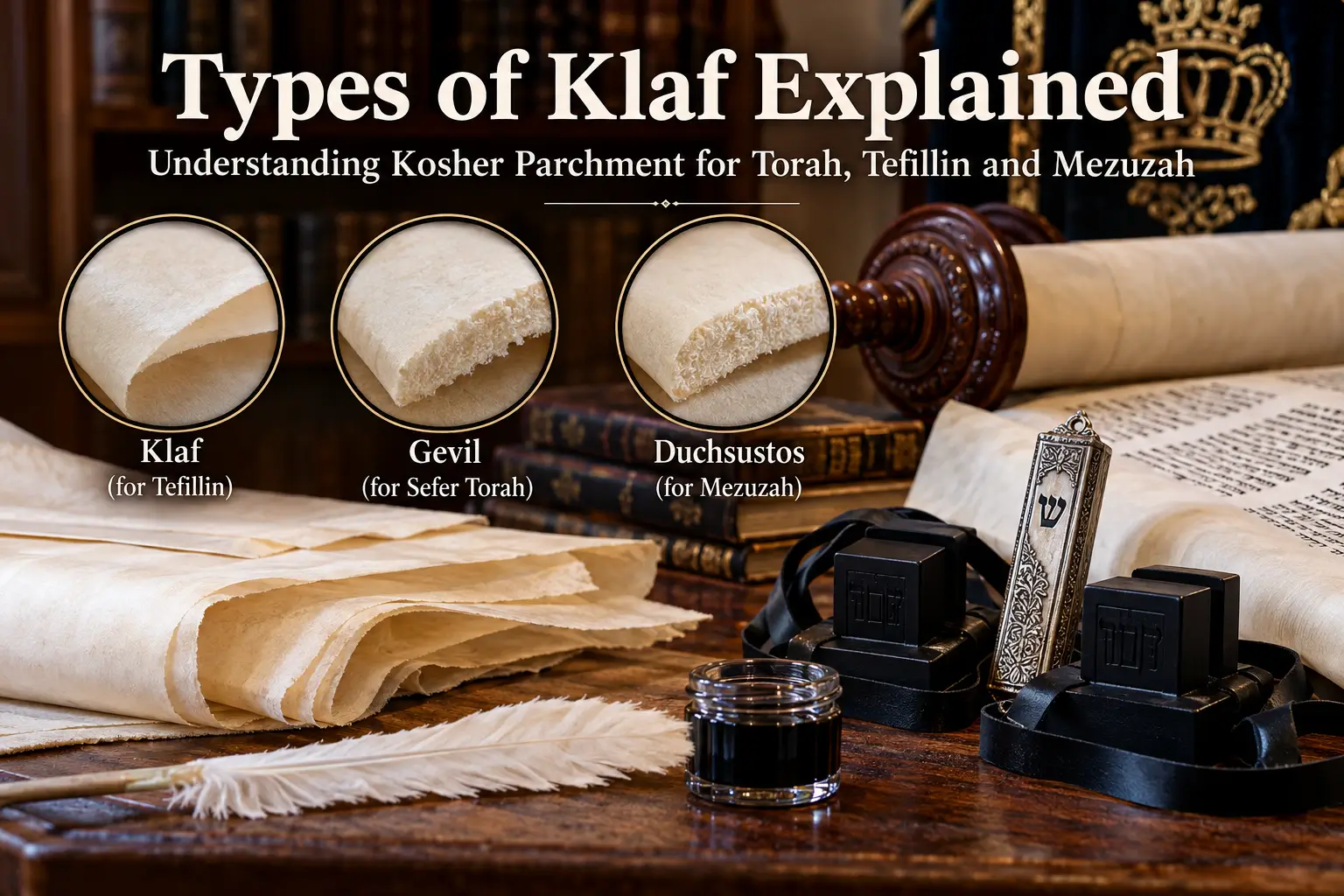
The parchment used for a Sefer Torah, Tefillin, or Mezuzah is far more than a writing surface. Its source, preparation, and suitability for sacred writing are governed by Halacha and the traditions of STa”M. Understanding the types of klaf helps explain why a Sofer must consider not only the appearance of parchment but also how it was produced and which sacred purpose it is intended to serve.
The word klaf is often used broadly to describe parchment used for sacred Jewish texts. In its more technical halachic sense, however, klaf is one of three traditional categories of prepared animal hide: klaf, gevil, and duchsustos. These terms describe distinctions associated with the layers of the hide and the way they are prepared.
This guide to Types of Klaf Explained explores those distinctions, the requirements for kosher parchment, and the practical questions buyers should ask when commissioning a Torah scroll or purchasing Tefillin or a Mezuzah.
What Is Klaf in STa”M?
STa”M is an abbreviation for Sifrei Torah, Tefillin, and Mezuzot—the three categories of sacred texts written by a qualified Sofer. Unlike ordinary documents, these texts must meet specific halachic requirements concerning their writing materials, preparation, lettering, and production.
Klaf is made from the hide of a kosher animal. The hide undergoes a specialized preparation process that removes the hair, treats the material, and produces a surface suitable for writing with the ink used by a Sofer.
The preparation is not simply a matter of making the hide smooth. The parchment must be suitable for its sacred purpose, and the processing must meet the relevant halachic requirements. The traditional requirement of lishmah—preparation with the appropriate intention for the sake of the sacred object—also has an important place in the discussion of parchment.
A parchment sheet may look attractive and accept ink well, but appearance alone cannot establish that it is kosher for STa”M. Its origin, processing, and suitability must be evaluated according to Halacha.
The Three Traditional Types of Parchment
The Rambam discusses three categories of prepared hide in Hilchot Tefillin, Mezuzah, and Sefer Torah, Chapter 1: gevil, klaf, and duchsustos. Understanding their traditional distinctions provides the foundation for understanding kosher parchment.
In the traditional description of a split hide, klaf is the thinner layer associated with the side where the animal’s hair grew. When prepared and used for Tefillin, the writing is placed on the appropriate flesh-facing side of the klaf layer.
Today, the term is also commonly used for the parchment prepared for writing Sifrei Torah, Tefillin, and Mezuzot. Modern parchment preparation does not always follow the older practice of completely splitting a hide into two separate layers. Instead, the hide may be processed by removing material from its surfaces until it reaches the form required for use.
This distinction matters because traditional terminology and contemporary workshop practice do not always correspond to three visibly separate commercial products.
Why it matters: A purchaser should not judge klaf solely by thickness, whiteness, or smoothness. The parchment’s preparation and suitability for its intended sacred use are more important than superficial appearance.
2. Gevil
Gevil traditionally refers to a hide that has been prepared without splitting it into the two separate layers described in the classical sources. The Rambam identifies gevil as the traditional material for a Sefer Torah, with writing on the side associated with the animal’s hair.
Halachic sources also recognize circumstances in which a Sefer Torah written on klaf is valid. Therefore, it would be inaccurate to claim that every Sefer Torah written on klaf is invalid or that the terms gevil and klaf are interchangeable in every halachic discussion.
The choice of parchment for a Torah scroll should be made with guidance from a competent halachic authority and an experienced Sofer familiar with the relevant standards and communal practice.
3. Duchsustos
Duchsustos is the other layer identified when a hide is split: the thicker portion associated with the flesh side. The classical discussion connects this material with the writing of a Mezuzah, on the appropriate side.
The Rambam distinguishes between the traditional designation of duchsustos for Mezuzot and the halachic validity of a Mezuzah written on other suitable parchment. In his discussion, a Mezuzah written on klaf or gevil can also be valid, while duchsustos is identified as the preferred material for the mitzvah in that framework.
Practical rulings should be made with reference to accepted halachic authorities and the standards followed by the Sofer producing the Mezuzah.
Which Parchment Is Used for a Sefer Torah, Tefillin, and Mezuzah?
The distinctions between the three traditional types are not merely manufacturing terminology. They arise from the halachic discussion of how sacred texts are written.
| Sacred item | Traditional parchment discussion | Practical consideration |
|---|---|---|
| Sefer Torah | Gevil is specified in the classical tradition; klaf may also be valid under the relevant halachic rules | Confirm the parchment and writing standards with the Sofer and halachic authority |
| Tefillin | Klaf is the prescribed parchment category | The parchment must be appropriately prepared, and the writing must meet halachic requirements |
| Mezuzah | Duchsustos is the traditional designation; klaf or gevil may also be valid under the Rambam’s discussion | Ask the Sofer about the parchment used and the halachic standard followed |
These distinctions are based on the Rambam’s discussion of parchment in Hilchot Tefillin, Mezuzah, and Sefer Torah, Chapter 1. They should not be treated as a substitute for a practical ruling in a particular case.
In contemporary practice, parchment prepared in a similar manner is commonly used for all three sacred items, with the processing and writing surfaces adjusted to meet the relevant requirements. The fact that the same general parchment-making process may be used does not eliminate the halachic distinctions governing its preparation and use.
How Is Klaf Prepared for Sacred Writing?
The production of klaf involves several stages. Each stage affects the parchment’s suitability as a writing surface.
Selecting the Hide
The parchment must originate from an appropriate kosher animal species. The source material is an essential part of the halachic requirements; parchment cannot be made acceptable simply by treating an unsuitable hide until it looks correct.
Removing Hair and Preparing the Surface
The hide is cleaned and the hair removed. It then undergoes processing intended to transform the skin into a durable writing material.
Classical descriptions discuss treatments involving salt, flour, and tannin-containing substances. Actual production methods vary, and the specific process must be evaluated according to the halachic standards applicable to the parchment.
Processing and Smoothing
The hide is stretched, dried, and worked to produce a surface suitable for writing. Depending on the method, material may be removed from one or both sides.
The goal is not merely visual uniformity. The resulting parchment must be suitable for the sacred writing, including the application of ink and the preservation of the letters over time.
Halachic Intention
Parchment for sacred writing is subject to requirements concerning its preparation for the sake of the relevant mitzvah. The precise application of lishmah depends on the process and the halachic issue being considered.
For this reason, buyers should ask about the preparation standards followed by the producer rather than relying on claims such as “handmade,” “natural,” or “traditional” as proof of halachic suitability.
What Makes Klaf Kosher?
Several factors must be considered when determining whether parchment is suitable for a Sefer Torah, Tefillin, or Mezuzah.
Permitted source material: The hide must come from an appropriate kosher species under the applicable halachic requirements.
Proper processing: The parchment must be processed according to the relevant halachic standards, including requirements concerning intention.
Suitable writing surface: The parchment and the side used for writing must conform to the rules governing the particular sacred text.
Appropriate production standards: The parchment must be suitable for the intended STa”M use. Appearance alone cannot establish this.
Competent oversight: The Sofer and relevant halachic authority must be able to address questions about the parchment’s preparation and use.
Klaf is only one part of the requirements for a kosher sacred text. Even properly prepared parchment does not guarantee that the finished Sefer Torah, Tefillin, or Mezuzah is kosher. The writing, letters, spacing, and other halachic requirements must also be satisfied.
How to Choose Klaf When Purchasing STa”M
For someone purchasing a Sefer Torah, Tefillin, or Mezuzah, the most useful questions concern the parchment’s halachic suitability and the standards followed during production.
Questions to Ask a Sofer or Seller
- What type of parchment is used for this particular sacred text?
- How is the parchment prepared, and what standards govern that process?
- Does the parchment meet the halachic requirements for its intended use?
- Which writing tradition or ksav is being followed, where relevant?
- Who can answer questions about the item’s production and halachic status?
A trustworthy seller should be able to explain the relevant details clearly or direct the buyer to someone qualified to address them. Avoid assuming that a higher price, a particular color, or a smoother surface automatically indicates greater halachic quality.
For Tefillin and Mezuzot, the parchment should be considered alongside the writing and the qualifications and standards of the Sofer. For a Sefer Torah, the broader production process, writing tradition, and halachic supervision also deserve attention.
Explore SeferTorah.Net’s STa”M and Judaica Collections
Choosing sacred items requires attention to more than appearance. Buyers should understand the intended use of the item, the standards followed in its production, and the guidance available if questions arise.
SeferTorah.Net serves customers seeking Torah-related items, Tefillin, Mezuzot, and synagogue Judaica. If you are considering a Sefer Torah or another STa”M item, review the available product information and ask for clarification about the writing, parchment, and relevant halachic standards before purchasing.
You can also explore SeferTorah.Net’s Judaica and synagogue collections for related ritual and ceremonial items, including Torah ornaments and accessories.
For an important purchase, seek clear answers about the item’s intended use and production standards. Where a halachic question arises, consult a competent rabbi or qualified Sofer rather than relying on a general product description.
Frequently Asked Questions About Types of Klaf
1. What are the three traditional types of klaf?
The three traditional categories of prepared hide are klaf, gevil, and duchsustos. They are associated with different layers or forms of the animal hide and have distinct roles in the classical halachic discussion of parchment for sacred writing.
2. Is klaf the same as parchment?
Klaf is commonly used to refer to parchment for sacred Jewish texts. In technical halachic terminology, however, klaf is one of three traditional categories, alongside gevil and duchsustos. The meaning therefore depends on whether the term is being used broadly or in its more specific sense.
3. What type of parchment is used for Tefillin?
Klaf is the prescribed parchment category for Tefillin in the classical halachic discussion. The parchment must be properly prepared, and the writing must meet the applicable halachic requirements. A product’s appearance alone cannot establish that it is kosher.
4. Must a Sefer Torah be written on gevil?
Gevil is specified in the classical tradition, but the Rambam also states that a Sefer Torah written on klaf can be valid. The halachic distinction is important, and the choice should be evaluated according to the applicable standards and the guidance of a qualified authority.
5. What parchment is traditionally used for a Mezuzah?
Duchsustos is the traditional parchment designation for a Mezuzah in the classical discussion. The Rambam also discusses the validity of a Mezuzah written on klaf or gevil. For practical purchasing decisions, ask the Sofer which parchment is used and which halachic standard is followed.
6. Is modern klaf split into separate layers?
Not necessarily. Classical descriptions discuss splitting a hide into klaf and duchsustos. Contemporary parchment preparation commonly uses a process in which material is removed from the hide’s surfaces without necessarily separating it into two complete layers. The final parchment must still meet the requirements for its intended sacred use.
7. Does white or smooth klaf indicate better quality?
No. Color, smoothness, and thickness cannot independently establish halachic suitability. The hide’s source, preparation, writing surface, and compliance with relevant requirements are more important than appearance alone.
8. What does lishmah mean in parchment preparation?
Lishmah means that an act is performed with the appropriate intention for the sake of the sacred purpose. In the context of STa”M, specific requirements concerning intention apply to preparation and writing. The details can be complex, so a buyer should ask about the standards followed by the parchment producer and Sofer.
9. Can a kosher parchment make an entire Mezuzah or pair of Tefillin kosher?
No. Suitable parchment is necessary, but it is only one part of the requirements. The writing, letter formation, spacing, and other applicable halachic details must also be correct. A qualified Sofer or halachic authority should address questions about the status of a particular item.
10. What should I ask before buying a Sefer Torah, Tefillin, or Mezuzah?
Ask about the parchment used, its preparation, the standards followed by the Sofer, and the item’s intended writing tradition where relevant. Request clear answers from someone qualified to explain these matters. If you have a specific halachic concern, consult a competent rabbi or Sofer before making a decision.
Conclusion
Understanding the types of klaf provides a useful foundation for understanding how sacred Jewish texts are produced. Klaf, gevil, and duchsustos have distinct meanings in the classical halachic discussion, and their significance extends beyond the physical appearance of the parchment.
When selecting a Sefer Torah, Tefillin, or Mezuzah, focus on the source and preparation of the parchment, the requirements governing its intended use, and the standards followed by the Sofer. These considerations are more meaningful than color, smoothness, or marketing claims alone.
For buyers seeking STa”M and related Judaica, informed questions and qualified guidance help ensure that the decision reflects the item’s sacred purpose and the halachic standards that govern its production.