


Who Is a Sofer STa”M?

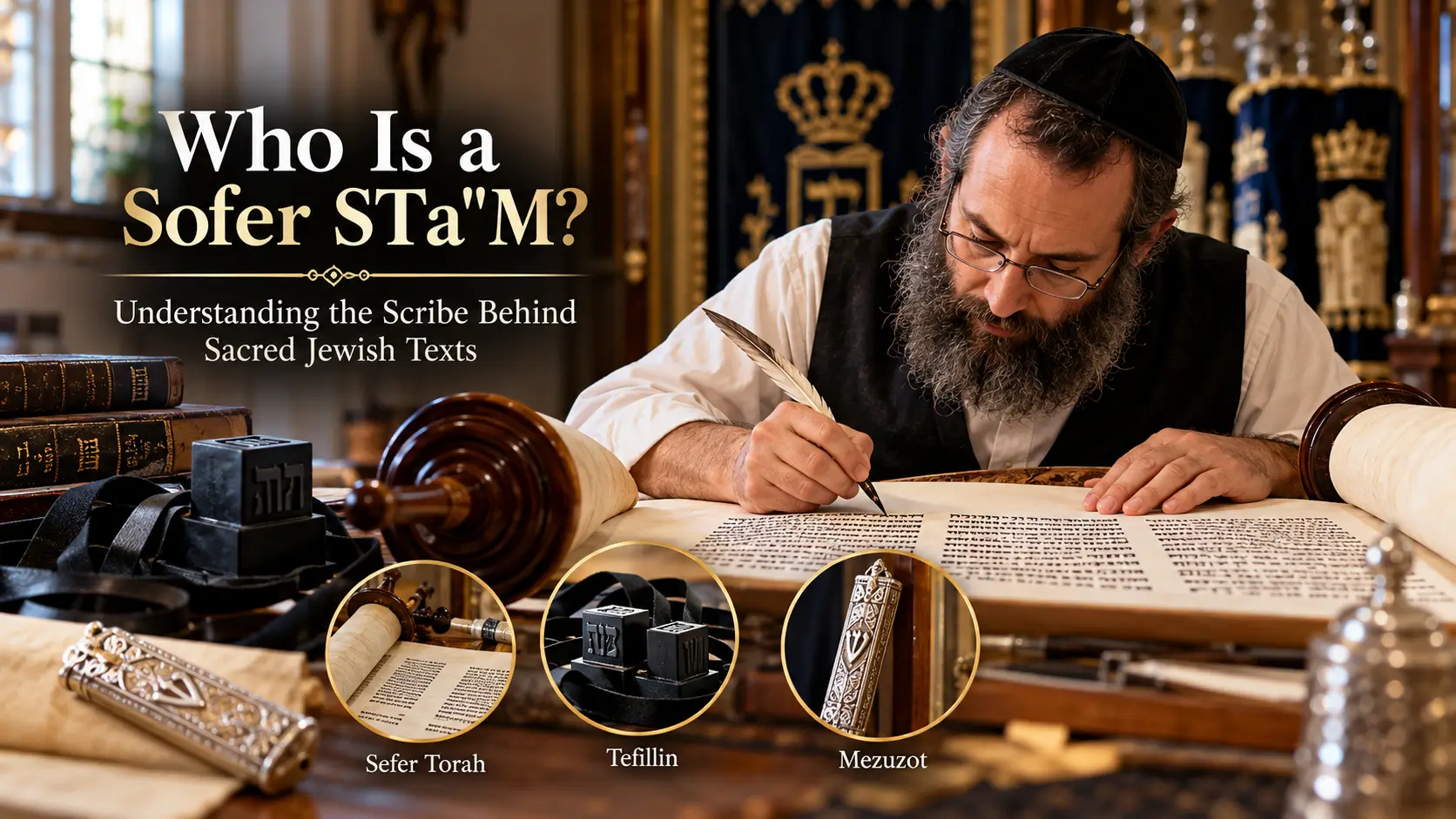
A Sofer STa”M is a trained Jewish scribe who writes sacred Hebrew texts used in Jewish religious life, including Sifrei Torah (Torah scrolls), Tefillin, and Mezuzot. The term STa”M is an abbreviation of Sefer Torah, Tefillin, and Mezuzot—the three principal categories of sacred writings associated with this specialized profession.
The work of a Sofer involves far more than writing Hebrew letters neatly. Each text must be produced according to applicable Halachic requirements, established scribal traditions, and detailed rules governing the parchment, ink, letter forms, and writing process. A mistake may affect the ritual validity of a sacred text, depending on its nature and whether it can be corrected.
Understanding who is a Sofer STa”M helps families, synagogue leaders, and Jewish communities make informed decisions when purchasing or commissioning sacred texts. It also explains why the training, integrity, and ongoing responsibility of the scribe matter so deeply.
What Does STa”M Mean?
STa”M stands for Sefer Torah, Tefillin, and Mezuzot. These sacred objects contain passages from the Torah, but they serve different purposes and have distinct requirements for their preparation.
Sefer Torah
A Sefer Torah is a handwritten Torah scroll used for public Torah reading in the synagogue. It contains the Five Books of Moses and is written on specially prepared parchment using traditional scribal methods.
The writing must follow established rules concerning the form and arrangement of letters, spacing, columns, and other details. The parchment and ink must also meet the applicable requirements.
Tefillin
Tefillin consist of black leather boxes containing parchment passages from the Torah. One set is worn on the arm and the head during weekday morning prayers, according to Jewish law and custom.
The passages inside the boxes are handwritten by a qualified Sofer. Their wording, letter forms, and preparation must comply with the relevant Halachic requirements.
Mezuzot
A Mezuzah scroll contains the Torah passages of Shema Yisrael and Vehayah im shamoa. It is placed in a Mezuzah case and affixed to the doorposts of qualifying entrances in accordance with Halacha.
Although the scroll is physically small, its preparation demands precision. Its letters, spacing, parchment, and writing process are subject to specific requirements.
What Does a Sofer STa”M Actually Do?
A Sofer’s responsibilities extend across several stages of preparation. The precise duties depend on whether the scribe is writing a Sefer Torah, Tefillin, or Mezuzah.
1. Preparing the Writing Materials
Traditional STa”M writing uses klaf, a specially prepared parchment suitable for sacred writing. Its preparation is governed by requirements that differ from those for ordinary paper or commercial printing materials.
The ink must also be suitable for the intended sacred text. Traditional scribal practice uses specialized ink, and its preparation and use are part of the broader discipline of STa”M writing.
A Sofer must understand the materials being used and follow the relevant Halachic requirements. Ordinary calligraphy supplies cannot simply be substituted for the materials required for sacred texts.
2. Writing the Hebrew Letters Correctly
STa”M writing follows traditional letter forms known as ketav. Different communities and scribal traditions may follow distinct accepted forms, including Ashkenazic and Sephardic traditions, as well as particular customs associated with Chabad and other communities.
The shapes of letters are not merely aesthetic choices. Their identifying features and distinctions can affect Halachic validity. A Sofer must therefore learn the relevant letter forms carefully and maintain consistency throughout the text.
The writing also requires attention to spacing, word separation, paragraph structure, and other rules appropriate to the particular text.
3. Following the Requirements of Lishmah
A central concept in the preparation of many STa”M texts is lishmah, meaning that the writing is undertaken with the required sacred intention. The precise application of this requirement depends on the text and the relevant Halachic rules.
A Sofer must understand which intentions are required and when they must be present. This illustrates why STa”M writing cannot be reduced to reproducing a visual pattern: the process includes religious and legal responsibilities alongside technical skill.
4. Checking the Finished Work
A completed text may require careful inspection to identify writing errors, damaged letters, missing elements, or other concerns. The applicable checking process depends on the type of text and the circumstances.
A Sofer should know when an issue can be corrected, when further expert examination is necessary, and when a question must be referred to a competent Halachic authority. Not every apparent flaw has the same consequence, and corrections must follow the rules governing the particular text.
What Training Does a Sofer STa”M Need?
There is no single short course that, by itself, guarantees that someone is qualified to write every type of STa”M. Training generally involves sustained study, supervised practice, and a detailed understanding of the rules applicable to the texts the scribe intends to produce.
Knowledge of Halacha
A Sofer needs to study the relevant Halachic laws governing sacred writing, including the materials, letter forms, writing procedures, and conditions affecting validity.
The requirements are not identical for Sifrei Torah, Tefillin, and Mezuzot. A person experienced in one area should not automatically be assumed to possess the same level of competence in every other area.
Practical Scribal Skill
Learning the theory is only part of the process. A student must develop the control needed to write traditional Hebrew letters accurately and consistently, using the appropriate quill, ink, and parchment.
Supervised practice helps students recognize common mistakes and understand how small differences in letter formation may affect the text.
Guidance and Evaluation
Training under an experienced teacher can help a prospective Sofer develop both technical proficiency and an understanding of the responsibilities associated with sacred writing. Depending on the community and the work undertaken, formal evaluation or certification may also be relevant.
When choosing a scribe, buyers should ask about training and qualifications appropriate to the particular text rather than relying on a general claim of expertise.
Why Is the Work of a Sofer So Important?
The work of a Sofer connects a physical act of writing with the preservation of Jewish religious tradition. Sacred texts are used in prayer, Torah study, synagogue worship, and the observance of mitzvot.
Halachic Precision
A sacred text must satisfy the applicable requirements for its intended use. Correct spelling alone does not establish that a text is valid. Letter formation, materials, writing procedures, and other factors may also matter.
This is why questions about the validity of a Torah scroll, Tefillin, or Mezuzah should be assessed by someone qualified to evaluate that particular text.
Tradition and Continuity
Scribal traditions preserve established forms of Hebrew letters and methods of writing across generations. The work requires familiarity with those traditions and careful attention to the practices followed by the intended community.
Integrity and Responsibility
A Sofer must approach the work with honesty and care. Buyers should be able to ask reasonable questions about the scribe, the text’s preparation, and any relevant inspection or documentation.
Religious seriousness and technical competence complement each other. Neither should be assumed solely from the appearance of a finished product.
How to Choose a Qualified Sofer STa”M
Whether you are purchasing Tefillin for a Bar Mitzvah, obtaining a Mezuzah for your home, or commissioning a Sefer Torah for a synagogue, selecting a suitable source is an important decision.
Consider the following factors:
- Relevant experience: Ask whether the scribe regularly works on the specific type of text you need.
- Training and qualifications: Seek information about the scribe’s teachers, learning, and any relevant evaluation or certification.
- Scribal tradition: Confirm that the text follows the tradition appropriate to your family or community.
- Inspection arrangements: Ask how the text is checked and what documentation, if any, accompanies it.
- Halachic guidance: For questions about validity, repairs, or community-specific requirements, consult a competent Rabbi or Halachic authority.
- Clear communication: A trustworthy provider should explain the product and its documentation honestly without making unsupported guarantees.
Price and appearance alone cannot establish whether a sacred text meets the relevant Halachic requirements. It is worth asking questions before purchasing rather than relying on assumptions after the item arrives.
Understanding STa”M Products at SeferTorah.Net
For families and communities looking for sacred Jewish items, it is important to distinguish between handwritten STa”M texts and the accessories used to protect, carry, or display them.
SeferTorah.Net offers Judaica and synagogue-related products for Jewish homes and communities. Depending on your needs, you can explore the SeferTorah.Net store to discover relevant items and review their individual product details.
If you are preparing for a Bar Mitzvah, you may be looking for Tefillin and their accessories. If you are furnishing a synagogue, you may need Torah ornaments or a Torah pointer (Yad). For a Mezuzah or other sacred item, review the product description carefully and ask for clarification about the materials, contents, and documentation where relevant.
A decorative accessory and a handwritten sacred text serve different purposes. When purchasing a STa”M item, confirm what is included and whether the product information addresses the specific requirements important to your community.
Choosing a reliable source, asking informed questions, and seeking appropriate Halachic guidance can help you make a decision with greater confidence.
Frequently Asked Questions About a Sofer STa”M
1. Who is a Sofer STa”M?
A Sofer STa”M is a Jewish scribe trained to write sacred texts such as Sifrei Torah, Tefillin, and Mezuzot according to the applicable Halachic rules and traditional scribal practices. The work requires specialized knowledge of Hebrew letter forms, parchment, ink, and the procedures governing sacred writing.
2. What does STa”M stand for?
STa”M is an abbreviation for Sefer Torah, Tefillin, and Mezuzot. These are three principal categories of sacred Jewish texts written by trained sofrim. Each has its own requirements, so competence in one category does not automatically establish expertise in all three.
3. Can any Hebrew calligrapher become a Sofer?
Skill in Hebrew calligraphy is useful, but it is not sufficient on its own. A Sofer needs specialized training in the Halachic requirements for sacred writing, including the correct materials, letter forms, procedures, and relevant laws of validity.
4. Does a Sofer need to follow a particular Jewish tradition?
A Sofer must be familiar with the scribal tradition followed for the text being written. Accepted letter forms and community customs may differ. Buyers should confirm that the text is appropriate for their family or community and consult a competent Rabbi when uncertain.
5. How is a Sefer Torah different from Tefillin and a Mezuzah?
A Sefer Torah is a handwritten scroll containing the Five Books of Moses and used for public Torah reading. Tefillin contain specified Torah passages in leather boxes worn during weekday prayers. A Mezuzah scroll contains two Torah passages and is affixed to qualifying doorposts. Their materials, formats, uses, and detailed Halachic requirements differ.
6. How can I tell whether a Sofer is qualified?
Ask about relevant training, experience with the particular text, the scribal tradition followed, and any applicable qualifications or inspection documentation. For important questions about Halachic status, seek guidance from a trusted Rabbi or qualified examiner rather than relying on appearance or marketing claims alone.
7. Can a Sofer repair a Torah scroll, Tefillin, or Mezuzah?
Some problems can be corrected, but not every defect is repairable in every circumstance. The answer depends on the type of text, the nature and location of the problem, and the applicable Halachic rules. A qualified Sofer or examiner should assess the issue, and a competent Halachic authority may need to be consulted.
8. Why does lishmah matter in STa”M writing?
Lishmah refers to performing the writing with the required sacred intention. Its application depends on the type of text and the relevant Halachic requirements. It reflects the principle that preparing a sacred text involves more than technical accuracy; the prescribed intention and process may also be essential.
9. Should Tefillin and Mezuzot be checked after purchase?
Follow the applicable Halachic guidance for inspection and maintenance. The appropriate schedule can depend on the item, its use, storage conditions, and the relevant rulings. If a text has been exposed to moisture, damaged, or stored in unsuitable conditions, seek advice from a qualified Sofer or examiner rather than waiting for the next routine check.
10. What should I consider when purchasing STa”M products online?
Confirm exactly what is included, the product’s intended use, the relevant scribal tradition, and what information is available about the text’s preparation and inspection. Read the product description carefully and ask questions when details are unclear. For Halachic decisions, consult a trusted Rabbi who understands your community’s requirements.
Conclusion
A Sofer STa”M plays a vital role in preserving the tradition of Jewish sacred writing. The profession combines practical scribal skill, detailed Halachic knowledge, familiarity with established letter forms, and responsibility for preparing texts intended for religious use.
Understanding who a Sofer is—and what the work requires—helps families, synagogue leaders, and Jewish communities ask better questions when purchasing or commissioning a Sefer Torah, Tefillin, or Mezuzah. By considering relevant training, scribal tradition, inspection, and trustworthy guidance, buyers can make more informed decisions.
Sacred writing is not simply a matter of producing attractive Hebrew lettering. It is a specialized discipline in which precision, tradition, and religious responsibility work together.