


Essential Torah Accessories Every Synagogue Needs

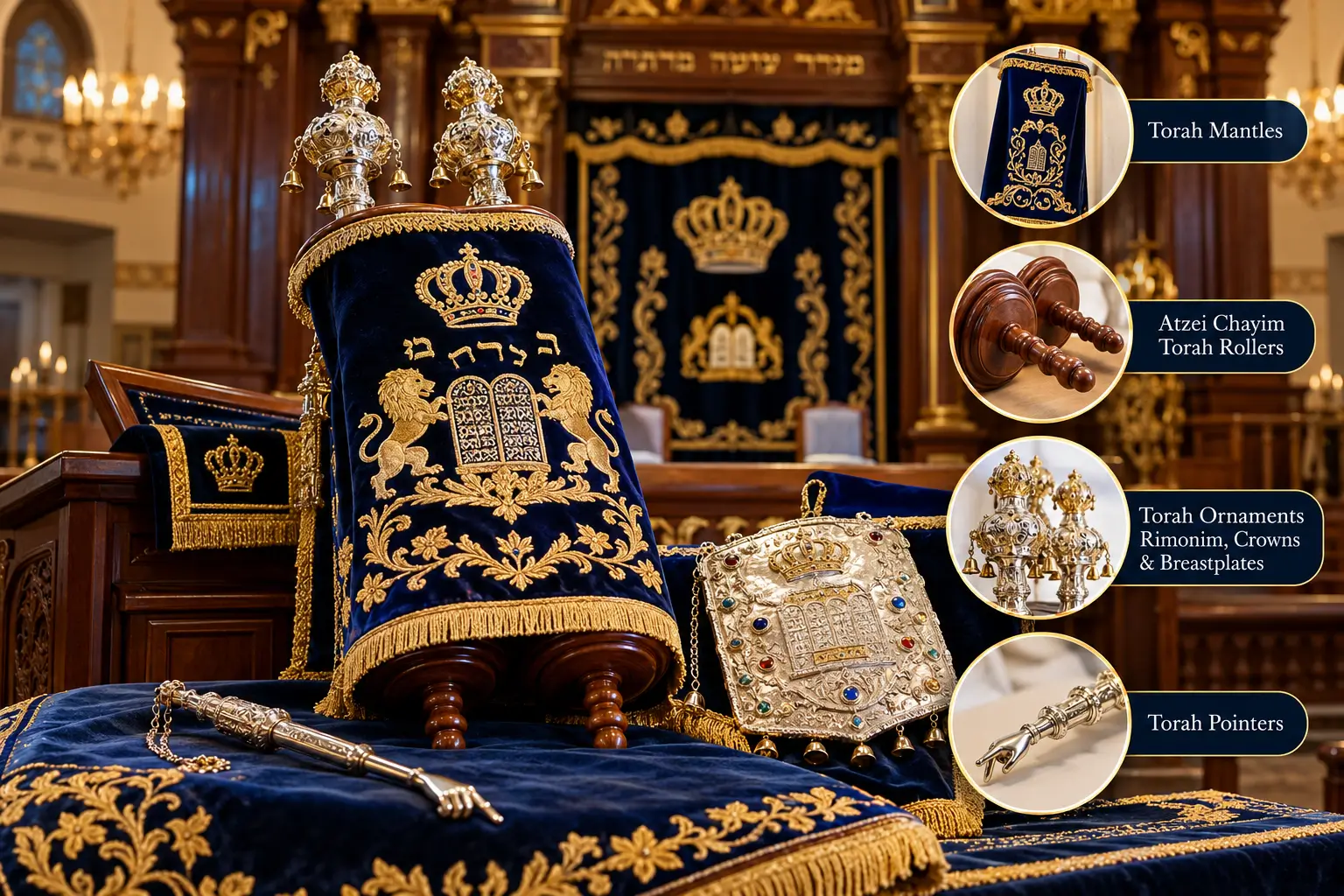
A Sefer Torah is the spiritual center of the synagogue, and the accessories surrounding it play an important role in preserving its condition and honoring its place in Jewish worship. From the coverings that protect the scroll to the ornaments used during synagogue services, each item serves a practical, traditional, or ceremonial purpose.
Choosing essential Torah accessories every synagogue needs requires more than selecting items that look appropriate. Synagogue leaders must consider the community’s minhag, the design of the Torah scroll and its case, the frequency of use, storage conditions, and the traditions followed during public Torah reading.
This guide explains the principal Torah accessories, their functions, and the considerations that synagogue committees, rabbis, and congregational leaders should keep in mind when purchasing them.
1. Torah Mantles: Protecting and Honoring the Sefer Torah
A Torah mantle is a textile covering used to protect and adorn a Sefer Torah. In communities that use an upright Torah case, the covering may differ from the mantle used with a scroll held by wooden rollers. The appropriate design depends on the community’s established practice and the physical form of its Torah scroll.
Beyond its decorative role, a mantle helps protect the scroll from dust and incidental contact. It also contributes to the visual dignity of the Torah during its handling and presentation in the synagogue.
Choosing the Right Torah Mantle
When selecting a mantle, consider:
- Fit: The dimensions must accommodate the Torah scroll or its rollers without excessive tightness or looseness.
- Material: The fabric should be suitable for regular handling and storage.
- Embroidery: Hebrew inscriptions, dedication names, and decorative motifs should be accurate and appropriate.
- Occasion: Some congregations use different coverings for Shabbat, festivals, or the High Holidays.
- Community custom: Ashkenazic, Sephardic, and other communities may follow different conventions based on their Torah cases and local traditions.
Synagogues commissioning a new mantle should verify measurements and spelling before production, particularly when the item includes a donor’s name or a memorial dedication.
Explore Torah Mantles to compare traditional, modern, hand-embroidered, and High Holiday designs.
2. Atzei Chayim: The Wooden Rollers of the Torah Scroll
Atzei Chayim are the wooden rollers attached to a Torah scroll. The parchment is wound around these rollers, allowing the reader to move between columns during the public reading. The rollers also provide a practical means of handling the scroll without unnecessary contact with the parchment.
Their dimensions, construction, and condition matter because they directly affect how the scroll opens, closes, and rests when handled.
What Synagogues Should Consider
Before purchasing or replacing Torah rollers, confirm the measurements of the existing Sefer Torah and its intended accessories. The roller length, diameter, spacing, and compatibility with the scroll’s mantle or case should be checked rather than assumed.
Inspect existing rollers periodically for looseness, damage, splintering, or other defects that could interfere with safe handling. Any work involving the scroll itself should be coordinated with a qualified sofer or an experienced professional familiar with Torah scroll care.
Different finishes and wood types may suit different synagogue settings, but appearance should not take priority over fit, stability, and appropriate handling.
See Atzei Chayim Torah Rollers for options suited to the physical requirements of your Sefer Torah.
3. Torah Ornaments: Rimonim, Crowns, and Breastplates
Torah ornaments express kavod haTorah—the honor accorded to the Torah. Their designs vary across Jewish communities, reflecting different artistic traditions, materials, and synagogue customs.
Three widely recognized forms are rimonim, Torah crowns, and Torah breastplates. Their suitability depends partly on how the Sefer Torah is constructed and dressed.
Rimonim
Rimonim are decorative ornaments traditionally placed on the upper ends of the wooden rollers of a Torah scroll. They may be made from silver or other materials and can feature bells, engraved patterns, or symbolic designs. Their form and use vary according to communal custom and the type of Torah case.
When selecting rimonim, confirm that the mounting arrangement and dimensions match the rollers. An ornament that is too heavy, unstable, or poorly fitted may complicate handling.
Torah Crowns
A Torah crown is an ornament that represents the Torah’s dignity and central place in Jewish life. Depending on the community’s tradition, it may be fitted over the upper part of the scroll’s rollers or incorporated into a different style of Torah case.
A synagogue should consider the crown’s dimensions, weight, stability, and compatibility with the existing Torah accessories before purchasing one.
Torah Breastplates
A Torah breastplate, often called a hoshen in Judaica contexts, is a decorative front ornament used with certain Torah scroll arrangements. Designs may incorporate Hebrew inscriptions, symbolic motifs, precious metals, or engraved dedication details.
Not every community uses a breastplate in the same way. Before commissioning one, establish whether the design is suitable for the synagogue’s particular Torah case or scroll arrangement.
For communities seeking coordinated ceremonial pieces, Torah Ornaments provides a relevant category to explore.
4. Torah Pointers (Yad): Supporting the Reading
A yad, the Hebrew word for “hand,” is a pointer used to follow the text during public Torah reading. Many traditional pointers feature a hand-shaped tip, often with an extended shaft and a chain or attachment for hanging.
The pointer allows the reader to follow the text without placing a finger directly on the parchment. This is especially practical because Torah parchment requires careful handling and should not be treated like an ordinary printed book.
Selecting a Torah Pointer
When choosing a yad, consider the following:
- Length and reach: The pointer should be comfortable for the reader to use across the width of the scroll.
- Weight and balance: A well-balanced design can be easier to control during extended readings.
- Tip design: The tip should allow precise tracking without catching on the parchment.
- Material: Silver, nickel, and other finishes offer different appearances and maintenance requirements.
- Attachment: A chain or hanging attachment should be suitable for the synagogue’s storage arrangements.
Torah pointers can also serve as meaningful dedication gifts. An engraved inscription or donor dedication may commemorate a family milestone or honor a loved one, provided the wording and placement are reviewed before production.
Browse Torah Pointers to explore designs ranging from traditional metalwork to ornate and contemporary styles.
5. Bima Covers and Parochets: Completing the Synagogue Setting
Torah accessories are not limited to the items attached to the scroll. The furnishings and coverings around the reading platform and Holy Ark also contribute to the synagogue’s ceremonial setting.
A bima cover protects and decorates the surface used for Torah reading. Its dimensions should suit the reading table, allowing sufficient coverage without interfering with the placement or handling of the Sefer Torah.
A parochet is the curtain covering the Holy Ark in many synagogues. Its design may reflect the congregation’s tradition, architectural setting, and dedication history. Some communities maintain special parochets for the High Holidays or other significant occasions.
When selecting either item, measure the intended space carefully and consider fabric durability, cleaning requirements, embroidery, and the practical demands of regular synagogue use.
These coverings should complement the Torah accessories without obstructing access, creating handling difficulties, or introducing unnecessary clutter around the reading area.
6. How to Build a Practical Torah Accessory Collection
Synagogues do not necessarily need to purchase every decorative accessory at once. A sensible purchasing plan begins with the items required for the congregation’s existing Torah scrolls and customary services.
Start With the Existing Torah Scroll
Identify whether the congregation uses a scroll with wooden rollers and a mantle or a Torah housed in an upright case. This distinction affects which accessories are appropriate. Record the relevant measurements before ordering any fitted item.
Review Condition and Compatibility
Inspect existing accessories for damage, poor fit, unstable attachments, worn fabric, or other issues that could affect safe handling. Where a question concerns the condition or handling of the parchment, consult a qualified sofer rather than attempting repairs independently.
Establish the Community’s Custom
Consult the rabbi or the person responsible for synagogue ritual practice before choosing ornaments or commissioning a new ceremonial set. The goal is to respect the congregation’s minhag while meeting its practical needs.
Plan for Maintenance
Textiles may require careful cleaning, while metal ornaments may need appropriate storage and maintenance. Avoid harsh cleaning agents or improvised repairs, particularly when an item is attached to or used with a Torah scroll.
A simple inventory can record each accessory, its dimensions, condition, storage location, and maintenance history. This helps synagogue committees budget responsibly and identify replacements before an item becomes unsuitable for use.
7. Finding Torah Accessories at SeferTorah.Net
SeferTorah.Net offers synagogue-related Judaica categories that can help congregations research accessories for Torah scrolls and ceremonial settings. When planning a purchase, begin by identifying the item’s intended function, the dimensions of the existing scroll or case, and the community’s customary practice.
Explore the Torah accessory categories relevant to your needs:
- Torah Mantles for protective coverings and ceremonial presentation.
- Atzei Chayim Torah Rollers for compatible wooden rollers.
- Torah Ornaments for rimonim, crowns, and breastplates.
- Torah Pointers for yads used during public Torah reading.
Before ordering a fitted accessory or commissioning a coordinated set, confirm measurements, material specifications, and compatibility with your existing Torah scroll or case. For custom pieces or unusual dimensions, requesting guidance before purchasing can help prevent costly sizing errors.
For synagogue committees preparing a dedication, renovating a reading area, or replacing worn accessories, planning the purchase as a coordinated project can also help maintain a consistent appearance while respecting established community traditions.
Frequently Asked Questions
1. What are the essential Torah accessories for a synagogue?
The essential items depend on the Torah scroll’s construction and the congregation’s minhag. Common accessories include a suitable mantle or case, compatible rollers where applicable, a yad for reading, and appropriate ornaments. Bima covers and parochets serve the surrounding ceremonial setting.
2. Does every synagogue need Torah crowns and rimonim?
No. Their use and form depend on the Torah’s construction and the community’s custom. Some communities use rimonim on the rollers, while others use a crown or ornaments designed for a different Torah case. Consult the rabbi before purchasing.
3. What is the purpose of a Torah pointer?
A yad helps the reader follow the text during public Torah reading while avoiding direct finger contact with the parchment. It is a practical reading aid and a traditional accessory.
4. How do I choose the correct Torah mantle size?
Measure the existing scroll and rollers carefully, taking the design of the mantle into account. Do not rely solely on a general size label. If the scroll uses a rigid case, confirm whether a mantle is appropriate for that arrangement.
5. What should a synagogue consider before buying Torah ornaments?
Consider compatibility, dimensions, weight, attachment method, material, maintenance, and communal custom. Ornaments should be stable and suitable for the Torah’s particular construction.
6. Can Torah accessories be purchased as dedication gifts?
Yes. A yad, mantle, rollers, or ornaments may be dedicated in honor or memory of an individual or family. Review inscriptions, Hebrew spelling, measurements, and the intended use before approving a commissioned item.
7. How should Torah accessories be maintained?
Follow care instructions appropriate to the material. Store metal ornaments securely, keep textiles clean and dry, and inspect fittings periodically. Avoid abrasive cleaning methods and consult a qualified professional if an accessory may affect the safe handling of the scroll.
8. Should all Torah accessories match?
A coordinated appearance can be desirable, but exact matching is not essential in every community. Compatibility, appropriate use, and respect for minhag should take priority over matching finishes or decorative patterns.
9. Who should approve accessories for synagogue use?
The rabbi or another person responsible for the congregation’s ritual standards should approve choices involving communal custom. A qualified sofer or experienced supplier can help with technical questions about measurements, fittings, and handling.
Conclusion
Choosing essential Torah accessories every synagogue needs is a matter of balancing practical requirements, established Jewish custom, and kavod haTorah. Mantles, rollers, pointers, and ornaments each serve distinct purposes, while bima covers and parochets contribute to the setting in which the Sefer Torah is read and honored.
A thoughtful selection process begins with the existing scroll, accurate measurements, and consultation with the appropriate synagogue authorities. By prioritizing compatibility, careful maintenance, and the congregation’s minhag, synagogue leaders can make informed purchases that serve their community for years to come.
Explore the relevant Torah accessory categories at SeferTorah.Net to compare available options and identify items suited to your synagogue’s needs.