


Israeli Judaica vs Imported Judaica: What Should You Know Before Buying?

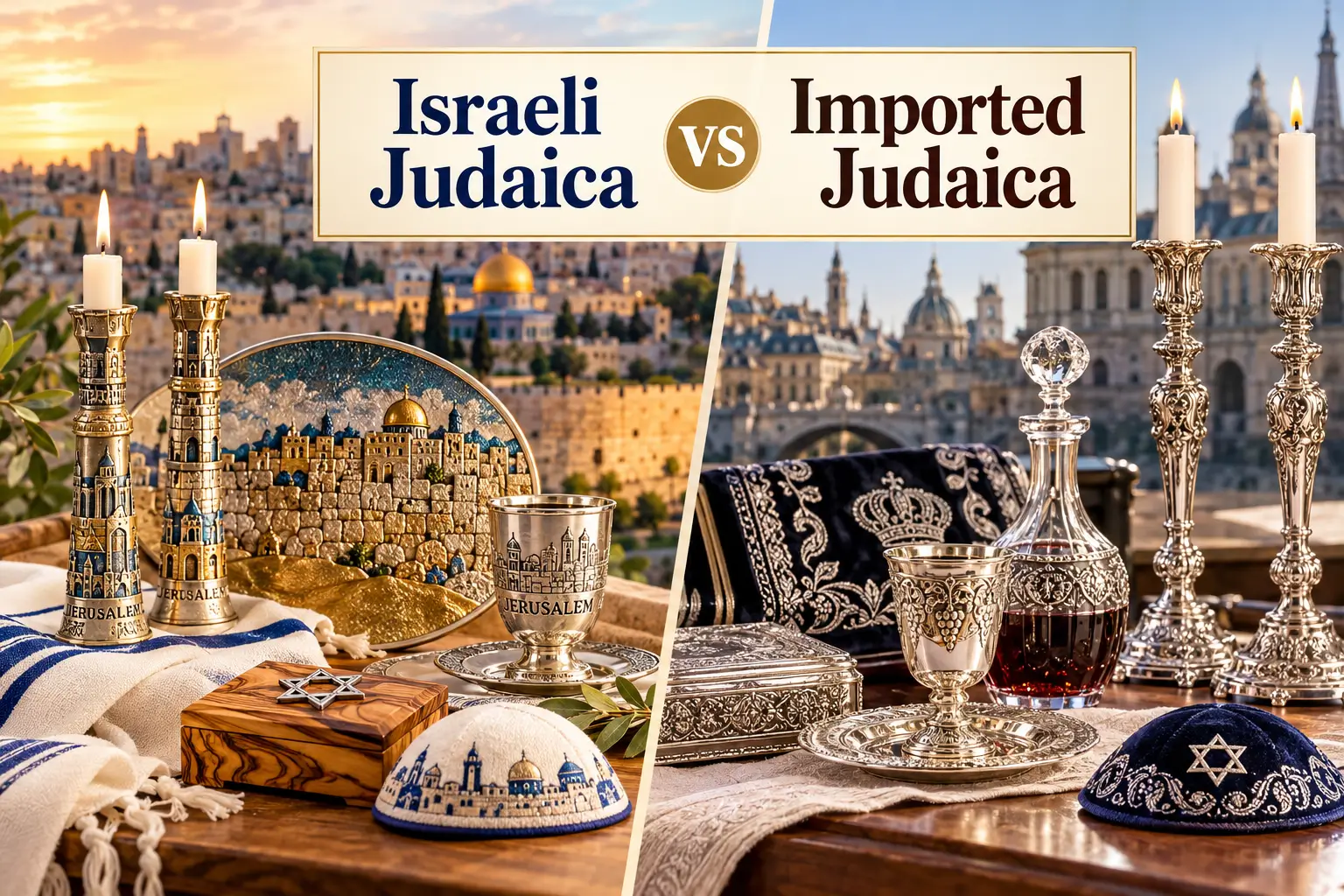
Israeli Judaica vs Imported Judaica. Judaica connects Jewish life with tradition, mitzvot, family customs, and the rhythm of the Jewish calendar. From Shabbat candlesticks and Kiddush cups to ceremonial objects used in the synagogue, these items can carry religious, historical, artistic, and personal significance. When shopping for them, buyers often encounter a fundamental question: should they choose Israeli Judaica or imported Judaica?
The comparison is not simply about where an item was manufactured. Israeli Judaica may reflect local artistic traditions, contemporary Israeli design, or established metalworking practices. Imported Judaica can include objects made by skilled artisans in Europe, North America, and other countries with longstanding Jewish communities and decorative traditions.
Understanding the differences helps buyers evaluate craftsmanship, materials, cultural influences, intended use, and price. Whether you are furnishing a Jewish home, selecting a wedding gift, preparing for a Bar or Bat Mitzvah, or purchasing ceremonial objects for a synagogue, the best choice depends on what you need and what matters most to you.
What Is Israeli Judaica?
Israeli Judaica refers to Jewish ritual objects, ceremonial items, and Jewish-themed decorative pieces manufactured in Israel. The category includes traditional objects as well as contemporary interpretations designed for modern Jewish homes and communal spaces.
Israeli artisans work with a range of materials, including silver, brass, wood, glass, ceramics, textiles, and other metals. Some specialize in traditional forms, while others combine familiar Jewish symbols with contemporary design.
The appeal of Israeli Judaica can extend beyond appearance. For some buyers, purchasing an object made in Israel creates a meaningful connection to the land, its artistic communities, and Jewish cultural life. For others, the attraction lies in a particular design, maker, material, or manufacturing method.
However, the label “Made in Israel” does not automatically establish an item’s religious suitability, durability, or artistic merit. These qualities depend on the individual product and how it is made.
What Is Imported Judaica?
Imported Judaica includes Jewish ritual and decorative objects manufactured outside Israel. Depending on the product, the country of origin may be the United States, the United Kingdom, Italy, Germany, or another manufacturing center.
Jewish communities throughout the diaspora have developed distinctive artistic traditions. European silversmithing, American Judaica design, and the craftsmanship of individual family workshops have all contributed to the variety of objects available today.
Imported Judaica may feature classical European ornamentation, restrained contemporary styling, elaborate engraving, or designs inspired by the customs of particular Jewish communities.
The term itself is broad. An imported item might be handmade by a specialist artisan, produced in a small workshop, or manufactured in a large factory. Its country of origin alone does not tell buyers which process was used.
For this reason, a meaningful comparison considers the maker, materials, workmanship, and intended use rather than treating all imported products as one category.
Israeli Judaica vs Imported Judaica: The Main Differences
The practical differences become clearer when buyers evaluate specific characteristics.
1. Design and artistic tradition
Israeli Judaica often includes contemporary interpretations of Jewish symbols alongside traditional designs. Some pieces draw inspiration from Jerusalem, biblical imagery, Hebrew lettering, or regional artistic influences.
Imported Judaica may reflect the visual traditions of diaspora communities, including European decorative arts, established silversmithing styles, or modern designs developed for Jewish households abroad.
Neither approach is inherently better. A buyer seeking a contemporary aesthetic may appreciate a minimalist Israeli design, while someone furnishing a traditional Shabbat table may prefer an ornate piece made by a European artisan.
The important question is whether the design suits the occasion, the household’s customs, and the intended setting.
2. Materials and construction
Material quality should be assessed independently of country of origin.
For metal Judaica, buyers should determine whether an item is sterling silver, silver-plated metal, brass, nickel, or another material. These are not interchangeable. Sterling silver, for example, is an alloy containing 92.5% silver, whereas silver plating refers to a surface layer of silver over a different underlying material.
For glass and ceramic objects, examine the finish, stability, thickness, and susceptibility to chipping. For textiles, consider the fabric, stitching, lining, and care requirements.
Construction also matters. Check joints, handles, hinges, bases, engraved details, and other areas subject to repeated handling.
An Israeli-made object can be carefully constructed, and an imported object can be equally well made. The reverse is also possible. Product specifications and workmanship provide more useful evidence than a national label alone.
3. Handcrafted versus mass-produced items
Handcrafted Judaica may show small variations in engraving, shaping, texture, or finish. These variations can be part of the character of a handmade object, although craftsmanship should still meet reasonable standards.
Machine production can offer consistent dimensions, repeatable designs, and more predictable pricing. It does not necessarily mean that an item lacks artistic value or durability.
Both Israeli and imported Judaica can be handmade or machine-produced. Buyers who specifically want handcrafted work should ask who made the item, which processes were used, and whether the maker’s description can be verified.
4. Price and long-term value
Price differences may reflect raw materials, labor costs, production scale, design complexity, finishing, packaging, distribution, and retailer margins.
An item made in Israel is not necessarily more expensive than an imported alternative, and an imported object is not automatically less expensive. A detailed comparison should use products of similar size, material, construction, and design.
Consider long-term value as well. A well-made ritual object that suits your needs and can be maintained appropriately may provide years of use. For silver pieces, understand the cleaning requirements; for delicate materials, check storage and handling recommendations.
Collectors may also care about the maker’s identity, documented provenance, or the history of a particular design. These factors should be supported by credible documentation rather than assumed from appearance.
Does Country of Origin Affect Halachic Suitability?
One of the most important distinctions in choosing Judaica is the difference between decorative craftsmanship and halachic requirements.
For many decorative ritual objects, country of manufacture is not the central religious consideration. A Kiddush cup, for example, should be suitable for its intended use, stable, and appropriately constructed. Its place of manufacture does not by itself determine whether it is suitable for Kiddush.
Other objects have specific halachic requirements that demand closer attention. A Mezuzah scroll or Tefillin cannot be evaluated by exterior appearance alone. Their status depends on matters such as the parchment, writing, prescribed forms, and the relevant laws governing their preparation and inspection.
A decorative case does not make a non-kosher scroll kosher. Similarly, an attractive ceremonial object should not be confused with a ritual item whose validity depends on specialized religious standards.
When purchasing STa”M items, including Mezuzah scrolls, Tefillin, or a Sefer Torah, buyers should seek appropriate documentation and guidance from a qualified Sofer STa”M or competent halachic authority. The applicable requirements depend on the item and the circumstances.
The principle of hidur mitzvah—beautifying a mitzvah—also helps explain why appearance matters to many Jewish buyers. However, beauty complements the requirements of a mitzvah; it does not replace them.
How to Choose Judaica for Your Home or Synagogue
A practical purchasing decision begins with the item’s intended purpose.
For Shabbat and Jewish holidays
Consider the objects you will use regularly, such as candlesticks, Kiddush cups, challah accessories, and Havdalah sets. Choose designs that suit your household’s customs, available space, cleaning preferences, and frequency of use.
Explore the [Candlesticks] category when comparing options for Shabbat lighting, and review product details carefully before deciding between different materials and finishes.
For weddings and meaningful gifts
Judaica gifts often commemorate weddings, Bar or Bat Mitzvah celebrations, housewarmings, and other important occasions. The recipient’s customs, personal taste, and practical needs should guide the choice.
A useful gift is one the recipient can comfortably incorporate into Jewish life. Engraving, presentation, and design may add personal significance, but buyers should verify personalization options and delivery times before ordering.
For a synagogue or communal setting
Synagogue purchases may require greater attention to durability, dimensions, consistency, and maintenance. Objects used regularly by a congregation should withstand repeated handling and suit the synagogue’s existing ceremonial furnishings.
For ceremonial items, examine the construction and the way the object will be used during services. If you are selecting Torah ornaments, compare the design, dimensions, attachment method, and compatibility with the congregation’s Torah furnishings. The [Torah Ornaments] category is a useful starting point for reviewing relevant options.
Explore Judaica at SeferTorah.Net
Choosing Judaica is an opportunity to bring Jewish tradition into daily life through objects selected with care. Rather than choosing exclusively by country of origin, consider the combination of design, materials, construction, intended use, and personal meaning.
At SeferTorah.Net, buyers can explore Judaica for Jewish homes, celebrations, and communal settings. The [Judaica] category provides a starting point for comparing relevant ritual and ceremonial items, while [Kiddush Cups] offers options to consider for Shabbat and holiday use.
Before purchasing, review the product description, material specifications, dimensions, care instructions, and any available information about the maker. For objects with specific halachic requirements, seek qualified guidance where appropriate.
This approach helps you select an item for the qualities that matter to you—not merely because it was manufactured in Israel or imported from elsewhere.
Frequently Asked Questions
1. Is Israeli Judaica better than imported Judaica?
Not necessarily. Israeli and imported Judaica both include carefully made, artistic, durable objects as well as products of varying construction and finish. Compare the specific item’s materials, workmanship, maker, intended use, and price rather than relying on country of origin alone.
2. What makes Israeli Judaica distinctive?
Some Israeli Judaica reflects contemporary Israeli design, local artistic influences, Hebrew lettering, or imagery associated with Jewish history and the land of Israel. However, designs vary considerably between makers, so buyers should assess individual pieces rather than assume every Israeli-made item shares the same style.
3. Is imported Judaica less expensive?
It depends on the product. Materials, labor, manufacturing scale, design complexity, distribution, and retailer pricing can all affect cost. Compare items with similar specifications to determine whether a price difference represents a meaningful difference in materials or craftsmanship.
4. How can I identify genuine Israeli-made Judaica?
Check the product listing for a clear statement of country of manufacture. Look for maker information, manufacturer details, or other supporting documentation where available. Do not assume that an Israeli-themed design, Hebrew inscription, or seller’s location proves that an item was manufactured in Israel.
5. Does country of origin affect whether Judaica is kosher?
Country of origin alone does not determine halachic validity. Some objects are primarily decorative or functional, while others—such as Tefillin, Mezuzah scrolls, and a Sefer Torah—must meet specific religious requirements. Consult a qualified Sofer or competent halachic authority for items whose validity depends on specialized laws.
6. Is handmade Judaica always better than machine-made Judaica?
No. Handmade production may provide distinctive details and individual craftsmanship, while machine production can provide consistency and precise repetition. Evaluate the actual finish, materials, construction, maker, and suitability for the intended use.
7. What materials should I consider when buying Judaica?
Common materials include sterling silver, silver-plated metal, brass, glass, ceramics, wood, and textiles. Each has different characteristics, costs, and maintenance needs. Verify the material description instead of relying on appearance, especially when comparing solid silver with silver-plated alternatives.
8. What should I consider when buying Judaica for a synagogue?
Consider dimensions, durability, ease of maintenance, compatibility with existing furnishings, and the customs of the congregation. For Torah ornaments and other ceremonial objects, check that the design and fittings suit the intended use. Ask the relevant synagogue leadership or religious authority when requirements are unclear.
9. Is Israeli Judaica a meaningful wedding or Bar Mitzvah gift?
It can be, particularly for recipients who value a connection to Israel or appreciate a particular Israeli artist or design. However, imported Judaica can be equally meaningful. Choose an object that reflects the recipient’s customs, preferences, and intended use.
10. Where can I buy Judaica for Shabbat, holidays, and synagogue use?
SeferTorah.Net offers categories covering Judaica and ceremonial objects. Review the relevant product descriptions, materials, dimensions, and care requirements before purchasing. For ritual items with specific halachic requirements, verify their status and seek qualified guidance when necessary.
Conclusion
The choice between Israeli Judaica and imported Judaica is best approached as a comparison of individual products, not national labels. Israeli-made pieces may appeal through their design influences or connection to Israel, while imported objects may reflect the artistic heritage of Jewish communities around the world.
In either case, thoughtful buyers look beyond appearance and price. They consider materials, workmanship, practical use, maintenance, provenance, and—where applicable—halachic requirements.
For Shabbat, holidays, celebrations, and synagogue life, the most suitable Judaica is the object that meets the intended purpose, respects the relevant traditions, and offers lasting meaning to the people who use it. Explore the Judaica selections at SeferTorah.Net to compare available options and make an informed choice.