


What Are Torah Rimonim? A Guide to Their Meaning and Use

What Are Torah Rimonim?
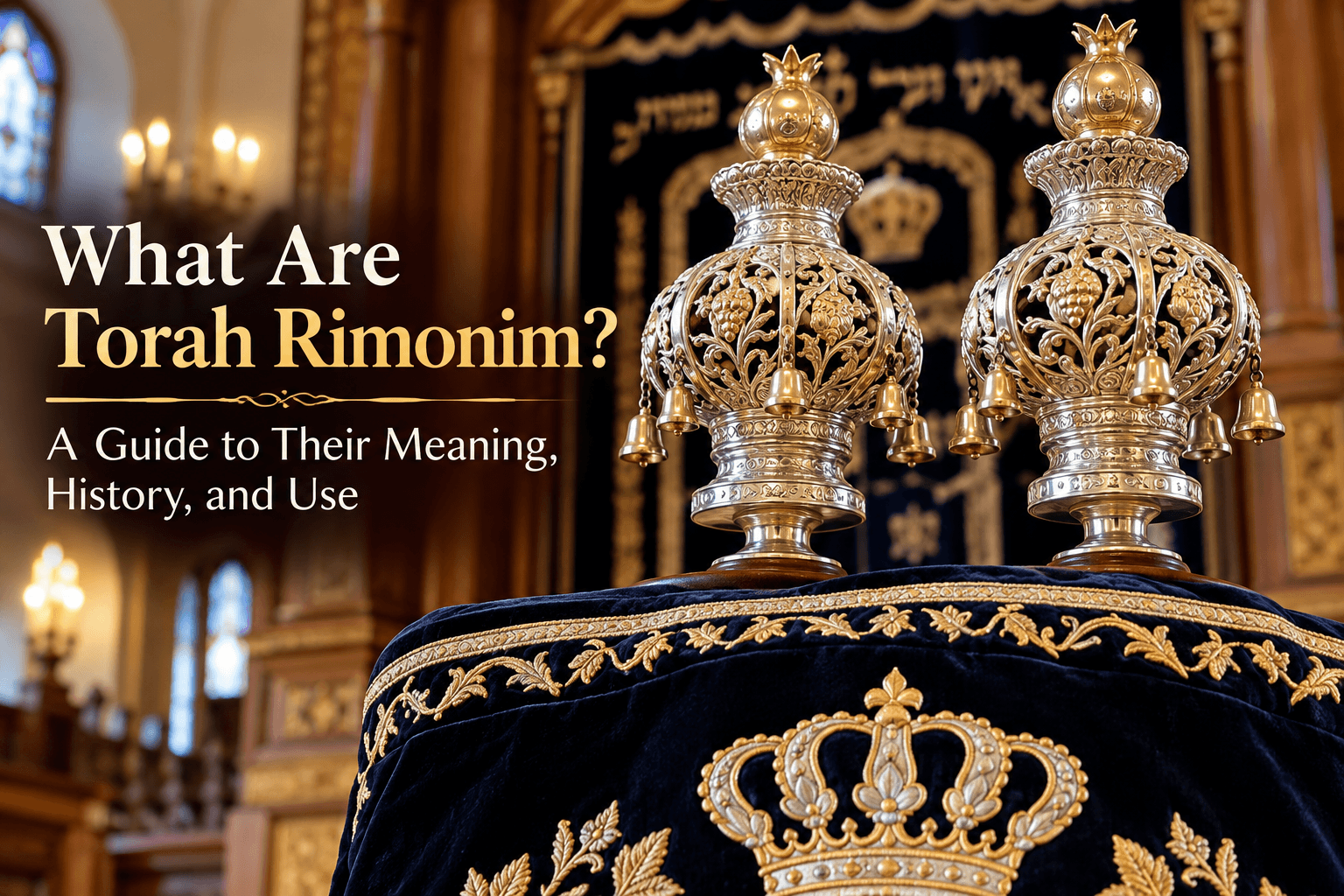
Torah Rimonim are decorative finials placed on the upper ends of the Atzei Chayim, the wooden rollers of a Sefer Torah. They are among the traditional ornaments used to honor and beautify the Torah scroll and are especially prominent in Ashkenazic synagogue practice.
For someone encountering them for the first time, the name can be confusing. Rimonim literally means “pomegranates,” referring to the traditional form of the ornament. While their appearance varies considerably—from simple metal finials to elaborate silver pieces—their purpose is connected to kavod haTorah and the principle of Hidur Mitzvah, beautifying a mitzvah.
Understanding what Rimonim are also requires understanding where they fit within the broader system of Torah ornaments. A synagogue may use Rimonim together with a Torah Crown, Torah Breastplate, Torah Mantle, and Torah Pointer, but each has its own place and function.
What Are Torah Rimonim and Where Are They Placed?
Torah Rimonim are fitted over the upper ends of the two Atzei Chayim. When the Sefer Torah is rolled closed and standing upright, the Rimonim are visible above the Torah mantle or other covering.
The two finials are normally designed as a matching pair. Their construction allows them to sit securely on the upper ends of the wooden rollers while providing a decorative finish to the Torah.
The term “pomegranate” comes from the traditional shape associated with these ornaments. Historical Jewish ritual art contains numerous interpretations of this form, although modern Rimonim can incorporate many additional artistic elements.
Their exact design may reflect:
- Regional Jewish traditions
- Community customs
- Historical artistic styles
- Materials available to the craftsman
- The preferences of a synagogue or donor
This is why there is no single universal appearance for Torah Rimonim.
The Meaning of Rimonim in Jewish Tradition
The pomegranate has a long-standing place in Jewish symbolism. It appears in the description of the garments of the Kohen Gadol, where pomegranate-shaped ornaments were attached to the hem of the robe.
The familiar imagery of pomegranates therefore became associated with Jewish religious art and ritual objects.
However, it is important to distinguish symbolism from Halachic requirement. The decorative form of a particular pair of Rimonim should not automatically be treated as a specific Halachic requirement.
Their principal role is connected with honoring the Sefer Torah and enhancing its presentation.
This is an important distinction when discussing sacred Judaica: not every artistic feature has the status of a Halachic requirement. Some elements arise from longstanding Jewish tradition, minhag, symbolism, or the general principle of honoring a mitzvah.
Rimonim and Hidur Mitzvah
The concept of Hidur Mitzvah refers broadly to beautifying the performance of a mitzvah.
With sacred objects, communities have traditionally expressed kavod through careful craftsmanship, appropriate materials, and dignified presentation. Torah Rimonim are one expression of this tradition.
The purpose is not simply decoration for its own sake. The Sefer Torah occupies a uniquely honored position in Jewish communal life, and its surroundings are therefore treated with corresponding respect.
For this reason, Rimonim may be made from materials such as:
- Silver
- Gold-plated or gold-finished metal
- Nickel or other decorative metals
- Other carefully worked materials
The choice of material and design can vary according to the community, budget, artistic tradition, and intended use.
How Are Torah Rimonim Used in a Synagogue?
In many synagogues, the Torah is removed from the Aron Kodesh and carried to the Bimah for reading. The Sefer Torah is generally kept covered when it is not being read, while the Rimonim remain visible above the covering.
Their practical function is connected to the Atzei Chayim and the completed presentation of the Torah scroll.
Because the Rimonim remain attached to the rollers, they should be appropriately sized and constructed for the particular Sefer Torah with which they will be used.
This is particularly important when purchasing Rimonim for an existing Torah.
A beautiful pair that does not fit the Atzei Chayim properly is not necessarily a practical choice.
Rimonim vs. Other Torah Ornaments
Torah Rimonim are sometimes confused with other Torah ornaments. Each serves a different role.
Rimonim vs. Torah Crown
A Torah Crown is placed above the Sefer Torah and represents a crown of Torah. Rimonim, by contrast, are fitted directly over the upper ends of the Atzei Chayim.
Rimonim vs. Torah Breastplate
A Torah Breastplate, or Hoshen, hangs on the front of the Torah mantle in communities where this tradition is followed. It is separate from the Rimonim.
Rimonim vs. Torah Pointer
A Torah Pointer (Yad) is a handheld instrument used by the reader to follow the text of the Torah without touching the parchment directly.
Rimonim vs. Torah Mantle
A Torah Mantle is the fabric covering placed over the Torah scroll. The Rimonim remain associated with the upper ends of the rollers and are generally visible above the mantle.
These objects can be coordinated aesthetically, but they should not be treated as interchangeable categories.
Different Styles of Torah Rimonim
There is considerable variation in the design of Rimonim.
Traditional examples may feature rounded or pomegranate-inspired forms, while more elaborate pieces can include:
- Filigree
- Engraving
- Hand chasing
- Floral motifs
- Crowns
- Hebrew inscriptions
- Gemstones
- Architectural motifs
- Community or donor inscriptions
Some pairs are deliberately restrained, while others are highly ornate.
The appropriate choice depends largely on the synagogue’s existing Judaica, minhag, aesthetic tradition, and the intended dedication.
A historic synagogue, for example, may want Rimonim that complement existing Torah ornaments rather than introducing an unrelated contemporary design.
How to Choose Torah Rimonim for a Sefer Torah
When purchasing Torah Rimonim, appearance should not be the only consideration.
1. Check the Measurements
The most important practical question is whether the Rimonim are compatible with the Torah’s Atzei Chayim.
Before ordering, obtain accurate measurements or consult someone familiar with the particular Sefer Torah.
2. Consider the Existing Torah Ornaments
If the Torah already has a mantle, breastplate, crown, or other ornaments, consider how the new Rimonim will relate to them.
A coordinated set generally creates a more unified presentation.
3. Consider the Community’s Tradition
Different communities may have different preferences concerning Torah ornaments and synagogue presentation.
If the Rimonim are being purchased for a specific congregation, the synagogue’s rabbi or appropriate leadership should be consulted before making a final decision.
4. Examine the Craftsmanship
For a sacred object intended for regular synagogue use, examine the construction carefully.
Consider:
- Metalwork
- Surface finish
- Engraving
- Structural stability
- Weight
- Attachment mechanism
- Ease of handling
- Long-term maintenance
Choosing Rimonim for a Torah Dedication
Rimonim can also form part of a Torah dedication or synagogue Judaica project.
A donor may choose to dedicate a pair in memory of a loved one, in honor of a family, or as part of a broader synagogue gift.
When purchasing for a dedication, it is useful to determine in advance:
- The Sefer Torah’s measurements
- The desired material
- The synagogue’s artistic style
- Whether an inscription is desired
- Whether the Rimonim should match existing ornaments
- Whether other Torah accessories are being purchased at the same time
This approach avoids treating the Rimonim as an isolated decorative purchase and instead considers the complete presentation of the Sefer Torah.
Explore Torah Rimonim and Related Judaica at SeferTorah.Net
If you are looking for Torah Rimonim for a synagogue, Torah dedication, or existing Sefer Torah, SeferTorah.Net offers a selection of traditional Torah ornaments and related Judaica.
Before selecting a pair, consider the measurements of your Atzei Chayim, the existing Torah ornaments, and the customs of your congregation.
You can also explore related categories such as Rimonim, Torah Crowns, Torah Breastplates, and Torah Pointers to create a coordinated Torah ornament set.
For a synagogue purchasing a complete set, it is often useful to consider the Torah’s mantle, crown, breastplate, and Rimonim together rather than selecting each item independently.
Frequently Asked Questions
1. What Are Torah Rimonim?
Torah Rimonim are decorative finials placed on the upper ends of the Atzei Chayim of a Sefer Torah. They are traditionally associated with the shape of pomegranates and are used to honor and beautify the Torah.
2. Why Are They Called Rimonim?
The Hebrew word rimonim means “pomegranates.” The name reflects the traditional pomegranate form associated with these Torah ornaments.
3. Are Torah Rimonim Required by Halacha?
The decorative form of Rimonim is not itself a universal Halachic requirement. Their use is associated with Jewish tradition, synagogue practice, and the honoring and beautifying of the Sefer Torah.
4. Where Do Torah Rimonim Go?
Rimonim are placed over the upper ends of the two Atzei Chayim, the wooden rollers of the Torah scroll.
5. Are Rimonim the Same as a Torah Crown?
No. A Torah Crown is placed above the Torah and has a different traditional role. Rimonim are fitted directly onto the upper ends of the Atzei Chayim.
6. What Materials Are Used to Make Rimonim?
Rimonim can be made using silver and various other metals or decorative materials. Their design and craftsmanship vary according to community tradition and artistic style.
7. Can Rimonim Be Personalized?
Some Rimonim can include inscriptions, engraving, or other decorative elements. For a synagogue dedication, the desired personalization should be discussed with the supplier before ordering.
8. How Do I Know Which Rimonim Fit My Torah?
The Rimonim should be compatible with the dimensions of the Torah’s Atzei Chayim. Accurate measurements should be obtained before ordering, particularly when purchasing for an existing Sefer Torah.
9. Can Rimonim Be Used With a Torah Crown?
Yes. Rimonim and a Torah Crown are separate Torah ornaments and may be used together when consistent with the synagogue’s tradition and arrangement.
10. Are Rimonim Appropriate for a Torah Dedication?
Yes. Rimonim can be dedicated as part of synagogue Judaica or a Torah dedication, including in honor or memory of an individual or family.
Conclusion
What Are Torah Rimonim? They are traditional Torah finials placed on the upper ends of the Atzei Chayim of a Sefer Torah. Their name reflects the pomegranate form associated with Jewish ritual art, while their broader purpose is connected with the honor, dignity, and beautification of the Torah.
Their design can range from simple traditional forms to elaborate handcrafted pieces. When selecting Rimonim, however, visual appeal should be considered alongside fit, craftsmanship, community tradition, and compatibility with the existing Torah ornaments.
For a synagogue or family commissioning Torah Judaica, understanding the role of each ornament makes it easier to create a respectful and coherent presentation of the Sefer Torah.