


Hand-Checked vs Computer-Checked Tefillin

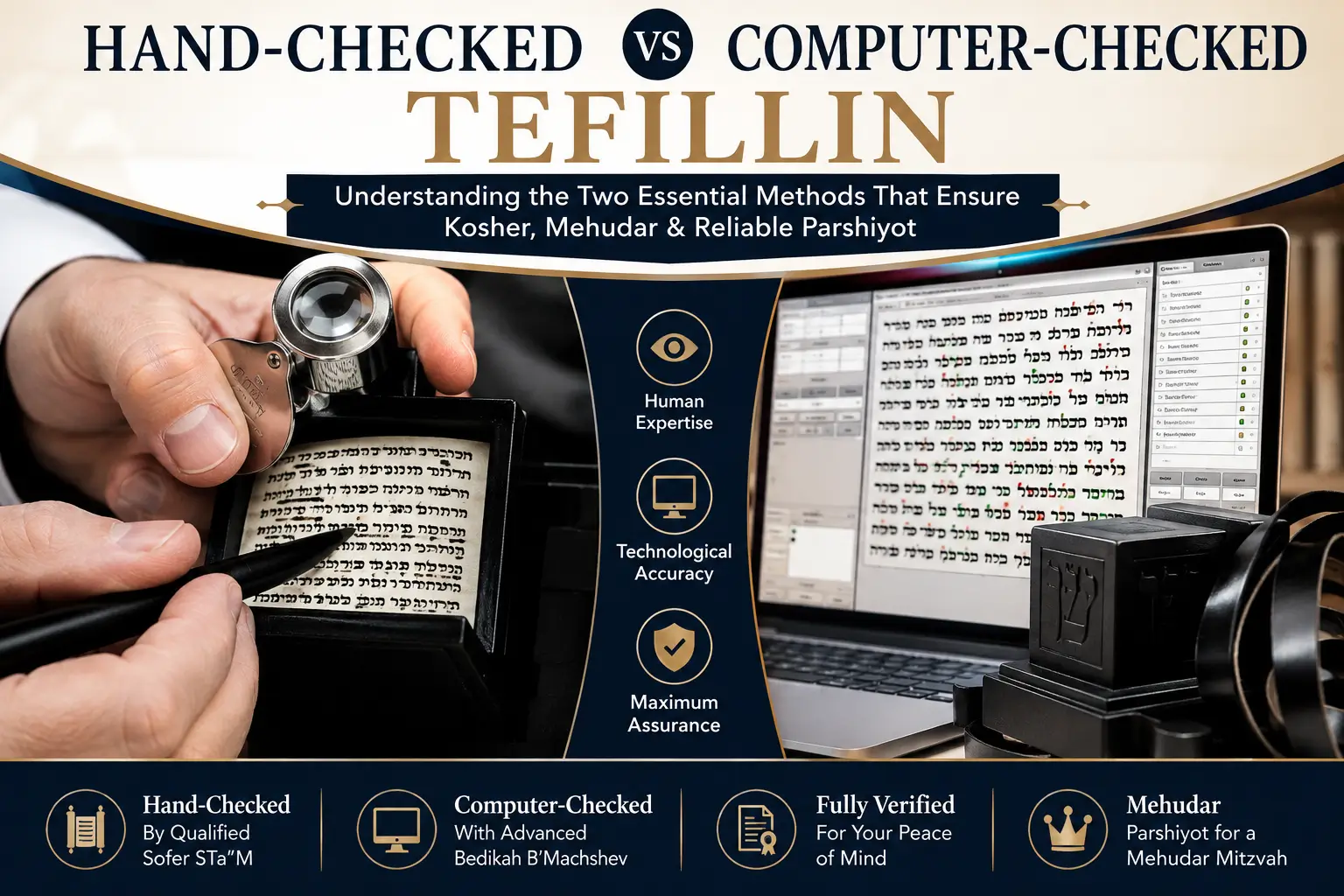
Tefillin are among the most significant daily mitzvot in Jewish life, and the kashrut of the Parshiyot inside them depends on far more than simply confirming that the words appear on the parchment. Every letter must be written according to the laws of STa”M, with the appropriate ksav, on properly prepared klaf, by a qualified Sofer. The completed Parshiyot must then be examined carefully to identify textual, structural, and halachic concerns.
This is where the question of Hand-Checked vs Computer-Checked Tefillin becomes important.
The two methods are sometimes presented as alternatives, but that is misleading. A computer can perform certain forms of textual verification with remarkable consistency, while an experienced Sofer or magiah brings halachic judgment and visual expertise that software cannot replace. For this reason, SeferTorah.Net treats both forms of verification as part of its standard for Tefillin Parshiyot.
What Does Hand-Checking Tefillin Mean?
Hand-checking is the traditional examination of handwritten Parshiyot by a qualified Sofer or magiah who understands the detailed laws governing STa”M. The examiner reviews the actual writing rather than merely comparing the text against a digital version.
This examination involves much more than reading the words.
A knowledgeable examiner looks at the formation of individual letters, the relationship between adjacent letters, spacing, line structure, and other details that can affect the halachic status of the writing. Certain questions require judgment rather than simple recognition: whether a particular letter has been formed correctly, whether two letters have become connected, or whether an apparent defect is significant according to the applicable halachic standards.
The human examiner also understands the ksav in which the Parshiyot were written. Ksav Beis Yosef, Ksav Ari, and Ketav Sefaradi have their own established letter forms and traditions. A person trained in STa”M can evaluate these forms in their proper context.
For this reason, hand-checking remains indispensable even when computer verification is available.
What Is Computer Checking of Tefillin Parshiyot?
Computer checking, known as bedikah b’machshev, uses specialized software to compare a scanned representation of the Parshiyot against an established text database.
Its particular strength is identifying textual discrepancies. Depending on the system used, computer checking can identify missing, extra, substituted, or misplaced letters and other inconsistencies that may be difficult to detect during ordinary reading.
This is especially valuable because a person can read a familiar Biblical passage and unconsciously anticipate what should appear next. A computer comparison does not approach the text in quite the same way. It systematically compares the scanned writing with its reference text.
However, computer checking should not be confused with a complete halachic examination.
Software does not replace the trained judgment of a magiah. It cannot independently determine every question involving the precise formation of a letter, the halachic significance of a questionable shape, or the broader circumstances surrounding a suspected defect.
That distinction is essential when evaluating Hand-Checked vs Computer-Checked Tefillin.
Hand-Checked vs Computer-Checked Tefillin: What Does Each Method Find?
The simplest way to understand Hand-Checked vs Computer-Checked Tefillin is to recognize that each method has a different strength.
Hand-checking is especially important for:
- Individual letter formation
- Questionable or unusual letter shapes
- Letters that may be touching
- Structural details of the writing
- Spacing and visual relationships
- Halachic judgment concerning doubtful letters
- Ksav-specific requirements
- Physical defects that require human interpretation
Computer checking is especially useful for:
- Missing letters
- Extra letters
- Substituted letters
- Incorrect textual sequences
- Certain transcription errors
- Systematic comparison against an approved text
Neither method should therefore be viewed as a replacement for the other.
A computer can find certain textual discrepancies efficiently, but it cannot make a complete determination of kashrut. Conversely, an experienced examiner can detect many issues that software cannot, but human beings are also capable of overlooking an error in a long handwritten text.
The strength lies in combining the two.
Why Computer Checking Does Not Replace a Sofer
A common misconception surrounding Hand-Checked vs Computer-Checked Tefillin is that computer checking represents a more advanced version of human checking and therefore makes the traditional examination unnecessary.
That is not the correct way to understand the technology.
The computer is a tool used to assist the examination process. It does not become the halachic authority.
For example, software may flag a particular area because it does not recognize a letter clearly. A qualified examiner must then determine whether the issue represents an actual writing defect, a scanning artifact, or simply an unusual but acceptable form.
The reverse can also happen. A letter may appear visually questionable to an experienced examiner even though the computer recognizes it as matching the expected text. The computer has confirmed the textual identity; it has not necessarily resolved the halachic question of the letter’s form.
This is why the expertise of the Sofer and magiah remains central.
Why Both Checks Matter for Mehudar Tefillin
When discussing Hand-Checked vs Computer-Checked Tefillin, it is important to distinguish basic kashrut from higher levels of hidur mitzvah.
Mehudar Parshiyot are not defined solely by whether a computer report exists. The caliber of the Sofer, the clarity and consistency of the writing, the quality of the klaf and ink, the precision of the letter formations, and the level of human review all contribute to the overall standard.
The concept of yirat shamayim is also central to the work of a Sofer. Writing STa”M is not simply a technical exercise. The Sofer works with sacred texts and must understand the seriousness of the work, including the required kavvanah and care associated with writing the Divine Names.
At SeferTorah.Net, Parshiyot are selected with these considerations in mind. The site’s stated standard is that Parshiyot undergo both careful hand-checking and bedikah b’machshev, rather than treating one as an optional substitute for the other.
Choosing Tefillin: What Should Buyers Ask?
If you are purchasing Tefillin, replacing Parshiyot, or upgrading an existing set, do not stop at the statement that the Parshiyot are “checked.”
Ask more specific questions.
Was the writing examined by a qualified Sofer or magiah? Was computer checking performed as well? Which ksav was used? What level of hidur does the Parshiyot represent? Who performed the checking? Is documentation available?
These questions are particularly relevant for families purchasing Tefillin for a Bar Mitzvah, individuals upgrading to a more mehudar set, and buyers selecting components separately.
The appropriate ksav should also reflect the buyer’s minhag. SeferTorah.Net offers Parshiyot in Ksav Beis Yosef, Ksav Ari, and Ketav Sefaradi, with the appropriate tradition determined by community and family practice. When there is uncertainty, guidance from one’s Rav or posek is appropriate.
Shop Properly Checked Tefillin Parshiyot at SeferTorah.Net
For buyers comparing Hand-Checked vs Computer-Checked Tefillin, the most important conclusion is that you should not have to choose between the two.
SeferTorah.Net’s Tefillin Parshiyot collection includes Ksav Beis Yosef, Ksav Ari, and Ketav Sefaradi options. According to the site’s established quality standard, every Parshah undergoes both hand-checking by the Sofer and bedikah b’machshev.
This approach recognizes what each method contributes: technology provides systematic textual verification, while experienced human examination provides the halachic judgment and expertise that software cannot reproduce.
Explore the Tefillin Parshiyot collection when selecting replacement Parshiyot or building a complete Tefillin set, and contact SeferTorah.Net if you need guidance regarding ksav, quality level, or compatibility with existing Batim.
Frequently Asked Questions
Is hand-checking better than computer checking for Tefillin?
Neither should be considered a replacement for the other. Hand-checking provides expert human and halachic examination, while computer checking provides systematic textual verification. Using both provides a stronger overall checking process.
What does a computer check look for in Tefillin Parshiyot?
Computer checking primarily assists with textual accuracy, including identifying missing, extra, substituted, or misplaced letters and other discrepancies that can be detected through comparison with a verified text.
Can a computer determine whether a Tefillin letter is kosher?
Not by itself. Questions involving the precise formation of letters and other halachic details require examination by a qualified Sofer or magiah with appropriate knowledge of STa”M.
Why do Tefillin need to be hand-checked if they are computer-checked?
Because computer checking does not replace human halachic judgment. A computer can identify certain textual discrepancies, while an experienced examiner can evaluate letter formation, questionable shapes, spacing, and other physical or halachic concerns.
What is bedikah b’machshev?
Bedikah b’machshev is computer-based verification of handwritten STa”M. Specialized software compares the scanned text against a reference text to identify certain textual discrepancies.
Are SeferTorah.Net Tefillin Parshiyot both hand-checked and computer-checked?
Yes. SeferTorah.Net states that every Parshah in its Tefillin collection undergoes both hand-checking and bedikah b’machshev as part of its quality standard.
Does the type of ksav matter when buying Tefillin Parshiyot?
Yes. Ksav is connected to community and family tradition. Common traditions include Ksav Beis Yosef, Ksav Ari, and Ketav Sefaradi. If you are uncertain which tradition is appropriate, consult your Rav or posek.
What else should I consider besides checking?
Consider the Sofer’s expertise, yirat shamayim, the quality of the klaf and ink, clarity and consistency of the writing, the ksav tradition, and the overall level of hidur. Checking is one important part of evaluating Parshiyot, not the only one.
Can I buy Tefillin Parshiyot separately?
Yes. SeferTorah.Net offers Parshiyot separately, allowing buyers with suitable existing Batim to replace or upgrade the Parshiyot according to their ksav and desired quality level.
Conclusion
The real question is not simply Hand-Checked vs Computer-Checked Tefillin. The better question is how the two methods work together.
Hand-checking brings the trained eye, halachic knowledge, and judgment of the Sofer or magiah. Computer checking adds systematic textual verification that can identify discrepancies that a human examiner may overlook. Neither technology nor human expertise should be treated as sufficient in isolation when both can contribute to a more thorough examination.
For an important mitzvah performed every weekday, the standard should be careful writing, appropriate ksav, qualified human examination, and reliable computer verification. That combination gives buyers greater confidence that the Parshiyot they place inside their Batim have been examined with the seriousness this mitzvah deserves.