


Gassos vs Dakos Tefillin: Understanding the Difference

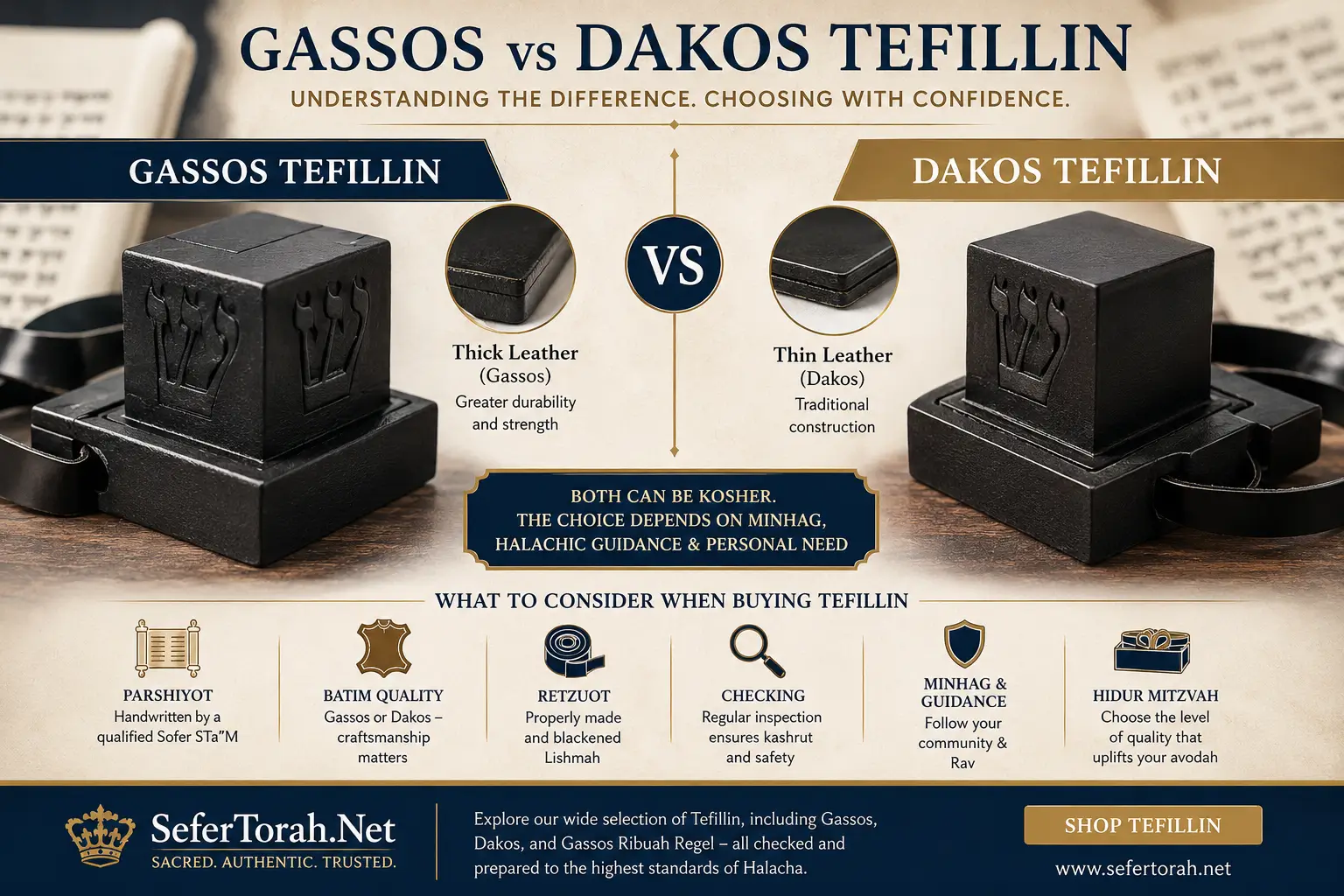
Gassos vs Dakos Tefillin | When purchasing Tefillin, one of the first distinctions a knowledgeable buyer encounters is the difference between Gassos and Dakos Tefillin. Both refer primarily to the construction of the Batim, the leather housings that contain the handwritten Parshiyot, but the difference involves far more than thickness alone.
The choice between Gassos and Dakos can affect durability, appearance, craftsmanship, price, and the way the Tefillin are regarded within different Jewish communities. For a Bar Mitzvah family purchasing a first pair, a ben Torah upgrading an existing set, or someone replacing aging Batim, understanding these distinctions is essential.
It is equally important to recognize that the quality of Tefillin cannot be judged by the Batim alone. The Parshiyot, Retzuot, writing, materials, construction, and halachic standards all matter. A knowledgeable purchase should therefore consider the complete set rather than focusing on a single specification.
What Are Gassos Tefillin?
The Hebrew word Gassos means “thick,” referring to the thick leather used in the construction of these Batim. Gassos Batim are generally made from a single piece of thick leather, commonly described as Ohr Echad, and require considerable skill to shape into the precise form required for Tefillin.
The advantage of this construction is not merely visual. Thick leather provides substantial structural strength and makes the Batim less vulnerable to the wear associated with daily use. The ability of the Batim to maintain their precise form is particularly important because the square configuration of Tefillin is itself a significant halachic requirement.
For this reason, Gassos have become the preferred choice for many buyers seeking a durable set intended for decades of regular use.
What Are Dakos Tefillin?
Dakos means “thin,” referring to the thinner leather construction used for these Batim. Dakos Tefillin are a legitimate traditional category and are used within various Jewish communities and traditions.
Because the leather is thinner, the construction is more delicate than that of Gassos. This does not mean that every pair of Dakos is inferior or that a kosher set of Dakos is unsuitable for fulfilling the mitzvah. Rather, the distinction lies in the method of construction, durability, and the level of craftsmanship involved.
Community custom and personal halachic guidance can therefore be relevant when determining whether Dakos are appropriate for a particular buyer.
Gassos vs Dakos Tefillin: The Main Differences
The most useful way to understand Gassos vs Dakos Tefillin is to compare the characteristics that matter when purchasing a set.
Leather Construction
Gassos are constructed from thick leather and are traditionally associated with the single-piece construction known as Ohr Echad.
Dakos use thinner leather construction. Their production requires its own specialized craftsmanship and has longstanding representation within different Jewish traditions.
Durability
One of the strongest practical advantages of Gassos is their durability. Thick leather is better suited to withstand the repeated handling, wrapping, storage, and environmental exposure associated with daily Tefillin use.
Dakos can certainly serve properly when produced and maintained according to the required standards, but their thinner construction generally makes them more susceptible to physical damage.
Ribua and Structural Integrity
The Batim must maintain their square form, known as ribua. This is not simply an aesthetic preference. The square shape of Tefillin is part of the traditional halachic requirements governing their construction.
Because Gassos are made from substantially thicker leather, they are generally better positioned to retain their structural form over prolonged use. This is one reason many buyers seeking a lifelong set favor Gassos.
Craftsmanship
Both Gassos and Dakos require skilled workmanship. However, producing high-grade Gassos Batim involves substantial expertise because the thick leather must be shaped, pressed, squared, and finished with precision.
Among Gassos, there are also different levels of craftsmanship. Gassos Ribuah Regel, for example, represents an elevated level of precision in the squaring of the base and is associated with a higher degree of hidur mitzvah.
Price
Gassos generally cost more than Dakos because of the leather, specialized labor, craftsmanship, and durability involved in their production.
Price, however, should never be treated as the sole indicator of kashrut. A buyer should establish what level of hidur is appropriate and then compare complete sets based on their Batim, Parshiyot, Retzuot, and reliable sourcing.
Is Gassos Better Than Dakos?
This question requires some qualification.
If “better” means more durable and structurally robust, Gassos generally have a significant practical advantage. Established purchasing guidance also notes that Gassos are more durable and less vulnerable to damage from prolonged use.
If the question is whether every person must own Gassos in order to fulfill the mitzvah, that is a different halachic question and should not be reduced to a simple yes-or-no comparison.
The appropriate choice can depend upon one’s minhag, family tradition, budget, intended use, and guidance from a Rav or qualified authority. A properly made pair of Dakos is not simply “bad Tefillin”; it represents a different construction category.
For someone purchasing a first pair and intending to use them every weekday for many years, however, Gassos are often an attractive investment because of their strength and longevity.
Gassos vs Dakos for a Bar Mitzvah
Choosing Tefillin for a Bar Mitzvah deserves particular care. This is often a family’s first significant purchase of a sacred STa”M item, and the set may accompany the young man throughout his adult life.
Rather than choosing solely according to price, families should consider:
- The family’s minhag and ksav tradition
- The quality of the Batim
- The quality and checking of the Parshiyot
- The source and preparation of the Retzuot
- The desired level of hidur mitzvah
- The expected frequency of use
- The long-term care of the set
For many families, Gassos provide an appropriate balance between durability and long-term value. Where budget or community practice points toward Dakos, however, the decision should be made with proper halachic guidance rather than assuming that one category is universally mandatory.
Gassos, Dakos, and the Other Components of Tefillin
A common mistake in comparing Gassos vs Dakos Tefillin is to treat the Batim as the entire Tefillin.
A complete pair consists of several essential components.
Parshiyot
The four Torah passages inside the Tefillin must be written by a qualified Sofer STa”M on appropriate parchment and according to the relevant scribal tradition.
The quality of the writing, formation of letters, parchment, ink, and checking process all deserve attention.
Retzuot
The leather straps must meet their own halachic requirements, including the requirement that the outer-facing surface be blackened appropriately. The blackening process and its lishmah requirements are significant considerations when purchasing Tefillin.
Batim
This is where the Gassos vs Dakos distinction becomes relevant. The construction, leather, ribua, stitching, compartments, and finish all contribute to the integrity of the Batim.
A genuinely informed purchase therefore evaluates the entire set.
Gassos vs Dakos Tefillin and Hidur Mitzvah
Hidur mitzvah means enhancing the performance of a mitzvah through beauty, care, and quality where halachically appropriate.
In Tefillin, hidur can involve numerous aspects rather than one feature. The craftsmanship of the Batim, clarity and beauty of the Parshiyot, quality of the klaf and ink, precision of construction, and quality of the Retzuot can all contribute to the overall standard of a set.
Gassos Ribuah Regel represents one example of increased refinement within Batim production. It should therefore be understood as part of a broader hierarchy of craftsmanship rather than simply another name for Gassos.
Which Tefillin Should You Buy?
There is no responsible substitute for considering your own minhag and, where necessary, consulting a Rav or knowledgeable Tefillin professional.
For a buyer comparing Gassos vs Dakos Tefillin, the following approach is useful:
Choose Gassos when:
- Long-term durability is a major priority.
- You want thick-leather Batim.
- You are looking for a higher level of Batim craftsmanship.
- Your community and Rav recommend or prefer Gassos.
- You expect decades of frequent use.
Consider Dakos when:
- Your community or family tradition uses them.
- Your Rav considers them appropriate.
- Budget is an important consideration.
- You specifically prefer their traditional construction.
The most important point is to purchase from a trustworthy source that can explain the origin, construction, Parshiyot, Retzuot, and halachic standards of the complete set.
Buy Kosher Tefillin from SeferTorah.Net
If you are ready to purchase Tefillin, SeferTorah.Net offers complete Tefillin sets as well as individual Tefillin Batim, Parshiyot, and Retzuot for buyers with different standards, traditions, and budgets.
Our Tefillin collection includes different quality levels, including Peshutim Mehudarim, Dakos, Gassos, and Gassos Ribuah Regel, with options serving Ashkenazic, Sephardic, and Chabad communities.
Because the purchase of Tefillin is both a halachic and deeply personal decision, buyers who are uncertain about the appropriate quality, ksav, or construction are encouraged to seek guidance before ordering.
Frequently Asked Questions
What is the main difference between Gassos and Dakos Tefillin?
The primary difference is the construction of the Batim. Gassos use thick leather, while Dakos use thinner leather construction. Gassos are generally more durable and structurally robust.
Are Dakos Tefillin kosher?
Yes. Dakos are a traditional category of Tefillin Batim. Their suitability for a particular individual depends on the construction, halachic standards, community custom, and the quality of the complete set.
Are Gassos Tefillin more durable than Dakos?
Generally, yes. The thicker leather used in Gassos provides greater resistance to physical wear and helps the Batim maintain their structure during prolonged daily use.
Why are Gassos Tefillin more expensive?
The price reflects factors including the thick leather, specialized craftsmanship, construction process, and labor required to produce the Batim. The complete set’s Parshiyot and Retzuot also affect its final price.
What does Ohr Echad mean?
Ohr Echad refers to construction from a single piece of leather. It is particularly associated with Gassos Batim and contributes to their structural integrity and durability.
What is Gassos Ribuah Regel?
Gassos Ribuah Regel is a highly refined category of Gassos Batim distinguished by particularly precise squaring of the base. It represents an elevated level of craftsmanship and hidur in Batim production.
Should a Bar Mitzvah boy get Gassos or Dakos?
There is no universal answer. Families should consider their minhag, budget, expected use, and the advice of their Rav. Gassos are often favored for their durability and long-term use.
Do Gassos and Dakos use different Parshiyot?
Not necessarily. Gassos and Dakos describe the Batim construction. The Parshiyot are a separate component and should be selected according to the appropriate ksav, community tradition, and desired level of hidur.
How often should Tefillin be checked?
Inspection practices vary according to circumstances and halachic guidance. Tefillin that are used regularly may require periodic checking, particularly if exposed to moisture, heat, or physical damage. A qualified Sofer should assess their condition when there is concern.
Where can I buy Gassos or Dakos Tefillin?
SeferTorah.Net offers Tefillin sets in multiple quality levels, including Dakos, Gassos, and Gassos Ribuah Regel, as well as individual Batim, Parshiyot, and Retzuot. Buyers who are uncertain about which configuration suits their minhag or needs should seek guidance before purchasing.
Conclusion
The choice between Gassos vs Dakos Tefillin is ultimately about understanding what you are purchasing rather than simply choosing the more expensive option. Gassos provide thick-leather construction, substantial durability, and access to very high levels of Batim craftsmanship. Dakos represent a thinner traditional construction that remains relevant within various communities and purchasing circumstances.
The right Tefillin should reflect your minhag, halachic requirements, desired level of hidur mitzvah, budget, and long-term needs. Most importantly, the Batim should not be considered in isolation. The Parshiyot, Retzuot, workmanship, checking, and reliability of the source all deserve equal attention.
For those beginning the Complete Guide to Buying Tefillin, understanding the distinction between Gassos and Dakos is an important first step toward making an informed and meaningful purchase.