


How to Identify Damage in a Torah Scroll

Introduction
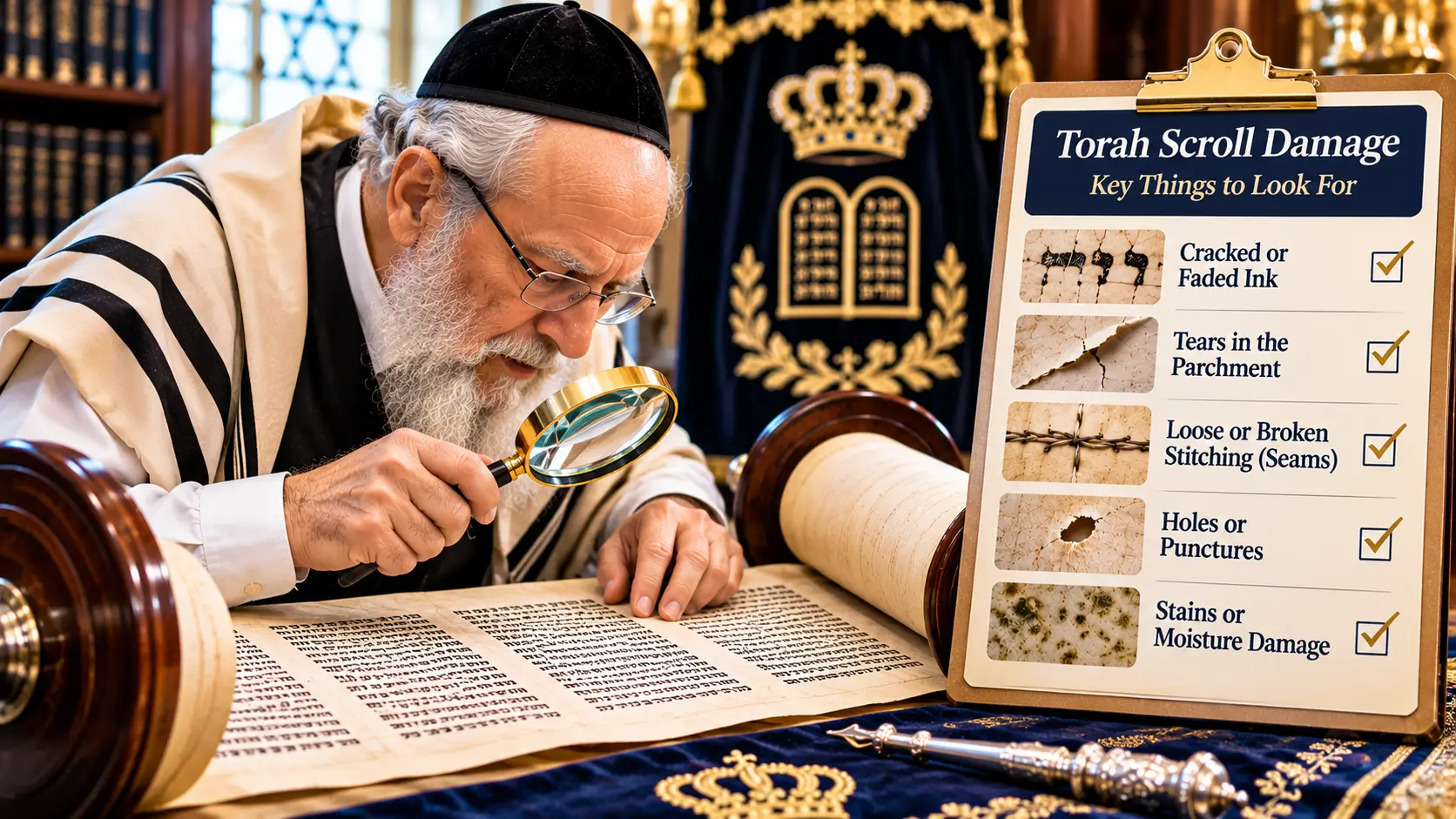
A Sefer Torah is not an ordinary manuscript. It is a sacred object written by a qualified Sofer STa”M on specially prepared parchment, following detailed requirements of Halacha and the established traditions of Jewish scribal practice. Every letter, word, column, and seam has significance. For a synagogue, identifying Torah scroll damage early is therefore an important responsibility—not simply a matter of preserving an old or valuable object, but of safeguarding the congregation’s ability to use its Sefer Torah for the mitzvah of public Torah reading.
Damage is not always obvious. A small tear may appear harmless while affecting a letter. Ink may fade gradually, a seam may loosen, or moisture may change the condition of the klaf. Conversely, a visible mark or surface imperfection does not automatically mean that a Torah scroll is pasul (not fit for use). The halachic status depends on the nature, location, and extent of the damage.
This guide explains the warning signs that synagogue leaders, caretakers, and Torah owners should recognize. It also explains what to do when a concern arises and why a qualified Sofer must assess the scroll before anyone makes a decision about its kosher status.
1. Understand the Difference Between Physical Damage and Halachic Disqualification
The first principle in assessing Torah scroll damage is that physical appearance and halachic status are related, but they are not identical.
A scroll may show signs of age, handling, or environmental exposure without necessarily being invalid. At the same time, a small defect in the form of a Hebrew letter can have serious halachic consequences. The Rambam, in Hilchot Tefillin, Mezuzah and Sefer Torah, discusses conditions that can invalidate a Sefer Torah, including missing letters, additional letters, letters that touch, and letter forms that have become distorted.
For example, a letter may become damaged through a tear, hole, fading ink, or abrasion. If the damage changes the letter’s required form, the issue is more serious than a stain on an unused area of parchment. The precise ruling depends on the circumstances and must be assessed by someone qualified in STa”M.
It is useful to distinguish three broad categories:
- Cosmetic or surface changes: Marks, discoloration, or signs of age that may not affect the writing.
- Physical deterioration: Tears, brittle parchment, loose stitching, or other structural problems that may require professional attention.
- Potentially halachic defects: Missing or altered letters, damaged writing, or other problems that may affect the scroll’s kosher status.
Do not assume that a scroll is kosher because the text remains readable to an ordinary reader. Equally, do not declare it invalid based on appearance alone.
2. Inspect the Hebrew Letters and Ink
The written text is the most important area to examine. A Sefer Torah contains handwritten Hebrew text, and the integrity of its letters is central to its halachic fitness.
Faded, cracked, or flaking ink
Over time, ink can become less distinct. Repeated handling, environmental conditions, and the natural aging of materials may contribute to changes in the appearance of the writing.
Look for:
- Ink that appears to be flaking or lifting from the parchment.
- Sections of a letter that appear thinner or incomplete.
- Cracks running through the written strokes.
- Letters that have become difficult to distinguish.
- Areas where ink appears to have rubbed away.
A letter does not have to disappear completely for a problem to arise. If part of its required form is missing or altered, the scroll may require correction or may be unfit for use until the matter is resolved. A visible outline or impression left on the parchment does not automatically establish that the letter remains halachically valid.
Letters that touch or change shape
The shape and separation of Hebrew letters matter. Two letters that touch may create a problem, while damage that changes one letter into another can affect the reading of the text.
A Sofer examines whether each letter retains its proper form and whether the spacing between letters and words remains correct. This assessment requires knowledge of the relevant letter forms and the applicable scribal tradition.
Missing crowns and other details
Some Hebrew letters are written with small ornamental strokes known as tagin. Their condition should be assessed in context. Not every missing decorative detail has the same halachic consequence as a missing part of the essential letter form.
For this reason, synagogue staff should record what they observe rather than attempt to decide whether a particular mark invalidates the scroll.
3. Look for Tears, Holes, and Damage to the Klaf
The parchment, known as klaf or gevil according to the relevant parchment type and scribal context, is the physical foundation of the Sefer Torah. Its condition affects both the preservation of the manuscript and the integrity of the writing.
Common signs of parchment damage
Watch for:
- Tears along the edges or within a written column.
- Small holes or punctures.
- Deep creases or folds.
- Areas that appear unusually thin or brittle.
- Peeling, splitting, or separation of the parchment surface.
- Stains associated with moisture or other exposure.
- Evidence of mold, mildew, or insect activity.
The location of a tear is especially important. A tear in a blank margin is not necessarily equivalent to one that passes through a letter. A hole may also affect the writing even when the surrounding text appears intact.
Moisture and mold
Water exposure can leave stains, cause distortion, and create conditions in which mold develops. A damp scroll should not be rolled, rubbed, heated, or treated with household cleaning products. These actions can worsen the damage.
If moisture or mold is suspected, keep the scroll away from further exposure and contact a qualified professional promptly. Do not attempt to dry the parchment with a hair dryer, direct sunlight, or a heater.
Why parchment damage needs expert assessment
The Rambam discusses specific circumstances in which tears in a Sefer Torah may be repaired and circumstances in which a damaged section requires a different response. The rules are not a general permission to sew, glue, or patch any tear. The condition of the parchment, the location of the tear, and whether the writing is affected all matter.
A Sofer should examine the damage and determine the appropriate course of action in consultation with the relevant halachic authority when needed.
4. Examine the Seams Between Parchment Sheets
A Torah scroll is made from parchment sheets joined together to form a continuous scroll. These joins are stitched according to traditional requirements. The stitching is therefore more than a practical construction detail.
Signs of possible seam damage include:
- Threads that are loose or visibly broken.
- A seam that has begun to separate.
- Gaps between adjoining parchment sheets.
- Tears developing near a stitched edge.
- Uneven tension that causes the sheets to pull against one another.
A partially loosened seam does not automatically mean that the entire Sefer Torah is pasul. Its status depends on the extent and location of the separation and the applicable halachic details.
The Rambam explains the traditional use of sinews from a kosher species for stitching parchment sheets. He also discusses repairs to tears and the need to ensure that stitching does not remove or distort a letter. These requirements show why ordinary bookbinding methods are not suitable substitutes for the work of a qualified Sofer.
If a seam is opening, avoid pulling the sheets apart to investigate it. Arrange a professional inspection instead.
5. Check the Torah Rollers and Handling Components
The Atzei Chayim are the wooden rollers attached to the Torah scroll. They allow the parchment to be rolled and unrolled for reading and storage. Although damage to a roller is not the same as damage to the written parchment, faulty rollers can place unnecessary strain on the scroll.
Inspect for:
- Cracks or splits in the wood.
- Loose handles or fittings.
- Rough edges that could catch the parchment.
- Uneven rotation or resistance when rolling.
- Loose attachments that allow the scroll to shift.
Never force a Torah scroll to turn when it meets resistance. A sudden pull can place stress on the parchment and stitching. If the rollers are unstable or difficult to operate, have them examined before further use.
For replacement or synagogue maintenance, browse the Torah Rollers / Atzei Chayim Torah Rollers category, including Dark Wood Torah Rollers and Light Wood Torah Rollers. The correct dimensions and compatibility should be confirmed before purchasing.
6. Recognize Damage Caused by Storage and Environmental Conditions
A Sefer Torah should be stored with care and protected from unnecessary exposure. Environmental problems may develop gradually, making regular observation important.
Heat, humidity, and direct sunlight
Excessive heat and changing humidity can contribute to the deterioration of parchment and other materials. Direct sunlight may also affect the appearance of the ink, parchment, and decorative coverings.
Synagogue caretakers should pay attention to:
- Persistent dampness inside the Aron Kodesh.
- Water leaks or condensation near the storage area.
- Unusual heat from lighting or nearby equipment.
- Dust accumulation.
- Evidence of insects or rodents.
- Poorly maintained storage spaces.
A Torah scroll should not be stored in a location where it is exposed to avoidable moisture or extreme environmental changes.
Protective coverings and accessories
Protective accessories help support respectful handling and storage. Depending on the community’s custom and the scroll’s design, relevant items may include a Torah Mantle, a Sephardic Torah Case / Tik, and appropriate storage arrangements.
Sephardic communities commonly use a rigid Torah case or tik, while many Ashkenazic communities use a mantle around the scroll. The particular custom should be respected when selecting or maintaining these items.
Decorative objects such as Torah Ornaments, Torah Crowns, Torah Breastplates, and Rimonim should also be handled carefully. They contribute to the dignity and adornment of the Sefer Torah, but they should not be allowed to place unnecessary pressure on the parchment or interfere with safe handling.
7. Observe the Scroll During Torah Reading
Regular use can reveal practical problems that may not be obvious when the Torah is stored. Those responsible for handling the scroll should be attentive to changes in how it opens, turns, and rests on the rollers.
Watch for:
- Unusual resistance when unrolling or rolling.
- Parchment that catches against itself.
- Sheets that pull apart near the seams.
- A roller that shifts or turns unevenly.
- A mantle or case that makes handling awkward.
- Newly visible marks or tears after use.
These observations do not replace a formal inspection. They help identify when professional attention may be needed.
If a problem appears during a public reading, the Rabbi or other appropriate halachic authority should guide the congregation on what to do. A caretaker should not independently decide whether to continue using the scroll.
8. What to Do When You Discover Torah Scroll Damage
A calm, careful response can prevent further deterioration.
Step 1: Stop unnecessary handling
Do not repeatedly open, roll, or touch the affected area to investigate it. Avoid pressing down on damaged parchment or attempting to flatten folds.
Step 2: Record what you observed
Note the approximate location of the damage, when it was discovered, and whether it appeared after storage, transport, or use. A photograph may help document the visible condition, but it cannot establish halachic status.
Step 3: Protect the scroll from further exposure
Keep it away from moisture, direct sunlight, excessive heat, and unnecessary handling. Do not apply tape, glue, ink, polish, or cleaning products.
Step 4: Contact a qualified Sofer STa”M
Arrange an examination by a qualified Sofer experienced in Torah scroll inspection and repair. If the issue affects the scroll’s kosher status or raises a complex halachic question, consult the congregation’s Rabbi or a competent halachic authority.
Step 5: Keep a record of the evaluation
For synagogue management, document the date of inspection, the findings, recommended work, and any follow-up required. This creates a useful maintenance history and helps future caretakers understand the scroll’s condition.
For professional assistance, visit the Torah Evaluations service page on SeferTorah.Net.
9. When Should a Torah Scroll Be Professionally Inspected?
A professional inspection is appropriate whenever there is a reasonable concern about the parchment, writing, stitching, or handling components. It is particularly important after:
- A fall or accidental impact.
- Exposure to water, dampness, or mold.
- Discovery of a tear, hole, or damaged letter.
- A seam becoming loose.
- A period of unsuitable storage.
- Transport over a long distance.
- A change in the scroll’s handling or rolling behavior.
Synagogues should establish a documented maintenance routine and seek guidance from their Sofer and Rabbi about an appropriate inspection schedule. There is no single interval that should be assumed to fit every scroll, because age, condition, use, storage, and community practice can differ.
A professional Torah evaluation is also advisable before purchasing a used Torah scroll or accepting one as a donation. The scroll’s appearance, age, or family history cannot by themselves confirm its present halachic status.
10. Explore Torah Scrolls and Accessories at SeferTorah.Net
Maintaining a Sefer Torah involves more than responding to damage. Synagogues also need suitable accessories for respectful handling, storage, and presentation.
SeferTorah.Net offers categories relevant to synagogue Torah care, including:
- Sefer Torah Scrolls: Explore Torah scroll options and scribal traditions, including Ketav Arizal, Ketav Bet Yosef, and Ketav Sefaradi.
- Used Torah Scrolls: A category to explore when considering an existing scroll; arrange a qualified evaluation before purchase.
- Torah Rollers / Atzei Chayim Torah Rollers: Browse dark and light wood roller options.
- Torah Mantles: Explore coverings suited to the congregation’s custom.
- Sephardic Torah Cases / Torah Cases-Tiks: Explore traditional case options for communities that use them.
- Torah Ornaments: Browse items such as Rimonim, Torah Crowns, Torah Breastplates, and Torah Pointers / Yads.
When selecting accessories, confirm the scroll’s measurements, construction, and community requirements. A product should suit the Sefer Torah rather than forcing the scroll to fit an unsuitable accessory. For questions about the scroll itself, a product purchase is not a substitute for a professional inspection.
Frequently Asked Questions About Torah Scroll Damage
1. What are the most common signs of Torah scroll damage?
Common warning signs include cracked or flaking ink, missing portions of letters, tears, holes, brittle parchment, loose stitching, moisture stains, mold, and difficulty rolling the scroll. Some issues are cosmetic, while others may affect the scroll’s halachic status. A qualified Sofer should assess any concern involving the writing or parchment.
2. Does a small tear make a Torah scroll pasul?
Not necessarily. The halachic status depends on where the tear is located, whether it affects a letter, the condition of the parchment, and the applicable rules for repair. A tear in a blank area may be treated differently from one that passes through a letter. Do not determine the scroll’s status without professional assessment.
3. Can faded ink make a Sefer Torah invalid?
It can, depending on the extent and effect of the fading. If part of a letter’s required form has disappeared or changed, a halachic problem may arise. A faint appearance alone does not establish that the scroll is invalid. The actual letter must be examined by a qualified Sofer.
4. Can a damaged Torah scroll be repaired?
Many types of damage may be repairable, but not every defect can be treated in the same way. Traditional halachic requirements govern the repair of letters, parchment, and seams. A qualified Sofer must determine whether correction is possible and what method is appropriate.
5. Can synagogue staff repair a tear with tape or glue?
No. Household tape, glue, ordinary thread, and other improvised materials should not be used. They may damage the parchment further and do not follow the requirements governing Torah scroll repair. Protect the scroll from further handling and contact a qualified Sofer.
6. Does a loose seam automatically invalidate a Torah scroll?
No. A loose or partially separated seam requires attention, but its halachic effect depends on the extent and location of the separation and other relevant details. The congregation should seek guidance from a qualified Sofer and Rabbi rather than assume the scroll is either valid or invalid.
7. What should we do if a Torah scroll gets wet?
Avoid rolling, rubbing, heating, or attempting to dry it with household equipment. Keep it away from additional moisture and arrange professional help promptly. Water exposure can affect parchment, ink, and stitching, and the extent of damage may not be immediately visible.
8. Should a used Torah scroll be inspected before purchase?
Yes. A used Sefer Torah should be examined by a qualified Sofer before purchase or acceptance. The evaluation should consider the writing, parchment, seams, and overall condition. Buyers should also request available documentation and discuss any findings with their Rabbi.
9. How often should a synagogue inspect its Torah scrolls?
Synagogues should maintain a regular care routine, but the appropriate professional inspection interval depends on the scroll’s age, condition, frequency of use, storage environment, and guidance from the congregation’s Rabbi and Sofer. Any suspected damage should be assessed promptly rather than waiting for the next routine inspection.
Conclusion
Identifying Torah scroll damage requires attentiveness, knowledge, and respect for the halachic standards governing STa”M. Faded ink, damaged letters, tears in the klaf, loose seams, and environmental deterioration are all reasons to take a closer look—but visible damage does not automatically determine whether a Sefer Torah is kosher.
The most responsible approach is to avoid improvised repairs, document concerns, protect the scroll from further damage, and consult a qualified Sofer STa”M. Synagogue leaders should also maintain suitable storage, handling practices, and protective accessories. Through careful stewardship and appropriate professional guidance, a community can preserve its Sefer Torah and uphold the dignity of this sacred inheritance.