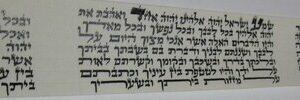
Handwritten Kosher Tefillin Parshiyot — The Sacred Foundation of Every Tefillin Set
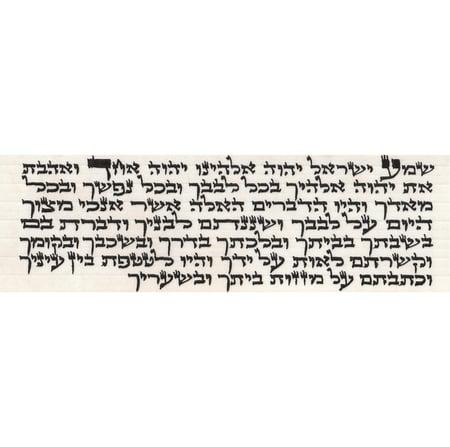
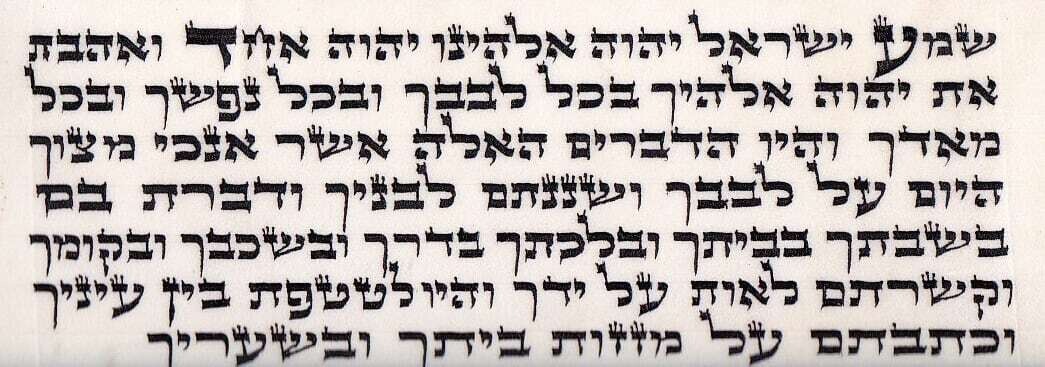
The Parshiyot — the four handwritten parchment sections placed inside the Batim of the Tefillin — are the soul of the mitzvah. Every letter of the sacred text must be formed with precision, intention, and deep knowledge of halacha. The quality of the Parshiyot determines not only the halachic validity of the Tefillin but the spiritual integrity with which this daily mitzvah is performed for years and decades to come.
At SeferTorah.Net, our Parshiyot are written exclusively by expert, G-d-fearing Sofrim who are certified in the laws of STaM, trained in the nuances of their ksav tradition, and who write every letter with the full kavvanah and yirat shamayim that this sacred work demands.
We offer Parshiyot in the three major script traditions of the Jewish world. The appropriate ksav is determined by your community minhag and, where there is any question, by the guidance of your Rav:
At SeferTorah.Net, every Parshah we carry has undergone both hand-checking by the sofer and bedikah b'machshev (computer-based verification). These are not separate tiers or options — they are both mandatory parts of our standard. We do not carry Parshiyot that have received only one form of checking.
Bedikah b'machshev uses specialized software to scan the written text for letter-level accuracy, spacing compliance, touching letters, and potential halachic deficiencies that can occasionally escape the human eye. Hand-checking by the sofer — a G-d-fearing expert in the laws of STaM — adds the halachic judgment, knowledge of l'ma'aseh psak, and yirat shamayim that no machine can provide. Together, they represent the gold standard in Parshiyot verification, and it is the only standard we accept.
Beyond basic kosher standards, Parshiyot vary significantly in their level of mehudar — the degree of enhancement and beautification in every aspect of their production. Factors that distinguish truly mehudar Parshiyot include:
We are happy to discuss the various levels of hidur available in our current Parshiyot inventory and to help you identify the option that best reflects your standards and budget.
Q: What are the four parshiyot written in Tefillin?
A: The four sections are: Kadesh (Shemos 13:1–10), VeHayah Ki Yeviacha (Shemos 13:11–16), Shema Yisrael (Devarim 6:4–9), and VeHayah Im Shamo'a (Devarim 11:13–21). In the Shel Yad they are written on a single parchment; in the Shel Rosh they are written on four separate parchments placed in four separate compartments.
Q: What is the difference between Ksav Beis Yosef and Ksav Ari?
A: They are two distinct Hebrew scribal letter traditions, each with specific formations for certain letters that differ from the other. The appropriate ksav is determined by community custom. Western Ashkenazic communities generally use Ksav Beis Yosef; Eastern European, Hasidic and nusach-Sefard communities generally use Ksav Ari.
Q: What is bedikah b'machshev?
A: Bedikah b'machshev is computer-based checking of Parshiyot, using specialized software to scan the written text for letter-level accuracy, spacing compliance, and potential halachic issues. At SeferTorah.Net it is performed on every Parshah we carry — always in conjunction with hand-checking by the sofer, never as a standalone substitute.
Q: Are your Parshiyot both hand-checked and computer-checked?
A: Yes — without exception. Every Parshah we carry has undergone both hand-checking by the sofer and bedikah b'machshev. These are not separate options at SeferTorah.Net; both forms of verification are mandatory and inseparable parts of our quality standard.
Q: How long do Tefillin Parshiyot last?
A: With proper care and storage, high-quality Parshiyot written on mehudar klaf with proper ink can remain in excellent condition for many decades. Parshiyot should be checked by a qualified sofer periodically — most authorities recommend doing so twice in seven years — to confirm their ongoing kosher status.
Q: Can I replace Parshiyot in existing Batim?
A: Yes. If your Batim are in good condition but your Parshiyot require replacement, we can discuss sourcing appropriate Parshiyot in your ksav and at your desired quality level. Please contact us to discuss your specific situation.
No account yet?
Create an Account