


Torah Scroll Restoration vs Replacement | Expert Guide

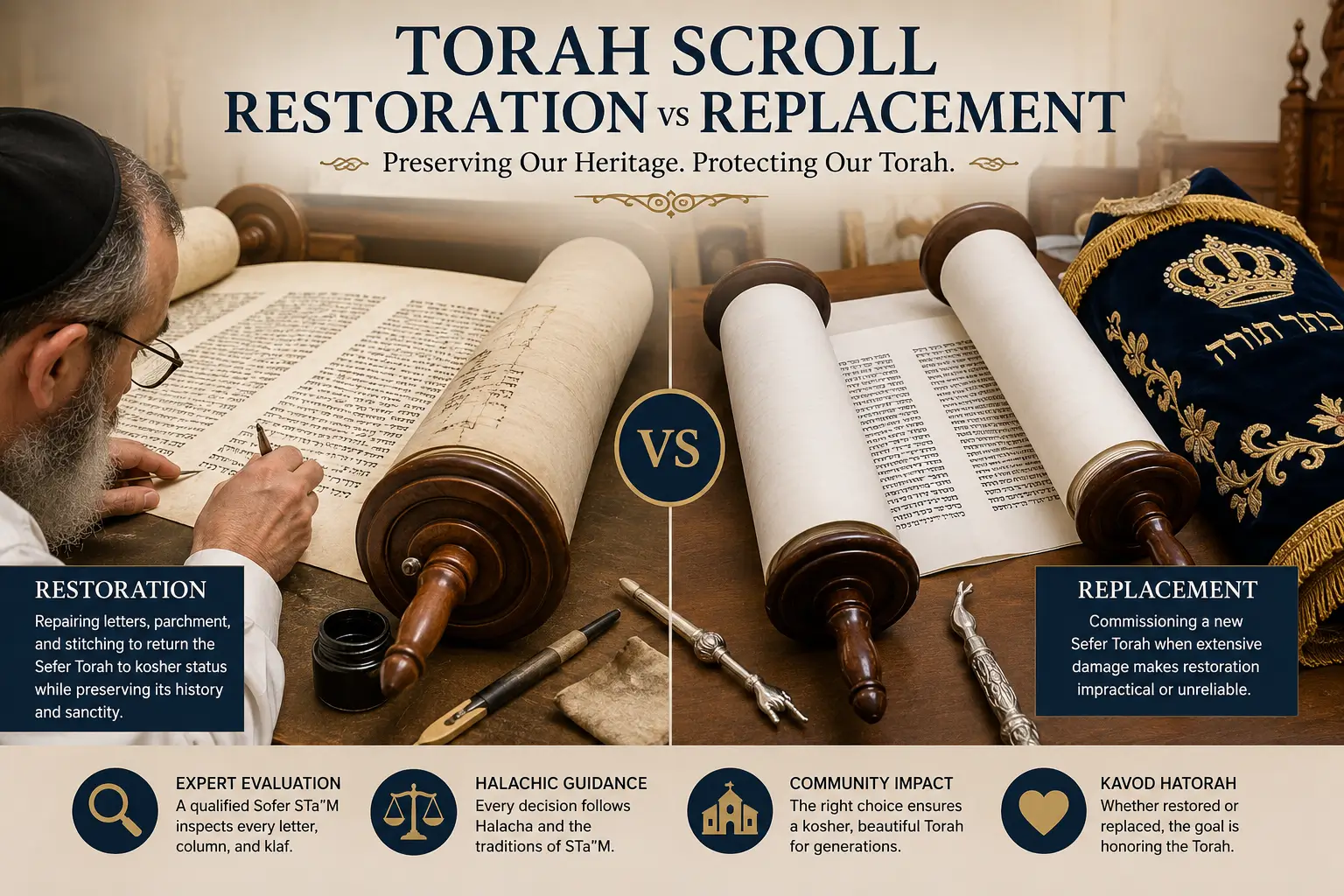
A Sefer Torah is far more than a handwritten manuscript. It is the living embodiment of Torah, painstakingly written by a qualified Sofer STa”M according to precise halachic requirements that have been preserved for generations. Every letter, every column, and every section of the klaf carries profound religious significance, making the care and preservation of a Torah scroll a sacred communal responsibility.
Over time, however, even the finest Torah scrolls are affected by age, regular use, environmental conditions, and natural wear. Ink may fade, parchment may deteriorate, stitching may loosen, or individual letters may develop halachic defects. When these issues arise, synagogue leaders, collectors, and private owners are often faced with an important question: Should the Torah Scroll be restored, or has the time come for a complete replacement?
Understanding Torah Scroll Restoration vs Replacement requires more than comparing costs. The decision involves Halacha, the condition of the scroll, the extent of the damage, the historical and sentimental value of the Sefer Torah, and the judgment of an experienced Sofer STa”M. In many cases, careful restoration can return a Torah scroll to full kosher status while preserving decades—or even centuries—of Jewish heritage. In other situations, extensive deterioration may make replacement the wiser long-term solution.
This guide explains the factors that influence Torah Scroll Restoration vs Replacement, helping synagogue boards, rabbis, Torah donors, and Jewish communities understand how these decisions are made while respecting both halachic standards and the enduring sanctity of the Torah.
Understanding Torah Scroll Restoration vs Replacement
The discussion of Torah Scroll Restoration vs Replacement begins with understanding that every Sefer Torah is unique. No two Torah scrolls share the same history, level of craftsmanship, or physical condition. Some have served congregations faithfully for well over a century, while others may have suffered damage from improper storage, moisture, excessive handling, or the natural aging of parchment and ink.
A Torah scroll is not automatically replaced simply because it has become old. Jewish tradition places great value on preserving sacred objects whenever this can be achieved in accordance with Halacha. An experienced Sofer STa”M carefully evaluates whether defects can be corrected while maintaining the scroll’s halachic integrity. This evaluation may include examining the clarity of every letter, the condition of the klaf, the strength of the stitching between panels, and the overall structural stability of the scroll.
Modern inspection techniques, combined with traditional expertise, allow many Torah scrolls to be restored successfully even after decades of use. Nevertheless, restoration has practical and halachic limits. When deterioration becomes widespread or affects the fundamental structure of the parchment, replacement may ultimately provide a more reliable solution for future generations.
For this reason, knowledgeable communities rarely approach the decision from a purely financial perspective. Instead, they balance halachic responsibility, long-term preservation, community needs, and respect for the history embodied within the Sefer Torah itself.
When Can a Torah Scroll Be Restored?
In many cases, restoration offers an excellent way to preserve both the sanctity and historical significance of a Sefer Torah. Restoration is generally considered when the scroll remains fundamentally sound and the defects can be corrected without compromising its halachic validity.
Common restoration work may include:
- Correcting letters that have faded, cracked, or become partially invalid.
- Repairing minor tears in the klaf using accepted restoration techniques.
- Re-sewing detached parchment panels with appropriate gidin (animal sinew).
- Re-inking letters where permissible according to halachic guidelines.
- Cleaning surface dirt and improving the scroll’s overall presentation without affecting the sacred text.
- Performing a complete inspection to identify additional issues before they become more serious.
The objective of restoration is never cosmetic alone. Every repair must preserve the Torah’s kosher status while respecting the original work of the Sofer who wrote it. A responsible restoration project seeks to extend the useful life of the scroll without introducing changes that conflict with established STa”M standards.
Many older Torah scrolls possess exceptional historical, communal, or sentimental value. A scroll dedicated in memory of loved ones, donated during the founding of a synagogue, or passed through several generations often represents far more than its physical components. When halachically feasible, restoration allows communities to continue reading from the same Sefer Torah that has accompanied their congregation through decades of Jewish life.
At SeferTorah.Net, we also encourage synagogue leaders to schedule periodic inspections rather than waiting until obvious defects appear. Early identification of worn letters or weakening parchment frequently allows smaller restorations that help avoid more extensive repairs in the future.
When Is Replacement the Better Option?
Although restoration is often desirable, there are situations in which replacing a Torah scroll becomes the more responsible long-term decision. A comprehensive evaluation by an experienced Sofer STa”M considers not only the number of defects but also their nature, distribution, and the likelihood that future problems will continue to develop.
Replacement may be recommended when:
- Large portions of the klaf have deteriorated beyond reliable repair.
- Multiple sheets require extensive reconstruction.
- The parchment has become brittle due to age or environmental damage.
- Widespread ink deterioration affects numerous sections of the scroll.
- Previous repairs were performed improperly and have compromised the scroll’s halachic integrity.
- The projected cost of restoration approaches or exceeds the value of commissioning a new Sefer Torah.
Even in these circumstances, replacement should not be viewed as abandoning the original scroll. Communities often preserve historically significant Torah scrolls for educational purposes, ceremonial display, or appropriate respectful storage in accordance with halachic guidance.
A newly commissioned Sefer Torah also presents an opportunity for congregational participation through Torah dedication projects, educational writing ceremonies, and the fulfillment of hidur mitzvah by investing in a scroll prepared according to the highest standards of contemporary STa”M craftsmanship.
The Halachic Process of Torah Scroll Restoration
Every Torah scroll restoration begins with a thorough halachic evaluation, not with repairs. Before any work is undertaken, an experienced Sofer STa”M carefully examines the entire Sefer Torah to determine whether restoration is both technically possible and halachically appropriate.
Unlike ordinary manuscript conservation, Torah restoration must follow the detailed laws governing STa”M (Sifrei Torah, Tefillin, and Mezuzot). Even a seemingly minor correction must preserve the scroll’s original sanctity and comply with centuries of accepted halachic practice.
A professional restoration typically includes several stages:
Comprehensive Inspection
The first step is a page-by-page examination of every column and every letter. The Sofer looks for:
- Cracked or faded letters
- Missing or touching letters
- Tears or damage to the klaf
- Loose or broken stitching
- Moisture or mold damage
- Previous repairs that may not meet halachic standards
Many Sofrim also use modern computer-assisted Bedikah b’machshev as an additional verification tool. While technology helps identify potential textual issues, the final determination always relies on the trained eye and judgment of an experienced Sofer.
Identifying Halachic Defects
Not every imperfection renders a Torah scroll pasul (invalid). Some issues can be corrected immediately, while others require more extensive work.
The Sofer evaluates:
- Whether missing ink can be restored.
- Whether damaged letters can retain their original form.
- Whether torn parchment can be repaired.
- Whether replacement of individual sheets is permissible.
- Whether the repairs will preserve the Torah’s overall halachic integrity.
Every decision is guided by established halachic authorities and accepted STa”M traditions.
Restoration with Lishmah
All restoration work must be performed with the appropriate Lishmah—the conscious intention that the work is being carried out for the sanctity of a Sefer Torah.
Letters are repaired individually using specialized ink and traditional writing methods. Whenever possible, the original craftsmanship of the scroll is preserved rather than replaced, maintaining the historical and spiritual continuity of the Torah.
Final Verification
After repairs are complete, the Torah undergoes another comprehensive inspection to ensure every correction meets halachic requirements before the scroll is returned to public Torah reading.
Factors to Consider Before Choosing Restoration or Replacement
Every congregation’s circumstances are different. The decision between Torah Scroll Restoration vs Replacement should consider far more than the visible condition of the parchment.
Age Does Not Determine the Decision
Some Torah scrolls that are over 150 years old remain fully repairable, while newer scrolls that have experienced water damage, improper storage, or poor maintenance may require extensive reconstruction.
Age alone is never the deciding factor.
Historical and Community Significance
Many Torah scrolls commemorate important moments in Jewish history or were donated in memory of loved ones.
A Torah that has served a congregation for generations often carries profound emotional and communal value. When restoration is halachically possible, preserving that legacy may be an important consideration.
Long-Term Reliability
Some repairs successfully extend a Torah’s lifespan for decades.
Others address only immediate issues while underlying deterioration continues to progress.
An experienced Sofer will honestly explain whether restoration offers a sustainable long-term solution or whether a new Sefer Torah would better serve the congregation in the years ahead.
Financial Stewardship
Although cost should never be the sole deciding factor, synagogue boards naturally consider responsible stewardship of communal resources.
A careful assessment compares:
- Estimated restoration costs
- Expected future maintenance
- Remaining lifespan of the existing scroll
- Investment required for commissioning a new Sefer Torah
Making an informed decision today often prevents significantly higher costs in the future.
Expert Guidance from SeferTorah.Net
Choosing between restoration and replacement is rarely straightforward. Every Torah scroll has its own history, condition, and halachic considerations, which is why professional evaluation is essential before any decision is made.
At SeferTorah.Net, we work with experienced Sofrim STa”M who understand both the technical craftsmanship and the halachic responsibilities involved in caring for sacred Torah scrolls. Whether a scroll requires a routine inspection, targeted restoration, or a complete replacement, each recommendation is based on a detailed assessment rather than assumptions.
Our synagogue services and Judaica collections support communities seeking to preserve and enhance their Torah reading experience. Readers interested in related topics may also explore our collections of Torah Scrolls, Torah Ornaments, Torah Pointers (Yad), Torah Crowns, Torah Breastplates (Hoshen), Torah Mantles, and other synagogue essentials. These resources can help congregations make informed decisions while maintaining the highest standards of kavod haTorah.
When restoration is possible, preserving a cherished Sefer Torah often allows future generations to continue reading from the same sacred scroll that has served the community for decades. When replacement becomes necessary, commissioning a new Torah represents another opportunity to fulfill the mitzvah with dignity, continuity, and respect for Jewish tradition.
Practical Expert Recommendations
Before deciding between Torah Scroll Restoration vs Replacement, synagogue leaders and Torah owners should consider these best practices:
- Arrange a professional Torah inspection every few years, even if no visible damage is present.
- Address minor defects promptly, as early repairs are often simpler and less extensive.
- Store Torah scrolls in stable temperature and humidity conditions to protect the klaf and ink.
- Handle Torah scrolls with care during reading, transportation, and storage.
- Consult a qualified Sofer STa”M before attempting any repairs or relying on previous restoration work.
- Keep detailed records of inspections and restoration history to support future maintenance decisions.
With regular care and knowledgeable guidance, many Torah scrolls continue serving Jewish communities for generations while maintaining their halachic integrity and enduring spiritual significance.
Frequently Asked Questions
1. What is the difference between Torah Scroll Restoration and Replacement?
The primary difference in Torah Scroll Restoration vs Replacement is whether the existing Sefer Torah can be returned to kosher status through halachically acceptable repairs. Restoration preserves the original scroll by correcting damaged letters, repairing parchment, or reinforcing stitching. Replacement involves commissioning a new Torah scroll when the original has deteriorated beyond practical or halachically appropriate repair.
2. Who determines whether a Torah scroll should be restored or replaced?
Only a qualified Sofer STa”M with expertise in Halacha and STa”M craftsmanship should evaluate a Torah scroll. After a thorough inspection, the Sofer assesses the condition of the klaf, lettering, stitching, and overall structural integrity before recommending restoration or replacement.
3. Can every Torah scroll be restored?
No. While many Torah scrolls can be successfully repaired, some have sustained damage that is too extensive. Severe parchment deterioration, widespread ink failure, repeated improper repairs, or structural instability may make replacement the more appropriate long-term solution.
4. How often should a Torah scroll be inspected?
Many rabbis and experienced Sofrim recommend periodic inspections, particularly for Torah scrolls that are read regularly in synagogue services. Early detection of worn letters, faded ink, or minor tears often allows simple repairs before more significant restoration becomes necessary.
5. Does restoring a Torah scroll affect its holiness?
No. When restoration is performed according to accepted Halacha by a qualified Sofer STa”M, the sanctity of the Sefer Torah remains intact. The purpose of restoration is to preserve the scroll’s kosher status while maintaining its original sacred character.
6. Is restoring a Torah scroll less expensive than replacing one?
In many situations, restoration is more economical than commissioning a new Torah scroll. However, the decision should not be based on cost alone. If extensive repairs are unlikely to provide long-term reliability, investing in a new Sefer Torah may be the wiser choice for the congregation.
7. What types of damage can usually be repaired?
Common repairable issues include faded or cracked letters, minor parchment tears, loose stitching between panels, isolated textual defects, and normal wear from regular synagogue use. Every repair must follow established STa”M standards and be evaluated individually.
8. What happens to a Torah scroll that cannot be restored?
A Torah scroll that can no longer be repaired should always be treated with dignity and respect. Depending on its condition and halachic guidance, it may be preserved for educational purposes, displayed appropriately, or retired according to accepted Jewish tradition.
9. Can replacing a Torah scroll become a community project?
Yes. Many congregations transform the commissioning of a new Sefer Torah into a meaningful communal mitzvah. Families often participate through Torah dedication opportunities, letter-writing ceremonies, and memorial donations that strengthen the community’s connection to the Torah.
10. Where can I receive expert guidance on Torah Scroll Restoration vs Replacement?
If your synagogue or community is considering Torah Scroll Restoration vs Replacement, obtaining a professional evaluation is the first step. At SeferTorah.Net, we assist communities by connecting them with experienced Sofrim STa”M and offering resources for Torah care, restoration guidance, synagogue Judaica, and Torah-related products to help preserve the honor and continuity of every Sefer Torah.
Conclusion
Deciding between Torah Scroll Restoration vs Replacement is a significant responsibility that requires careful consideration of Halacha, craftsmanship, the physical condition of the scroll, and its historical importance to the community. While many Torah scrolls can continue serving future generations through expert restoration, others may have reached a stage where commissioning a new Sefer Torah provides the most reliable and sustainable path forward.
Rather than viewing restoration and replacement as opposing choices, they should be understood as complementary approaches to preserving kavod haTorah. The goal is always the same: ensuring that the Torah remains kosher, respected, and ready to be read publicly in accordance with Jewish law and tradition.
Whether you are caring for a treasured family Torah, managing a synagogue collection, or planning a new Torah dedication, an experienced Sofer STa”M can provide the guidance needed to make an informed decision. At SeferTorah.Net, we are committed to supporting Jewish communities with expert resources, authentic Torah-related products, and trusted guidance that reflects the enduring values of STa”M craftsmanship and the sanctity of the Sefer Torah.