


How Long Does It Take to Write a Torah Scroll?

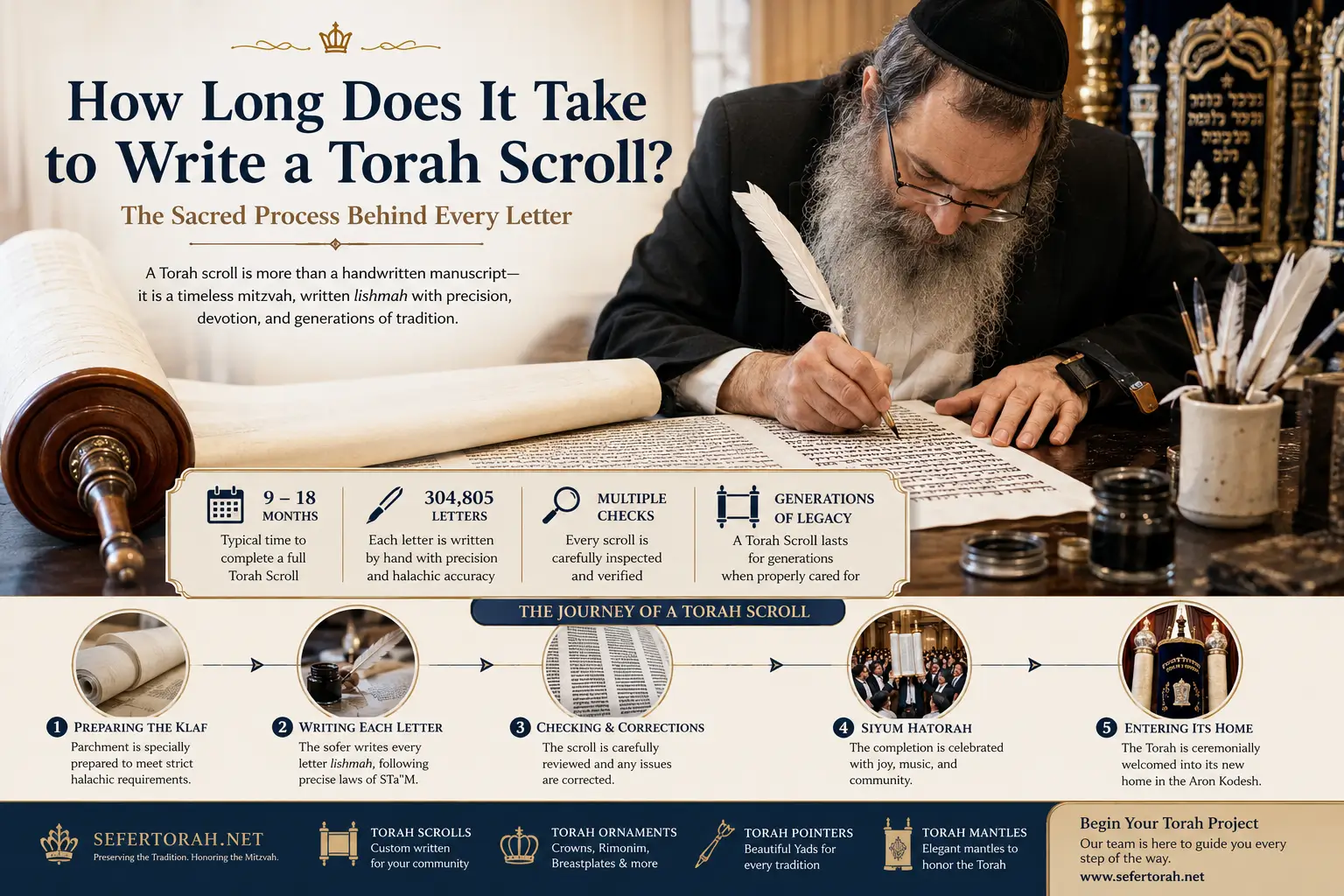
Writing a Sefer Torah is among the most demanding and revered forms of sacred craftsmanship in Jewish life. Every Torah scroll represents thousands of hours of disciplined work, meticulous preparation, and unwavering adherence to Halacha. Unlike printed books, a Torah scroll cannot be produced by machine or copied digitally. Each of its 304,805 Hebrew letters must be written individually by a qualified Sofer STa”M, using traditional materials and methods that have remained fundamentally unchanged for centuries.
For many synagogues, schools, and families considering commissioning a new Torah scroll, one of the first questions is: How long does it take to write a Torah Scroll? The answer depends on several important factors, including the experience of the sofer, the level of hidur sought, the writing schedule, and whether the project includes communal dedication events.
Understanding the timeline also provides a deeper appreciation for the extraordinary commitment behind every kosher Sefer Torah. The months invested in its creation are not simply a matter of careful handwriting—they reflect a sacred process governed by Jewish law, spiritual intention, and generations of scribal tradition.
Why Writing a Torah Scroll Takes So Long
A Torah scroll is far more than a handwritten manuscript. It is one of Judaism’s holiest ritual objects and must satisfy precise halachic requirements before it may be read publicly in the synagogue.
Every letter must be written lishmah—for the specific purpose of writing a Torah scroll—and each word must conform exactly to the traditional masoretic text. Even a seemingly minor omission, addition, or malformed letter may affect the scroll’s kosher status until corrected by a qualified sofer.
Unlike modern calligraphy, the work cannot be rushed. Throughout the writing process, the sofer maintains intense concentration while ensuring:
- Every letter is formed according to accepted STa”M traditions.
- Proper spacing is maintained between letters, words, and columns.
- Divine Names are written with special reverence and preparation.
- The ink, quill, and klaf (parchment) meet established halachic standards.
- Each section is completed with consistency from beginning to end.
This combination of technical precision and religious responsibility explains why producing a Torah scroll requires many months rather than weeks.
The Typical Timeline for Writing a Sefer Torah
For an experienced Sofer STa”M working consistently, writing a complete Torah scroll generally takes between nine months and eighteen months.
Several variables influence this timeframe.
Full-Time Writing
When a sofer is able to devote the majority of his working schedule to a single Torah project, completion often falls within approximately nine to twelve months. This assumes uninterrupted access to properly prepared klaf, regular writing sessions, and no unusual customization requirements.
Commissioned Community Torah Projects
Many Torah scrolls are commissioned by synagogues, schools, or Jewish organizations as community projects. These commissions frequently include dedication ceremonies, educational events, and opportunities for donors to symbolically participate in writing selected letters under the supervision of the sofer.
Because these events are scheduled throughout the project, completion often extends to twelve, fifteen, or even eighteen months.
Complex or Highly Mehudar Scrolls
Some communities request exceptionally refined Torah scrolls featuring a distinguished script tradition, enhanced aesthetic consistency, or work by a particularly renowned sofer. These projects naturally require additional time because every aspect of the writing receives heightened attention to detail.
Rather than viewing a longer timeline as a disadvantage, many buyers understand it as a reflection of the care devoted to producing a Torah that will serve generations of Jewish life.
Factors That Influence the Writing Process
No two Torah scroll projects are identical. Several important considerations determine how long the writing process will ultimately require.
The Experience of the Sofer STa”M
An experienced sofer develops remarkable consistency through years of study and practice. However, experience rarely means writing more quickly. In fact, highly respected sofrim often work deliberately, pausing frequently to inspect letter formation, maintain concentration, and ensure complete compliance with halachic standards.
Script Tradition (Ksav)
Different Jewish communities preserve distinct scribal traditions, including Ksav Beis Yosef, Ksav Ari, and Ketav Sefaradi. Each tradition has its own accepted letter forms and stylistic characteristics. Depending on the chosen ksav, certain aspects of the writing process may require additional care and precision.
If you are uncertain which script is appropriate for your synagogue or community, consulting your Rav before commissioning a Torah is generally recommended.
Preparation of the Klaf
The parchment itself plays a significant role in the overall timeline. Properly prepared klaf, produced specifically for STa”M use, must satisfy stringent halachic requirements before writing begins. Any imperfections discovered during preparation may require replacement before the project can continue.
Inspection and Correction
Writing the Torah is only part of the process. Before the scroll is considered ready for synagogue use, it undergoes careful review to identify missing letters, spacing irregularities, or other issues requiring correction. This quality-control stage is essential for ensuring that the finished Sefer Torah fully satisfies accepted halachic standards.
What Happens After the Torah Scroll Is Written?
Completing the final letter of a Sefer Torah does not immediately make the scroll ready for public Torah reading. Before it is placed in the Aron Kodesh and used in synagogue services, the scroll undergoes a series of essential inspections to verify its halachic integrity.
Traditionally, a qualified Sofer STa”M carefully reviews the completed Torah to identify any irregularities in letter formation, spacing, or layout. Many contemporary sofrim also utilize bedikah b’machshev (computer-assisted checking), which scans the scroll for missing letters, touching letters, spacing inconsistencies, and other potential concerns that require further review. Computer verification, however, does not replace the expertise of the sofer—it complements the careful human inspection required by Halacha.
Only after every necessary correction has been completed can the Torah Scroll be considered fully prepared for synagogue use.
Community Torah Projects and Siyum HaTorah
Many new Torah Scrolls are commissioned as community projects rather than private purchases. These projects often become meaningful educational and spiritual experiences that bring congregations together around a shared mitzvah.
Throughout the writing process, families, donors, schools, and synagogue members may participate in special dedication events. Under the direct supervision of the sofer, participants are often given the opportunity to symbolically complete selected letters, while the sofer ensures that every letter remains fully compliant with halachic requirements.
The completion of the final letters is traditionally celebrated with a Siyum HaTorah, a joyful ceremony marking the completion of the Torah Scroll before it is escorted to its new home. These celebrations frequently include music, dancing, communal prayer, and the formal dedication of the Torah to the synagogue or organization.
For many congregations, the year-long writing process becomes more than a commission—it becomes an enduring communal milestone.
Choosing the Right Sofer STa”M
When commissioning a Torah Scroll, the choice of Sofer STa”M is often more important than the speed of completion.
A qualified sofer possesses years of specialized training in the laws of STa”M and writes with the concentration and yirat shamayim expected for sacred texts. Beyond technical skill, buyers should consider the sofer’s reputation, experience, script tradition, and familiarity with the standards expected by their Rav or community.
Questions commonly discussed before beginning a commission include:
- Which ksav tradition is appropriate?
- What level of hidur mitzvah is desired?
- Will the Torah be used for daily synagogue readings or special occasions?
- Will the project include community writing events?
- What timeline is realistic for completion?
Working with an experienced provider helps ensure these questions are addressed before writing begins, allowing the project to progress smoothly from commission to dedication.
Commissioning a Torah Scroll
Every Torah Scroll commission reflects the unique needs of the community it will serve. Some congregations seek a Torah for daily synagogue use, while others commission a scroll to commemorate a significant anniversary, honor a loved one, establish a new congregation, or celebrate the growth of a Jewish school.
Before writing begins, buyers typically determine:
- the preferred script tradition,
- desired level of craftsmanship,
- anticipated completion schedule,
- dedication opportunities,
- and accompanying synagogue ornaments such as Torah mantles, Torah crowns, Torah breastplates (Hoshen), Torah pointers (Yads), and Rimonim.
Planning these details in advance allows both the sofer and the commissioning community to approach the project with clarity and shared expectations.
If you are considering commissioning a new Torah Scroll, our Torah Scrolls collection provides an overview of available script traditions and writing options. Communities seeking a complete presentation may also explore our selection of Torah Ornaments, Torah Mantles, Torah Pointers, Rimonim, and other synagogue accessories that complement the beauty and dignity of a newly completed Sefer Torah.
Why Communities Choose SeferTorah.Net
Commissioning a Torah Scroll is one of the most meaningful investments a synagogue or Jewish family can make. At SeferTorah.Net, we understand that buyers are not simply purchasing a sacred object—they are beginning a process that may become part of their community’s history for generations.
Our team provides knowledgeable guidance throughout the commissioning process, helping clients understand script traditions, craftsmanship, project timelines, and available Torah-related products. Whether you are searching for a new Sefer Torah, synagogue ornaments, or complementary STa”M items, we are happy to discuss your community’s needs and help identify appropriate options.
Conclusion
So, how long does it take to write a Torah Scroll? In most cases, the answer is between nine and eighteen months, depending on the scope of the project, the writing schedule, the chosen script tradition, and the level of craftsmanship required.
The timeline reflects far more than careful handwriting. Every stage—from preparing the klaf, to writing each of the 304,805 letters, to final inspection and dedication—is guided by Halacha, tradition, and profound respect for the sanctity of the Torah.
For communities planning to commission a new Sefer Torah, understanding this process helps establish realistic expectations while deepening appreciation for the remarkable skill, patience, and devotion invested by every Sofer STa”M. The finished Torah Scroll is not simply a completed manuscript—it is a living expression of Jewish continuity, crafted to inspire generations of Torah reading, learning, and communal worship.
Frequently Asked Questions
1. How long does it take to write a Torah Scroll?
A complete Sefer Torah typically takes between 9 and 18 months to write. The timeline depends on the sofer’s writing schedule, the level of hidur mitzvah, the chosen ksav tradition, and whether the project includes community dedication events. Every Torah Scroll is handwritten, making speed secondary to halachic accuracy and craftsmanship.
2. Why does writing a Torah Scroll take so much time?
A Torah Scroll contains 304,805 Hebrew letters, each of which must be written individually by a qualified Sofer STa”M using traditional materials and methods. Every letter must conform to precise halachic standards, and mistakes require careful correction before the scroll can be certified as kosher.
3. Can more than one sofer write the same Torah Scroll?
Yes. Under appropriate halachic supervision, multiple qualified sofrim may contribute to a Torah Scroll. However, many commissioned Torah Scrolls are written primarily by a single sofer to maintain consistency in letter formation, script style, and overall appearance.
4. What factors affect the writing timeline?
Several factors influence how long it takes to complete a Torah Scroll, including:
- The experience of the Sofer STa”M
- The chosen Ksav (Beis Yosef, Ari, or Ketav Sefaradi)
- The level of craftsmanship requested
- Community writing ceremonies
- Inspection and correction requirements
- The availability of properly prepared klaf
Each project is unique and should be planned according to the needs of the commissioning community.
5. How is a Torah Scroll checked before it is used?
Before a Torah Scroll is placed into synagogue service, it undergoes careful inspection by a qualified sofer. Many contemporary Torah Scrolls also receive bedikah b’machshev (computer-assisted verification), which helps identify missing or malformed letters, spacing irregularities, and other potential concerns. Final halachic approval always depends on expert human review.
6. Can a community participate in writing a Torah Scroll?
Yes. Many synagogue Torah projects include special dedication events where donors, families, and community members symbolically complete selected letters under the direct supervision of the sofer. These events culminate in a joyful Siyum HaTorah, celebrating the completion and dedication of the new Sefer Torah.
7. What should I consider before commissioning a Torah Scroll?
Before commissioning a Sefer Torah, buyers should discuss:
- The appropriate script tradition (Ksav Beis Yosef, Ksav Ari, or Ketav Sefaradi)
- The intended synagogue or communal use
- Desired level of hidur mitzvah
- Project timeline
- Dedication opportunities
- Matching Torah ornaments and synagogue accessories
Consulting an experienced Judaica specialist helps ensure the Torah reflects both your community’s minhag and long-term needs.
8. How long can a Torah Scroll last?
When written by a qualified Sofer STa”M, properly maintained, and inspected periodically, a Torah Scroll can remain kosher and in active synagogue use for many generations. Regular inspections and timely restoration help preserve both its physical condition and halachic validity.
9. Can an older Torah Scroll be restored instead of replaced?
In many cases, yes. A qualified sofer can evaluate an older Torah Scroll to determine whether damaged letters, worn parchment, or other issues can be repaired. Restoration is often an excellent option when the scroll retains historical, communal, or sentimental significance.
10. Where can I learn more about Torah Scrolls and related Judaica?
If you are considering commissioning a Torah Scroll or wish to learn more about Torah Scrolls, Torah Ornaments, Torah Pointers (Yads), Rimonim, Torah Mantles, or other synagogue Judaica, SeferTorah.Net offers expert guidance and a carefully curated selection of products that support Jewish communities, synagogues, schools, and collectors worldwide.