


What Are Torah Scroll Rollers Made Of?

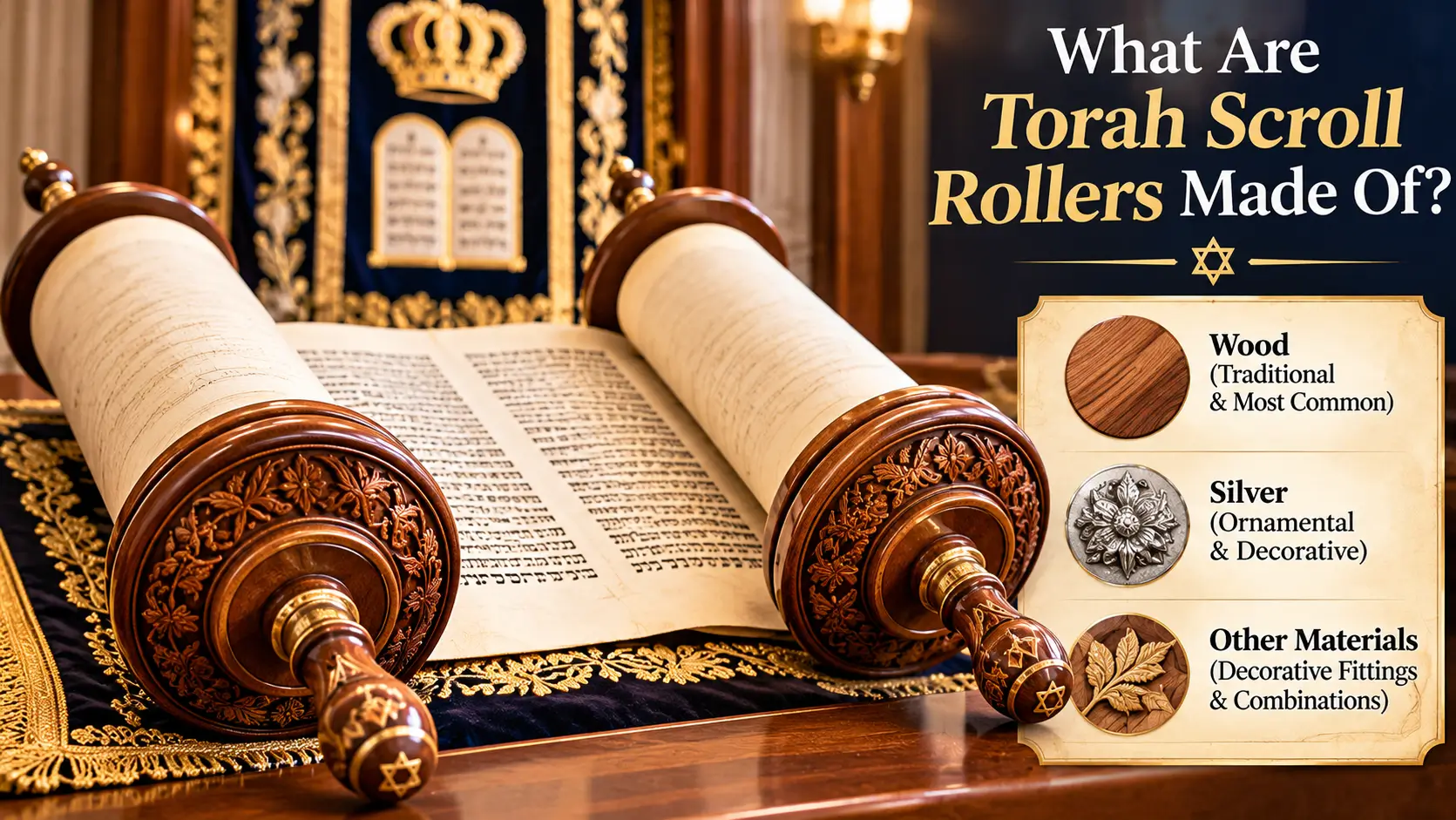
A Sefer Torah is written on parchment and attached to two shafts that allow the scroll to be rolled, held, and positioned for public reading. These shafts are known as Atzei Chayim (עצי חיים), meaning “Trees of Life.” They are among the most recognizable components of the traditional Torah scroll assembly, particularly in Ashkenazic communities.
The question of Torah scroll rollers material is more interesting than it may first appear. Although wooden rollers are the familiar traditional form, Jewish sources and historical examples show that their construction and decoration have not always been identical. Wood has a long-standing place in the design, but silver and other decorative materials have also been used.
Understanding what Atzei Chayim are made of requires looking at their practical function, their connection to Halacha, the differences between community customs, and the craftsmanship involved in making them. It also helps synagogue leaders and collectors choose suitable Torah Rollers that support the scroll safely while respecting its tradition.
1. What Are Torah Scroll Rollers?
Torah scroll rollers are the two shafts attached to the beginning and end of a Sefer Torah. The parchment is rolled around them, allowing the reader to move between different sections of the Five Books of Moses.
The Hebrew name Atzei Chayim is often translated as “Trees of Life.” The singular form is Etz Chayim. The name is associated with the verse in Mishlei (Proverbs 3:18): “It is a tree of life to those who grasp it.” This expression gives the rollers a meaningful connection to the life-giving wisdom of Torah.
Each shaft extends beyond the upper and lower edges of the parchment. These projecting sections serve as handles and provide a way to hold and turn the scroll without unnecessarily touching the written surface.
How the two rollers work
The two shafts have different roles depending on how the scroll is positioned:
- One shaft holds the parchment that has already been rolled.
- The other supports the section being opened for reading.
- Turning the shafts moves the parchment from one side to the other.
- The projecting handles allow the scroll to be held and adjusted during Torah reading.
The rollers are therefore functional components, not simply decorative accessories. Their dimensions, alignment, and condition influence how smoothly the scroll can be opened and closed.
2. What Material Are Torah Scroll Rollers Made Of?
The traditional and most familiar material is wood. Wooden shafts are commonly used in Torah scrolls that follow the open-scroll format associated with many Ashkenazic communities.
However, the phrase “Torah scroll rollers material” should not be understood as meaning that every roller must be made entirely from one material. The shafts, decorative fittings, end pieces, and handles may use different materials.
Wood: The traditional material
Wood is the standard material most people associate with Atzei Chayim. It is suitable for making long, rounded shafts that can be turned by hand and attached to the parchment.
Wood offers several practical advantages:
- It can be shaped into smooth, rounded shafts.
- It is relatively easy to work with and repair.
- It provides a comfortable surface for handling.
- It can be carved, polished, stained, or decorated.
- It can be made in different lengths and diameters to suit a scroll.
Historical Torah rollers demonstrate the variety of woodworking traditions used across Jewish communities. The Center for Jewish Art, for example, documents a pair of fifteenth-century Atzei Chayim from Piedmont carved from boxwood and decorated in a late Gothic style. This illustrates how the rollers could combine practical construction with the artistic traditions of their period.
Silver and other decorative metals
Silver is also associated with Torah roller craftsmanship, particularly in decorative fittings and ornamental elements. Some historical examples feature silver staves or silver-covered handles.
Chabad’s discussion of the two Torah rollers explains that Halacha does not require the shafts to be made specifically from wood and notes that beautifying them with silver can be praiseworthy. This distinction is important: traditional wooden construction is widespread, but it should not be confused with an exclusive material requirement.
In many examples, the structural shaft and its decorative fittings are made from different materials. A wooden core may be combined with silver plates, caps, rings, or other ornamental details.
Other metals and decorative materials may also appear in historical or contemporary craftsmanship. Their suitability depends on construction, weight, stability, and the way the rollers interact with the scroll.
3. Which Types of Wood Are Used for Torah Rollers?
Not every Torah roller is made from the same species of wood. The choice may depend on the maker, the community’s tradition, availability, the desired appearance, and the dimensions of the scroll.
It is important to distinguish between documented historical examples and general woodworking considerations. Jewish tradition establishes the role of the rollers, but it does not create one universal list of wood species that every synagogue must use.
Boxwood and historical examples
Boxwood is a documented material in historical Atzei Chayim. The Center for Jewish Art records a pair of fifteenth-century Torah staves from Piedmont made from boxwood. Their carved details show that rollers could be carefully crafted objects in their own right.
This example is useful because it demonstrates that Torah roller design has a long artistic history. The material was selected not only for its practical role but also for the craftsmanship and visual character it could provide.
Other hardwoods
Depending on the maker and the project, other workable woods may be considered for roller construction. Woodworkers commonly evaluate species according to:
- Density and strength.
- Grain consistency.
- Resistance to splitting.
- Stability as humidity changes.
- Ease of turning and finishing.
- Weight in relation to the scroll’s size.
Maple, beech, walnut, and similar woodworking materials may be encountered in general woodcraft, but their mention should not be taken as a claim that they are prescribed or universally traditional for Atzei Chayim.
The important consideration is not simply the name of the wood. The finished shaft must be stable, smoothly shaped, properly fitted, and suitable for the particular Sefer Torah.
4. Does Halacha Require Torah Rollers to Be Made of Wood?
This is an important question for anyone commissioning a Torah scroll or selecting replacement rollers.
The Rambam discusses the attachment of two wooden poles to the parchment in Mishneh Torah, Hilchot Tefillin, Mezuzah, and Sefer Torah, chapter 9. In chapter 9, the description explains how the parchment is attached to the shafts so the scroll can be rolled.
At the same time, later explanations of the Halachic discussion clarify that wood is not necessarily the only permissible material for the shafts. Chabad’s explanation of why a Torah has two rollers notes that the poles need not specifically be wooden and that silver may be used as an enhancement.
The practical distinction is between the traditional form and the underlying Halachic requirement. Wooden Atzei Chayim are the familiar custom in many communities, but the material question should not be reduced to a universal rule without considering the relevant sources and Minhag.
The importance of Minhag
A synagogue should consider its established community practice when choosing or replacing rollers. Ashkenazic communities commonly use an open Torah scroll with two projecting wooden shafts, while many Sephardic and Mizrahi communities traditionally house the scroll in an upright case called a tik.
A tik may be made from wood, silver, or other materials and is designed to hold the scroll in a different format. It is not simply a decorative cover placed over the same exposed roller arrangement.
When a synagogue is commissioning a new Sefer Torah, replacing Atzei Chayim, or changing its scroll fittings, it is sensible to consult the community’s Rabbi and a qualified Sofer STa”M.
5. How Are Torah Rollers Attached to the Parchment?
The attachment of the rollers is an important part of the scroll’s construction. The parchment must be secured in a way that allows it to move without placing unnecessary strain on the sheets or their seams.
The Rambam’s discussion in Hilchot Sefer Torah 9:14 describes leaving portions of parchment unsewn at the top and bottom when joining the sheets. This allows flexibility when the Torah is rolled. The remaining parchment at the beginning and end is attached to the two poles.
Traditional descriptions refer to sinew, or gidin, in the attachment and sewing process. This is distinct from the decorative materials that may be used on the outside of the rollers.
Why the attachment matters
A poorly fitted roller can cause practical problems:
- The parchment may not roll evenly.
- The scroll may become difficult to open or close.
- Uneven tension may place strain on the parchment.
- The scroll may shift on the shafts.
- A rough or damaged attachment area may contribute to wear.
For these reasons, the attachment should be carried out by someone familiar with Torah scroll construction. It is not an ordinary woodworking task. The person handling the work must understand both the physical structure of the scroll and the relevant STa”M requirements.
6. What Makes a Torah Roller Well Constructed?
A suitable Atzei Chayim should support the scroll’s movement and handling. Its design should be considered in relation to the scroll’s size, weight, and construction.
Smooth and even surfaces
The shafts should be smoothly finished, without splinters, sharp edges, or rough areas that could catch fabric or damage nearby components.
Appropriate dimensions
The length and diameter should be suitable for the scroll. Rollers that are too short may be awkward to handle, while unsuitable proportions can affect balance and the way the scroll rests.
Secure fittings
Decorative plates, caps, rings, or handles should be firmly attached. Loose fittings can move during handling and may create unnecessary risk.
Balanced construction
The two shafts should work together. Excessive differences in weight or shape may make the scroll harder to turn evenly.
Suitable finishing
Any stain, polish, or protective finish should be fully cured and appropriate for the intended use. Strong odors, sticky surfaces, flaking coatings, or finishes that transfer onto fabric are undesirable.
These are practical workmanship considerations, not a substitute for Halachic assessment. A qualified Sofer should be involved if the work affects the parchment, its attachment, or the scroll’s kosher status.
7. How to Care for and Maintain Torah Scroll Rollers
Atzei Chayim should be checked as part of a synagogue’s regular Torah care routine. Even when the parchment is in good condition, damaged rollers can make handling more difficult.
A practical inspection should include the following:
- Check for cracks: Look for splits, deep scratches, or signs that the wood is weakening.
- Inspect the surface: Make sure there are no splinters or rough areas.
- Examine the fittings: Check that decorative plates and handles remain secure.
- Test the movement: The scroll should roll without unusual resistance or uneven movement.
- Look for moisture damage: Swelling, discoloration, or a musty smell may indicate an environmental problem.
- Review the attachment: If the parchment shifts or the attachment appears loose, stop using the scroll until it has been assessed.
Do not apply household oils, furniture polish, wax, or cleaning chemicals to the rollers while they are attached to the Sefer Torah. Such products may transfer to the parchment, mantle, or other components.
If a roller is cracked, loose, or difficult to turn, do not attempt to glue, sand, or replace it while the Torah remains attached. Seek help from a qualified professional who understands Torah scroll construction.
8. Torah Rollers in Ashkenazic and Sephardic Traditions
The way a Torah scroll is supported and presented differs among Jewish communities. These differences reflect longstanding Minhag and the development of distinct forms of sacred Judaica.
Ashkenazic Torah scrolls
In many Ashkenazic communities, the Sefer Torah is mounted on two Atzei Chayim. The parchment is rolled between the shafts, and the scroll is dressed with a mantle and sash.
The rollers extend above and below the parchment, allowing the Torah to be carried and manipulated during reading. Silver Rimonim or a Torah Crown may be placed on the upper ends, depending on the community’s custom and the scroll’s design.
Sephardic and Mizrahi Torah cases
Many Sephardic and Mizrahi communities use a tik, an upright protective case that houses the Torah scroll. These cases may be made from wood, silver, or other materials and can feature elaborate decorative work.
The tik is a different approach to housing and presenting the Sefer Torah. It should not be confused with the exposed pair of Atzei Chayim commonly seen on an Ashkenazic-style scroll.
SeferTorah.Net‘s Sephardic Torah Cases category is relevant to communities seeking this traditional form of Torah housing. The choice between a tik and a mantle-and-roller arrangement should reflect the congregation’s Minhag and the construction of its scroll.
9. Choosing Torah Rollers for a Synagogue or Torah Commission
When selecting Atzei Chayim, the first consideration should be compatibility with the Sefer Torah. A decorative design should never take priority over safe construction and suitable dimensions.
Before purchasing or commissioning rollers, consider:
- Scroll measurements: Confirm the required length, diameter, and proportions.
- Community Minhag: Follow the synagogue’s established tradition.
- Material and weight: Consider whether the wood and fittings are appropriate for the scroll.
- Craftsmanship: Check the finish, balance, and security of decorative components.
- Attachment requirements: Ensure that the person fitting the rollers understands STa”M construction.
- Future maintenance: Consider whether the design can be inspected and repaired when necessary.
If the Torah is part of a new synagogue dedication, the rollers should be planned alongside the mantle, sash, and other accessories rather than selected as an afterthought.
10. Explore Torah Rollers and Related Judaica at SeferTorah.Net
A Sefer Torah’s presentation involves several related items, each with its own role in synagogue practice. At SeferTorah.Net, visitors can explore the SEFER TORAH and SYNAGOGUE categories to find products associated with Torah scrolls and their ceremonial use.
Relevant categories include:
- Torah Rollers: Atzei Chayim used to support and roll the parchment.
- Torah Scrolls: Sefer Torah scrolls for communities and congregations.
- Sephardic Torah Cases: Traditional protective cases used in Sephardic and related communities.
- Torah Mantles: Fabric coverings used with open-scroll arrangements.
- Torah Ornaments: Decorative accessories that honor the Sefer Torah.
- Rimonim: Finials traditionally placed on the upper ends of the rollers.
- Torah Crowns: Ornamental crowns used according to community custom.
- Torah Breastplates: Decorative breastplates used in certain traditions.
When considering a purchase, verify that the item is suitable for the scroll’s dimensions and the congregation’s custom. For Atzei Chayim in particular, confirm the measurements and fitting requirements before ordering.
Explore the Torah Rollers category at SeferTorah.Net to review available options for your synagogue or Torah scroll project.
Frequently Asked Questions About Torah Scroll Rollers Material
1. What are Torah scroll rollers made of?
Traditional Torah scroll rollers, called Atzei Chayim, are commonly made of wood. Some examples include decorative silver or metal fittings, and historical examples demonstrate that the materials and ornamentation have varied across communities and periods.
2. Are Torah scroll rollers always made of wood?
No. Wood is the familiar traditional material, but Chabad’s explanation of the Halachic discussion notes that the shafts do not necessarily have to be made of wood. Silver may also be used as a form of beautification. A synagogue should follow its relevant Minhag and seek Rabbinic guidance when making a change.
3. What does Atzei Chayim mean?
Atzei Chayim means “Trees of Life.” It is the Hebrew name for the two shafts attached to a Torah scroll. The name is associated with the verse in Mishlei (Proverbs 3:18), which describes Torah as a tree of life.
4. Why does a Torah scroll have two rollers?
The two rollers allow the parchment to be moved from one side to the other. One holds the rolled portion while the other supports the section being opened. Together, they make it possible to position the text for public reading.
5. Can silver be used to make Torah rollers?
Silver can be used in Torah roller construction or as an ornamental material. Chabad’s explanation notes that beautifying the poles with silver can be praiseworthy. The design should still be practical, balanced, and suitable for the scroll.
6. Are Torah rollers part of the parchment itself?
No. They are separate shafts attached to the beginning and end of the parchment. The parchment is secured to them as part of the scroll’s construction, allowing it to be rolled and handled.
7. Do Sephardic Torah scrolls use the same rollers as Ashkenazic scrolls?
Many Sephardic and Mizrahi communities traditionally house the Torah in an upright case called a tik. Many Ashkenazic communities use an open-scroll arrangement with two projecting Atzei Chayim and a mantle. Practices vary, so the community’s Minhag should guide the choice.
8. How should wooden Torah rollers be cleaned?
They should be inspected and maintained carefully. Avoid applying household polish, oil, wax, or chemical cleaners while the rollers are attached to the scroll. If cleaning or repair is needed, consult someone experienced in Torah scroll care.
9. When should Torah rollers be replaced?
Replacement or repair may be necessary if a shaft is cracked, unstable, badly worn, or no longer supports smooth movement. The scroll should not be forced or modified casually. A qualified professional should assess the rollers and their attachment before work begins.
Conclusion
Torah scroll rollers are more than wooden handles. Known as Atzei Chayim, they support the parchment, enable the scroll to be opened and closed, and form an important part of the traditional presentation of the Sefer Torah.
Wood remains the familiar material, while silver and other decorative elements appear in historical and contemporary examples. Halachic discussions also show that the material question is more nuanced than a simple rule that every roller must be wooden.
For synagogue leaders, collectors, and those commissioning a Sefer Torah, the best approach is to consider material, construction, dimensions, community Minhag, and professional fitting together. Whether choosing traditional wooden Atzei Chayim or a design incorporating silver, the guiding priorities should remain safe handling, respect for the Torah, and the preservation of its sacred parchment for future generations.