


Mezuzah Sizes Explained

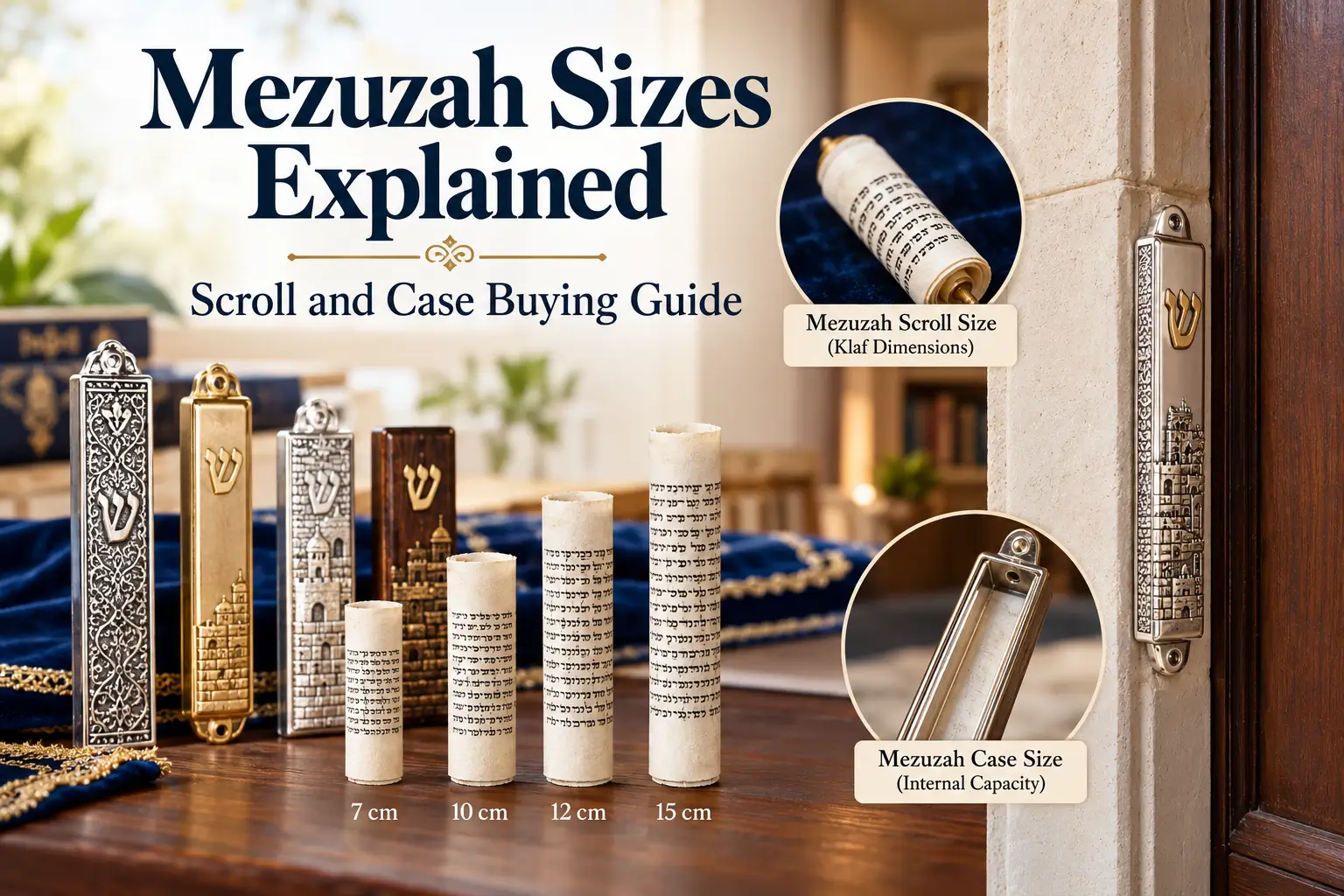
Choosing a mezuzah involves more than selecting a decorative case for a doorway. The parchment scroll, known as a klaf, must be written according to the laws governing STa”M, while the case must accommodate and protect that scroll. Understanding the difference between scroll dimensions and case dimensions helps buyers select suitable Judaica without confusing appearance with Halachic validity.
This guide to Mezuzah Sizes Explained covers common scroll measurements, how to match a scroll with its case, what Jewish law requires, and what to consider when purchasing mezuzot for a home, office, or synagogue.
One important point should be clear from the beginning: a larger mezuzah scroll is not automatically more kosher than a smaller one. Correct writing, suitable parchment, the integrity of every letter, and compliance with Halacha are fundamental. Size is a practical consideration, while the quality and validity of the scroll must be assessed separately.
1. Understanding Mezuzah Scroll Sizes
A mezuzah scroll contains the two Torah passages associated with the mitzvah: Shema Yisrael (Deuteronomy 6:4–9) and Vehayah im shamoa (Deuteronomy 11:13–21). A qualified sofer STa”M writes these passages by hand on appropriate parchment, following the relevant scribal laws.
Commercial mezuzah scrolls are commonly sold in sizes such as 7 cm, 10 cm, 12 cm, and 15 cm, although availability varies by seller and larger or smaller options may also exist. These measurements generally refer to the length of the prepared scroll before it is rolled, not the exterior length of the case.
Common Mezuzah Scroll Measurements
| Scroll size | Practical considerations |
|---|---|
| 7 cm | A compact option where space is limited, provided the scroll is properly written and suitable for the intended use. |
| 10 cm | A commonly available size that may fit many standard cases. |
| 12 cm | A larger option requiring a case designed to accommodate its dimensions. |
| 15 cm | Often selected for larger cases or when a more substantial scroll is desired. |
| Larger sizes | May be available for particular requirements or preferences; check availability and case compatibility. |
These are commercial size categories, not a universal Halachic ranking. The exact dimensions, usable interior space, and available scribal traditions should be confirmed with the seller before ordering.
Does a Larger Mezuzah Scroll Have an Advantage?
A larger scroll may provide more physical space for writing, depending on the layout and the sofer’s work. Some buyers prefer larger lettering or a more substantial presentation. However, size alone does not establish that the writing is more accurate, that the parchment is better, or that the mezuzah is kosher.
A smaller scroll can be kosher when it meets the applicable requirements. Conversely, a large scroll can be invalid if it contains a disqualifying writing error. Ask about the scroll’s provenance, inspection, script, and condition rather than judging it by dimensions alone.
2. Mezuzah Scroll Size vs. Mezuzah Case Size
One of the most common purchasing mistakes is confusing the scroll’s size with the case’s exterior measurements.
A case advertised as 15 cm long may have less usable interior space than expected, while a larger decorative case may accommodate several scroll sizes. Product descriptions are not always standardized, so verify the manufacturer’s stated scroll capacity.
Before buying, check three measurements:
- Scroll length: The stated length of the klaf before rolling.
- Internal case capacity: The space available for the rolled parchment.
- Exterior case dimensions: The full height, width, and depth of the finished case.
The internal space must accommodate the scroll safely without forcing it into place. A case that is too small can damage the parchment or prevent proper closure. A scroll that is much smaller than the case may also move around if it is not secured appropriately.
Can a Smaller Scroll Fit in a Larger Case?
Sometimes. Compatibility depends on the case’s construction, the rolled scroll’s diameter, and how the parchment is secured. A larger case does not necessarily accept every smaller scroll safely, particularly when its shape is narrow or irregular.
The safest approach is to select a case whose specifications explicitly list the scroll size it accommodates. If you are buying the scroll and case separately, confirm compatibility with the seller first.
3. What Does Halacha Say About Mezuzah Size?
Halacha does not establish one universal retail measurement in centimeters that every mezuzah scroll must follow. The central requirements concern the parchment, the writing, the arrangement of the passages, and the validity of the scroll—not a commercial size label.
The Rambam’s Mishneh Torah, in Hilchot Tefillin, Mezuzah veSefer Torah, chapter 5, describes the writing of the mezuzah passages and the importance of their proper arrangement. The relevant laws also address the margins and form of the writing. These requirements cannot be replaced by simply purchasing a scroll of a particular length.
Parchment, Writing, and Letter Integrity
A kosher mezuzah must be written by an appropriately qualified sofer on suitable parchment, with the passages written in the required order and the letters formed according to the applicable scribal laws.
A missing, damaged, or incorrectly formed letter may affect validity. Some defects may be correctable under Halacha, while others are not. Such questions require examination by a qualified authority; the external size of the scroll cannot reveal whether it is valid.
For this reason, buyers should look for clear information about who wrote the scroll, the scribal tradition followed, and what inspection it has undergone.
Script and Community Custom
Different communities follow established scribal traditions, including forms of Ksav Beis Yosef, Ksav Ari, and Sephardic scripts. The appropriate choice depends on the buyer’s community and custom.
Do not assume that two scrolls of identical dimensions use the same script or follow the same tradition. If you are uncertain which form is appropriate for your household or synagogue, consult your rabbi or a knowledgeable STa”M professional.
4. How to Choose the Right Mezuzah Size for Your Home
For most buyers, the practical decision involves three questions: which kosher scroll is appropriate, which case can accommodate it, and where the mezuzah will be installed.
Interior Doorways
For an interior doorway, first determine which scroll sizes are available in the preferred scribal tradition. Then select a case designed for that size. A compact case may be suitable where the doorframe has limited space, but the scroll must remain protected and the case must be securely affixed.
Do not choose a scroll solely because it is the smallest option. Confirm its suitability and validity with a reputable seller.
Main Entrance Doors
Some households prefer a larger scroll or a more prominent case for the main entrance. This may reflect personal preference or a desire for hidur mitzvah—beautifying the performance of a mitzvah.
However, a larger scroll is not automatically a superior Halachic choice. The scroll must still be kosher, suitable for the household’s custom, and properly placed according to the applicable laws.
Offices, Apartments, and Synagogue Buildings
For a building with many doorways, planning ahead can prevent compatibility problems. Create an inventory of the relevant doorways, determine which require a mezuzah according to Halacha, and record the preferred scroll and case sizes.
Not every opening is necessarily obligated in the same way. Room dimensions, doorway construction, use, and other details can affect the ruling. Consult a rabbi about uncertain or borderline cases rather than deciding solely from a measurement chart.
5. How to Measure Before Buying a Mezuzah Case
Accurate measurements are particularly important when purchasing decorative cases, ordering several mezuzot, or replacing an existing case.
Follow these steps:
- Check the scroll specification. Confirm the scroll’s stated length and any relevant dimensions supplied by the seller.
- Review the case’s capacity. Look for an explicit statement of the scroll sizes the case can hold.
- Measure the available installation area. Check the doorpost’s width and the surrounding space to ensure the case can be attached securely without interfering with the door.
- Consider the environment. An exposed entrance may require a case designed for outdoor conditions and protection from moisture.
- Confirm the fit before installation. If the scroll and case are separate purchases, have the seller verify that they are compatible.
Never force a rolled parchment into a narrow case or trim the parchment to make it fit. If the scroll does not fit, choose an appropriate case or seek guidance from the seller.
6. Choosing a Mezuzah Case: Materials, Protection, and Design
The case protects the parchment and can also contribute to the appearance of a doorway. Mezuzah cases are available in many materials and styles, from simple protective designs to decorative pieces made from metal, wood, glass, or other materials.
When choosing a case, consider:
- Protection: The case should shield the parchment from ordinary exposure and accidental damage.
- Fit: Its internal dimensions must accommodate the scroll without squeezing or damaging it.
- Durability: Outdoor installations may face rain, sunlight, humidity, and temperature changes.
- Access: The case should permit appropriate inspection or replacement of the scroll.
- Design: Decorative choices can reflect personal taste and the style of the home, provided the case remains suitable for its intended use.
A transparent case also requires attention to the setting in which it will be used. Questions about exposure of sacred writing, the room’s use, and appropriate covering should be discussed with a rabbi when relevant.
7. Buying Mezuzah Scrolls and Cases from SeferTorah.Net
Once you understand the difference between scroll dimensions and case capacity, you can compare products more confidently. SeferTorah.Net offers dedicated categories for both the parchment scroll and the protective case, making it easier to consider these as related but distinct purchases.
Explore the Mezuzah Scrolls category when choosing the written parchment, and browse Mezuzah Cases for protective cases in different styles and dimensions.
Before ordering, verify the scroll size, scribal tradition, and inspection details. For a case, check the stated internal capacity, exterior measurements, and suitability for the intended location. If you are furnishing several doorways, confirming these details in advance can help you order compatible items.
You may also wish to explore SeferTorah.Net’s Tefillin Sets and Torah Scrolls categories when researching other STa”M items. Each has its own requirements, so advice specific to mezuzah scrolls should not be applied automatically to tefillin or Torah scrolls.
A well-informed purchase considers the validity of the scroll, the needs of the household, and the suitability of the case—not size alone.
8. Mezuzah Size and Long-Term Care
Selecting the correct size is only the beginning. A mezuzah scroll must also be protected from conditions that can damage parchment or ink.
Moisture, direct exposure to the elements, and unsuitable storage can compromise the scroll. Choose a case appropriate for the installation environment, and avoid opening or unrolling the parchment unnecessarily.
Mezuzot should be checked according to the applicable Halachic guidance and community practice. If a case has leaked, the parchment has become wet, or damage is suspected, consult a qualified sofer or rabbinic authority. Do not assume that a scroll remains kosher simply because its exterior looks intact.
A case’s size and material can help protect the scroll, but neither can guarantee its ongoing validity. Periodic inspection and appropriate handling remain important.
Frequently Asked Questions About Mezuzah Sizes Explained
1. What is the standard size of a mezuzah scroll?
There is no single universal retail size. Common commercial options include 7 cm, 10 cm, 12 cm, and 15 cm, with other sizes available. The right choice depends on the scroll’s suitability, the buyer’s custom, and the case’s capacity.
2. Does a larger mezuzah scroll have to be more kosher?
No. Size alone does not determine whether a mezuzah is kosher. The parchment, writing, letter formation, order of the passages, and other Halachic requirements are central to validity. A larger scroll may be preferred by some buyers, but it is not automatically more valid.
3. How do I know which size mezuzah case to buy?
Check the scroll’s stated size and the case manufacturer’s internal capacity. Do not rely only on the exterior length of the case. If you are buying the scroll and case separately, ask the seller to confirm that the two are compatible.
4. Can I put a 10 cm scroll in a 15 cm case?
Possibly, but it depends on the case’s design and how the rolled parchment is secured. A scroll should not move around unnecessarily or become damaged. Confirm compatibility with the manufacturer or seller before purchase.
5. Are small mezuzah scrolls kosher?
A small scroll can be kosher if it meets all applicable requirements. Commercial size alone does not establish validity. Because the writing and parchment must comply with Halacha, buy from a reliable source and seek qualified guidance if you have concerns.
6. Does the size of the door determine the size of the mezuzah?
Not directly. Doorway dimensions can affect the placement of the mezuzah and the available room for its case, but they do not automatically prescribe a particular scroll size. Questions about whether a doorway requires a mezuzah should be resolved according to Halacha.
7. Are Ashkenazic and Sephardic mezuzah scrolls available in different sizes?
Both Ashkenazic and Sephardic scrolls may be offered in various commercial sizes, depending on the seller. The more important distinction is the scribal tradition and the community custom the scroll is intended to follow. Confirm both the script and dimensions when ordering.
8. Can I trim a mezuzah scroll if it is too large for the case?
No. Do not cut or alter the parchment to make it fit. Doing so can damage the scroll and raise serious Halachic concerns. Obtain a properly sized case or consult a qualified sofer about the situation.
9. How often should a mezuzah scroll be checked?
The accepted checking schedule can depend on the circumstances and applicable Halachic guidance. Common guidance calls for checking residential mezuzot twice in seven years, while mezuzot used in public settings may have a different schedule. Ask your rabbi or qualified sofer what applies to your situation, especially after exposure to moisture or suspected damage.
10. Should I buy the mezuzah scroll and case together?
Buying them together can simplify size matching, but it is not essential. If purchasing separately, confirm that the case accommodates the scroll and that the scroll follows the appropriate scribal tradition. In either case, make sure the product information clearly distinguishes the written scroll from the decorative case.
Understanding mezuzah sizes means distinguishing the dimensions of the handwritten scroll from the external size and capacity of its case. Common retail measurements can help with shopping, but they do not replace the Halachic requirements governing a kosher mezuzah.
Before purchasing, confirm the scroll’s size, scribal tradition, and inspection information, then select a case that protects the parchment and fits the intended doorway. For uncertain doorways, installation questions, or concerns about a scroll’s validity, seek guidance from a qualified rabbi or sofer.
With careful selection and appropriate care, the mezuzah can be housed securely and maintained with the respect due to this important mitzvah.