


What Is a Torah Pointer (Yad)? A Guide to Its Meaning, Use & Tradition

What Is a Torah Pointer (Yad)?
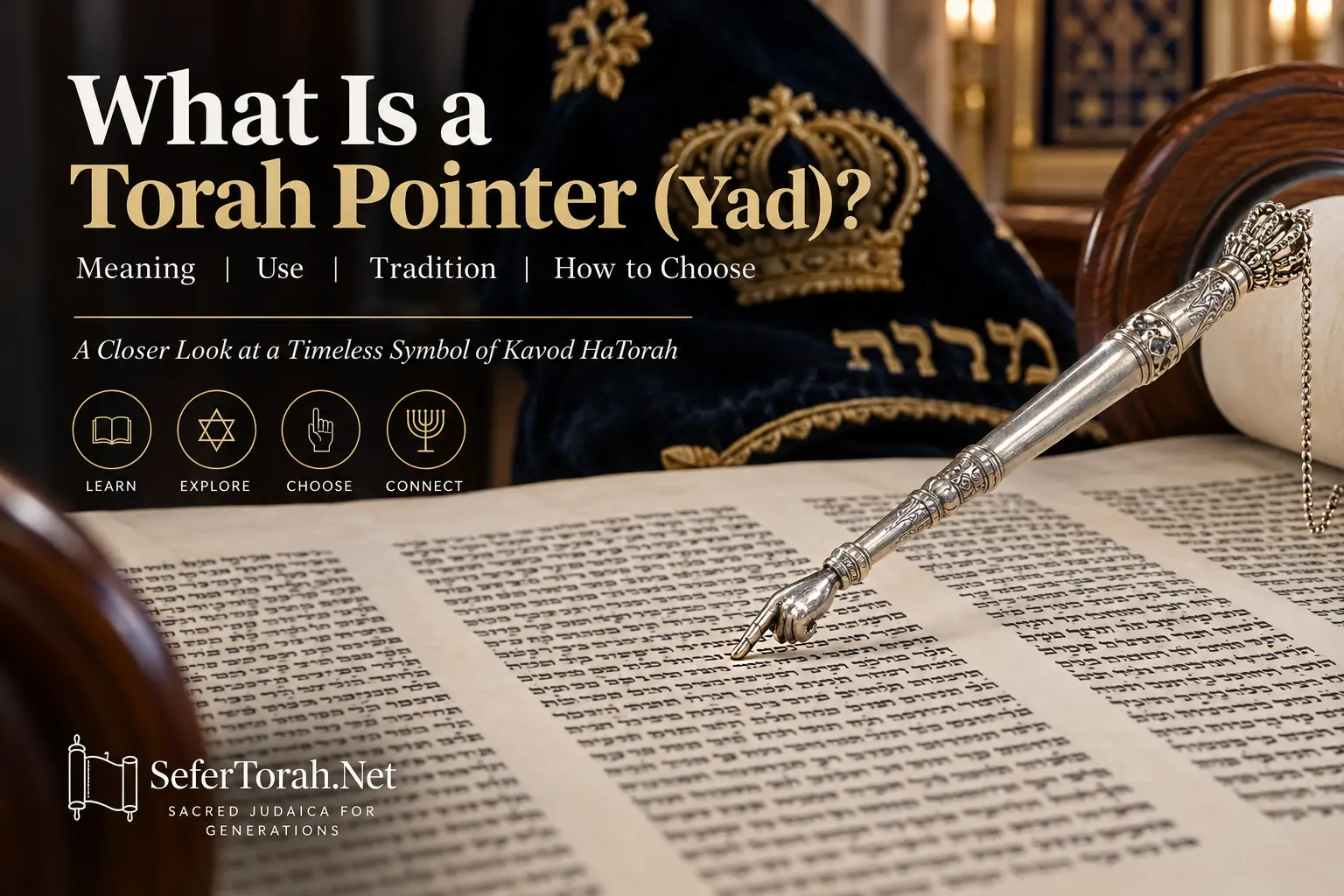
A Torah pointer, commonly called a Yad, is a ceremonial pointer used to follow the text of a Sefer Torah during public Torah reading. The Hebrew word Yad means “hand,” and the name reflects the shape of the pointer, which traditionally ends in a small hand with an extended index finger.
Although the Yad is not part of the Torah scroll itself, it has an important practical role in the synagogue. It allows the reader to follow the words on the parchment without placing a finger directly on the sacred klaf. Over generations, the Yad has also developed into an object of Jewish craftsmanship, with examples made from silver, gold, nickel, wood, ivory substitutes, and other materials.
For synagogues, families, and collectors, understanding what is a Torah pointer (Yad) means looking beyond its appearance. Its design, materials, craftsmanship, and relationship to the dignity of the Sefer Torah all have a place within Jewish tradition.
What Is a Torah Pointer (Yad) Used For?
The primary purpose of a Yad is straightforward: it helps the Torah reader follow the text while reading from the Sefer Torah.
A Torah scroll is handwritten on parchment, and the columns contain closely arranged Hebrew letters without the familiar punctuation and formatting found in a printed Chumash. During Torah reading, the reader must maintain an exact place in the text.
The Yad provides a precise visual guide.
As the reader progresses through the reading, the pointer moves along the line of text. This is particularly useful because the reader’s hand does not need to touch the parchment.
The Yad therefore serves both a practical function and a ceremonial one.
It is not simply a decorative accessory placed beside the Torah. Its design developed around the needs of Torah reading while also reflecting the broader Jewish principle of kavod haTorah, showing honor and respect for the Torah.
Why Is It Called a Yad?
The Hebrew word Yad (יד) literally means “hand.”
Traditional Torah pointers commonly terminate in a hand-shaped design with one finger extended toward the text. This explains both the physical appearance of many pointers and their Hebrew name.
The hand motif has become one of the most recognizable features of a Torah Yad. Depending on the style, the hand may be highly detailed or represented in a more restrained artistic form.
The rest of the pointer is generally elongated and narrow, allowing the reader to indicate a particular line or word without obstructing the surrounding text.
For this reason, when someone asks what is a Torah pointer (Yad), the simplest answer is a hand-shaped pointer used to follow the Torah reading. Its significance, however, extends into Jewish ritual practice and synagogue craftsmanship.
Is a Yad Required to Read the Torah?
A useful distinction is necessary here.
The Yad is an established and traditional Torah-reading accessory, but it should not be confused with the Sefer Torah itself or with the essential requirements governing the writing and kosher status of the scroll.
The Torah can be read from a kosher scroll without treating the Yad as an intrinsic component of the scroll. Nevertheless, using a pointer has become standard practice in many communities because it facilitates reading and helps prevent unnecessary contact with the parchment.
Halachic practice concerning the handling of a Sefer Torah is an area in which details matter. A synagogue should follow the guidance of its rabbi and its established minhag rather than treating every decorative or practical custom as a universal Halachic requirement.
This distinction is important when evaluating Judaica: traditional importance does not always mean the same thing as Halachic necessity.
The Connection Between a Yad and Kavod HaTorah
One of the most important concepts surrounding Torah furnishings is kavod haTorah, the honor accorded to the Torah.
A Sefer Torah is treated with exceptional respect because it contains the written Torah. That respect is reflected not only in how the scroll is written and stored but also in the way it is handled and used during services.
A Yad contributes to that environment of respect.
Rather than touching the parchment unnecessarily while following the reading, the reader uses a dedicated instrument designed for the task. Over time, communities have also commissioned beautifully crafted Yad pointers as part of the broader collection of objects associated with a Torah scroll.
This is where Hidur Mitzvah can become relevant. Jewish tradition places value on beautifying mitzvot and sacred objects, provided that artistic enhancement remains appropriate to their purpose and dignity.
How Are Torah Pointers Made?
Torah pointers vary considerably in craftsmanship.
Traditional examples may be:
- Sterling silver
- Silver-plated metal
- Gold
- Nickel
- Brass
- Aluminum
- Wood
- Other decorative materials
The material itself does not automatically determine the religious value of a Yad. Rather, buyers should consider craftsmanship, durability, suitability for regular synagogue use, and whether the design complements the community’s traditions.
Handcrafted Torah Pointers
Hand chasing, engraving, hammering, embossing, filigree, and other metalworking techniques can produce distinctive surfaces and patterns.
A silver hand-chased Yad for Torah, for example, may contain individually worked decorative details rather than a completely uniform manufactured surface.
Other designs may incorporate Jerusalem imagery, floral patterns, geometric ornamentation, or motifs associated with Jewish tradition.
The goal should not simply be ornamentation. A well-designed Yad should remain functional and comfortable for the Torah reader.
What Should You Look for When Choosing a Torah Pointer?
If you are purchasing a Yad for a synagogue, family Sefer Torah, Bar Mitzvah, dedication, or Judaica collection, several practical considerations deserve attention.
1. Length and Proportion
The pointer should be long enough to reach the Torah text comfortably while remaining easy to control.
An excessively heavy or poorly balanced Yad can be inconvenient during a Torah reading. A pointer should feel natural in the reader’s hand.
2. Grip and Handling
The handle should provide a secure grip.
Decorative work is valuable, but excessive ornamentation should not make the pointer difficult to hold or use.
3. Durability
A synagogue Yad may be handled frequently. Materials and construction should therefore be selected with regular use in mind.
For a presentation or dedication piece, artistic detail may carry greater importance. For a frequently used synagogue Yad, durability and handling should receive equal consideration.
4. Craftsmanship
Look carefully at the workmanship.
Engraving, chasing, embossing, and other decorative techniques should be clean and consistent. On handcrafted Judaica, small variations can sometimes reflect the handmade nature of the piece rather than a manufacturing defect.
5. Community Tradition
Different Jewish communities have different aesthetic traditions.
A Sephardic synagogue may favor a different visual vocabulary from an Ashkenazic congregation, while Chabad and other communities may have their own preferences.
There is no need to impose one decorative style universally. The most appropriate Yad is one that serves the synagogue while fitting its established traditions.
Torah Pointers as Gifts and Dedications
A Yad can also carry considerable personal significance.
Families may dedicate a Torah pointer in memory of a loved one, in honor of a Bar Mitzvah, or as part of a synagogue or Sefer Torah dedication.
In such circumstances, the object becomes more than a functional accessory. It can become part of the community’s ongoing relationship with a particular Sefer Torah.
A personalized dedication may be engraved on the Yad or incorporated into accompanying documentation, depending on the design and the wishes of the donor.
When selecting a dedication piece, consider both its long-term usefulness and the significance of the occasion. A synagogue may use the same Yad for many years, making craftsmanship and durability particularly important.
Torah Pointer vs Other Torah Ornaments
A Yad is one part of a broader group of objects associated with a Sefer Torah.
Depending on community tradition, these may include:
- Atzei Chaim — the wooden rollers around which the Torah is wound
- Torah mantle — the fabric covering placed over the scroll
- Rimonim — decorative finials placed on the Torah rollers
- Keter Torah — a Torah crown
- Hoshen — a breastplate or decorative Torah ornament
- Yad — the pointer used during Torah reading
These objects serve different purposes.
The Yad is primarily associated with following the text during reading, while the other ornaments generally serve protective, ceremonial, or decorative functions.
Understanding these distinctions is useful when furnishing a synagogue or planning a Torah dedication because it allows donors to choose an object according to its actual role rather than simply its appearance.
Choosing a Yad for Your Sefer Torah
When purchasing a Torah pointer, start with the intended use.
For a synagogue, prioritize:
Function → durability → comfortable handling → craftsmanship → design.
For a dedication or gift, you may place greater emphasis on:
Meaning → craftsmanship → personalization → materials → presentation.
For collectors, historical style, artistic technique, provenance, and compatibility with an existing Judaica collection may also be important.
At SeferTorah.Net, you can explore a range of Torah pointers and related Torah ornaments, including silver, gold, nickel, hammered, hand-chased, and Jerusalem-inspired designs. The selection can be considered alongside related synagogue Judaica and Sefer Torah accessories when creating a coordinated collection.
Whether you are looking for an ornate Yad Torah pointer, a silver hand-chased Yad, a gold Torah pointer, or a more understated synagogue Yad, the most important consideration is that the object combines practical usefulness with the dignity appropriate to Torah reading.
Frequently Asked Questions
1. What is a Torah pointer (Yad)?
A Torah pointer, or Yad, is a narrow pointer traditionally ending in a hand-shaped design with an extended finger. It is used by the Torah reader to follow the text of a Sefer Torah during public reading.
2. Why is a Torah pointer called a Yad?
Yad is the Hebrew word for “hand.” The name refers to the hand-shaped end of the traditional pointer.
3. Is a Yad required for Torah reading?
The Yad is a traditional and widely used Torah-reading accessory, but it should not be confused with an essential component of the Sefer Torah itself. Specific Halachic questions should be directed to the community’s rabbi.
4. Why don’t readers simply touch the Torah?
The Yad allows the reader to follow the text without placing a finger directly on the parchment. It also provides a precise visual guide while reading.
5. What materials are Torah pointers made from?
Torah pointers can be made from silver, gold, nickel, brass, aluminum, wood, and other materials. Craftsmanship and suitability for use are important considerations alongside material.
6. Can a Torah Yad be engraved?
Yes. Many Yad pointers are suitable for engraving or dedication, making them appropriate for synagogue gifts, memorial dedications, Bar Mitzvahs, and other occasions.
7. What is the difference between a Yad and Rimonim?
A Yad is used to follow the Torah text during reading. Rimonim are decorative finials placed on the Torah rollers. They serve different functions within the Torah’s traditional furnishings.
8. How do I choose the right Torah pointer?
Consider the Yad’s length, weight, grip, durability, craftsmanship, decorative style, and intended use. Synagogues should also consider their community’s minhag and aesthetic tradition.
9. Is a silver Yad better than a nickel or aluminum Yad?
Not necessarily. Material alone does not determine whether a Yad is more appropriate. The intended use, workmanship, durability, handling, and community preference should all be considered.
10. Where can I buy a Torah pointer?
A Torah pointer can be purchased from established Judaica suppliers offering Yad pointers in different materials and styles. When purchasing, look beyond appearance and consider craftsmanship, intended use, and the supplier’s familiarity with Torah and synagogue Judaica.
Conclusion
A Torah pointer (Yad) is a small object with an important place in the practical and ceremonial life of a synagogue. Its immediate purpose is to help the reader follow the words of the Sefer Torah, while its traditional hand-shaped design reflects the Hebrew meaning of Yad.
For generations, Jewish craftsmen have transformed this functional instrument into an object of Judaica that can also express kavod haTorah, craftsmanship, community tradition, and personal dedication.
Whether selecting a Yad for regular synagogue use, a Sefer Torah dedication, a Bar Mitzvah, or a meaningful Judaica gift, the best choice begins with understanding its purpose. Function, Halachic awareness, craftsmanship, durability, and respect for Jewish tradition should guide the decision.
At SeferTorah.Net, Torah pointers can be explored alongside Sefer Torah accessories and Torah ornaments, allowing families and congregations to choose pieces that are both useful and appropriate for the dignity of Torah reading.