


What Makes a Mezuzah Kosher?

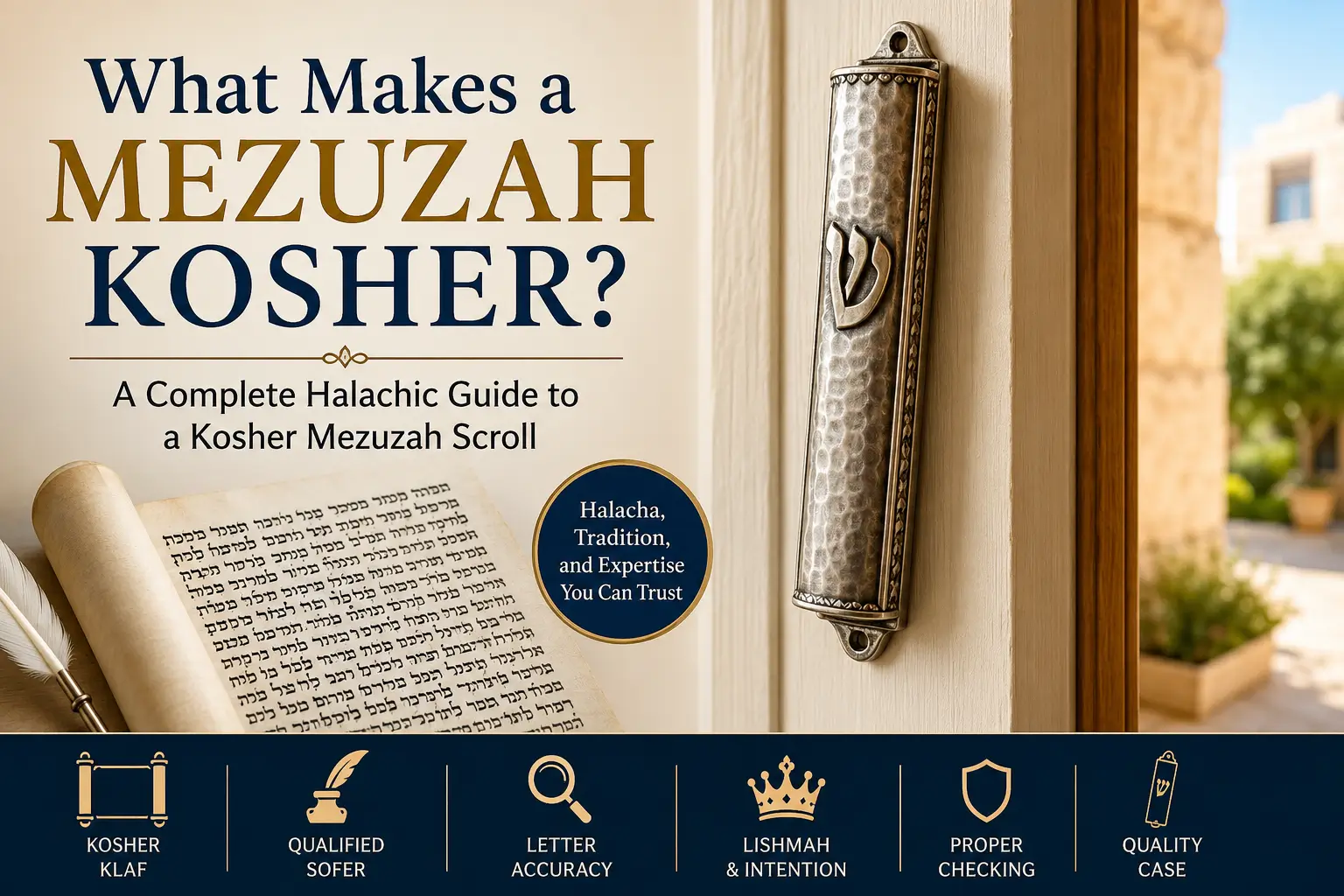
A kosher Mezuzah is not simply a parchment containing Hebrew verses placed inside a decorative case. The mitzvah of Mezuzah depends on a carefully prepared scroll written according to detailed Halachic requirements by a qualified Sofer STa”M. The parchment, ink, script, order of the letters, formation of each letter, and manner in which the Mezuzah is written all matter.
For this reason, determining what makes a Mezuzah kosher requires looking beyond its appearance. A beautifully designed Mezuzah case does not make the scroll inside kosher, and a scroll that appears correct to an untrained eye may contain deficiencies that only an experienced Sofer or qualified checker can identify.
At SeferTorah.Net, our Mezuzah collection is intended for buyers who take the mitzvah seriously and want to understand what they are purchasing. The following guide explains the principal elements that determine the Kashrut of a Mezuzah and what to consider when purchasing one.
What Is Actually the Mezuzah?
In common usage, the word “Mezuzah” can refer either to the complete object mounted on a doorway or, more precisely, to the handwritten parchment scroll itself. Halachically, it is the scroll that contains the essential mitzvah; the decorative case is a protective housing for that scroll.
The scroll contains two passages from the Torah: Shema (Devarim 6:4–9) and Vehayah Im Shamoa (Devarim 11:13–21). These passages contain the Torah’s command to write these words upon the doorposts of one’s house and gates.
Consequently, purchasing an elaborate Mezuzah case without a kosher scroll does not fulfill the mitzvah. When evaluating a Mezuzah, the scroll itself must always be the primary consideration.
Kosher Klaf — The Parchment Matters
One of the first requirements of a kosher Mezuzah is the klaf, the specially prepared parchment upon which the text is written.
The parchment must come from the hide of a kosher animal species and must be prepared for use in sacred writing. Traditional STa”M production involves a specialized tanning and preparation process, and the preparation itself has Halachic requirements.
The physical quality and preparation of the klaf also affect the writing. The surface must allow the Sofer to form the letters properly and maintain their integrity over time.
A buyer should therefore be cautious about Mezuzah scrolls that appear unusually inexpensive or are produced using questionable materials. Some parchment may also be coated to create an exceptionally smooth writing surface. Such coatings raise Halachic concerns and can create additional problems if the coating cracks and damages the letters.
For a buyer, the practical lesson is straightforward: the provenance and preparation of the klaf matter just as much as the appearance of the finished writing.
The Mezuzah Must Be Handwritten
A kosher Mezuzah is handwritten by a qualified Sofer. A printed copy, photocopy, or mechanically reproduced text cannot substitute for the required handwritten scroll.
The Sofer is trained not merely in Hebrew calligraphy but in the intricate laws governing STa”M—Sefer Torah, Tefillin, and Mezuzot. The distinction between a beautiful piece of Hebrew handwriting and a kosher sacred text lies in thousands of details involving materials, letter formation, spacing, order, intention, and correction.
This is why the identity, training, reputation, and reliability of the Sofer are important considerations when purchasing a Mezuzah.
Every Letter Must Be Correct
One of the most important answers to the question what makes a Mezuzah kosher is the accuracy of its letters.
A Mezuzah contains 713 letters, and each letter has detailed requirements concerning its shape and formation. A missing, malformed, cracked, or improperly connected letter can invalidate the scroll.
This is one reason that simply looking at a Mezuzah and seeing recognizable Hebrew words is not enough. Two scrolls may look similar to an inexperienced buyer while differing significantly in Halachic status.
The Sofer must know the precise forms of the letters according to the relevant scribal tradition. Letters must also remain sufficiently separated so that they are recognizable as individual letters. Where letters touch or other defects occur, the Halachic consequences can be significant.
For this reason, kosher Mezuzot are generally examined by qualified Magihim or experienced Sofrim in addition to relying on the original writer’s expertise. Professional checking provides an additional layer of protection against errors that may not be obvious to the purchaser.
Correct Order and Proper Writing
A Mezuzah is not simply a collection of the correct letters. The text must be written in the correct order, following the order in which the Torah text appears.
The Sofer must therefore possess detailed knowledge of the laws of STa”M and maintain concentration throughout the writing process. This is one reason that Mezuzah writing is fundamentally different from ordinary Hebrew calligraphy.
The writing also follows the traditional Ktav Ashurit script used for sacred texts, with specific letter forms governed by the relevant Halachic and communal tradition.
Lishmah — Writing for the Sake of the Mitzvah
Another important concept in STa”M is Lishmah, meaning that the sacred writing is performed with the appropriate intention for the holiness and purpose of the Mezuzah.
The laws surrounding Lishmah are technical and should not be reduced to a marketing statement. The Sofer must understand the relevant Halachic requirements and act accordingly when preparing and writing the scroll.
This is one reason the religious integrity and training of the Sofer are so important. A kosher Mezuzah is not simply a product manufactured according to a visual specification; it is a sacred text produced within a Halachic framework.
Kosher Ink and the Sofer’s Writing Tools
The ink used for STa”M writing must meet the requirements applicable to sacred writing. Traditional Sofer ink is specially prepared and is expected to produce a deep black, durable script.
The Sofer also uses a specialized writing instrument, traditionally a kulmus, often made from a feather or reed depending on the scribal tradition. The quality and preparation of the writing instrument influence the Sofer’s ability to produce precise strokes, corners, and letter formations.
These details illustrate why STa”M should be viewed as a specialized discipline rather than ordinary handwriting.
Ashkenazic and Sephardic Scribal Traditions
Different Jewish communities have established traditions concerning the precise formation of Hebrew letters.
Ashkenazic and Sephardic Sofrim may therefore differ in certain details of script formation, while remaining within the framework of their respective accepted traditions. When purchasing a Mezuzah, it is sensible to select a scroll appropriate to your family’s or community’s minhag.
If there is uncertainty about which scribal tradition should be used, a buyer should consult a knowledgeable Rav or qualified Sofer rather than choosing solely according to appearance.
The purpose of a kosher Mezuzah is not to obtain the most visually elaborate script but to obtain a scroll written according to the appropriate Halachic and communal standards.
Sirtut — The Lines Guiding the Writing
A Mezuzah is written on parchment that has been prepared with sirtut, scored lines that guide the Sofer’s writing.
These lines help maintain orderly writing and are part of the traditional requirements governing STa”M preparation. The Sofer must carefully position the letters and words according to the required layout rather than simply writing freely across the parchment.
This is another detail that demonstrates how much technical precision is involved in producing a kosher Mezuzah.
Why Checking Is So Important
Even an experienced Sofer can make an error. A letter can be damaged, a stroke can become unclear, or an unnoticed problem can arise over time through handling, folding, moisture, or other physical conditions.
For this reason, checking is an essential part of responsible Mezuzah purchasing and maintenance. Qualified checkers examine the scroll for letter formation, missing or damaged letters, spacing, and other potential deficiencies. Some professional checking systems also use computer-assisted scanning as an additional tool.
Computer checking can be useful, but it should not be understood as a replacement for qualified human Halachic judgment. A knowledgeable Sofer or Magiah understands contextual and visual issues that software cannot independently resolve.
What About the Mezuzah Case?
The case protects the parchment and allows the Mezuzah to be mounted appropriately on a doorway, but the case itself does not determine whether the scroll is kosher.
A purchaser may select a case based on material, design, durability, synagogue or household style, or personal taste. However, an expensive silver or artistic case does not compensate for a defective scroll.
For this reason, when purchasing a kosher Mezuzah, always distinguish between:
- the handwritten scroll
- the Halachic quality of the scroll
- the Sofer and checking process
- the protective case
The scroll is the essential component of the mitzvah.
How to Buy a Kosher Mezuzah
When purchasing a Mezuzah, look beyond photographs and decorative presentation. Ask appropriate questions about the scroll’s origin, the Sofer, the parchment, the checking process, and the relevant scribal tradition.
A reliable source should be able to explain:
- Who wrote the Mezuzah?
- Was it handwritten by a qualified Sofer?
- What type of klaf was used?
- Was the scroll checked?
- Which scribal tradition was followed?
- Is the scroll appropriate for your community’s minhag?
- How should the Mezuzah be stored and handled before installation?
If you are uncertain about the appropriate size, script tradition, checking standard, or case, professional guidance is preferable to making a decision based solely on price or appearance.
Shop Kosher Mezuzah Scrolls and Cases at SeferTorah.Net
For buyers who want to explore authentic Mezuzah options, SeferTorah.Net provides a dedicated collection of Mezuzah Scrolls and Mezuzah Cases.
Our collection allows customers to consider the sacred scroll and its protective case as two distinct elements of the Mezuzah. Whether you are purchasing Mezuzot for a new home, replacing existing scrolls, preparing for a Bar or Bat Mitzvah, furnishing a synagogue or Jewish institution, or seeking a more carefully selected scroll for your household, we encourage you to consider the Halachic standards behind the product—not simply its outward appearance.
If you are unsure which Mezuzah is appropriate for your family or minhag, contact SeferTorah.Net for guidance before purchasing.
Frequently Asked Questions About What Makes a Mezuzah Kosher
What makes a Mezuzah kosher?
A kosher Mezuzah must meet detailed Halachic requirements concerning its parchment, ink, handwriting, letter formation, order, script, and preparation. It must be handwritten by a qualified Sofer and should be checked by an appropriately qualified expert.
Can a printed Mezuzah be kosher?
No. A printed or mechanically reproduced Mezuzah does not fulfill the requirement for a handwritten sacred scroll. The Mezuzah text must be written by hand on appropriate parchment by a qualified Sofer.
What is klaf in a Mezuzah?
Klaf is the specially prepared parchment used for writing Mezuzah, Tefillin, and other STa”M texts. For Mezuzah, the parchment comes from the hide of a kosher animal species and must be prepared according to the applicable requirements.
How many letters are in a Mezuzah?
A Mezuzah contains 713 letters. Every letter must be formed correctly, and even a single significant defect can affect the Kashrut of the entire scroll.
Does a Mezuzah need to be written Lishmah?
Lishmah is an important concept in the Halachic production of sacred STa”M texts, including Mezuzot. The relevant requirements concern the intention with which the scroll is prepared and written for its sacred purpose.
Should a Mezuzah be checked after purchasing it?
Purchasing from a trustworthy source is important, and professional checking provides additional assurance that the scroll conforms to the necessary requirements. Mezuzot can also require checking during their lifetime, particularly when there is reason to suspect damage or deterioration.
Does the Mezuzah case need to be kosher?
The decorative case is not what makes the Mezuzah scroll kosher. Its primary role is to protect the scroll and provide an appropriate means of mounting it. The handwritten parchment inside is the essential component of the mitzvah.
How do I know whether a Sofer is qualified?
A buyer should purchase from a reputable Sofer or established Judaica source that can provide meaningful information about the scroll’s origin and checking. When necessary, ask your Rav or a trusted STa”M professional for guidance.
Are Ashkenazic and Sephardic Mezuzot different?
There can be differences in scribal traditions and letter formation between communities. The appropriate tradition should generally follow one’s family or community minhag, and a Rav or knowledgeable Sofer can help when there is uncertainty.
Can a beautiful Mezuzah case make a Mezuzah kosher?
No. The artistic quality or monetary value of the case has no ability to make a defective scroll kosher. The Halachic status of the handwritten Mezuzah itself is what matters.
Conclusion
Understanding what makes a Mezuzah kosher begins with recognizing that a Mezuzah is not simply a decorative object placed on a doorway. It is a sacred handwritten text whose Kashrut depends upon a combination of properly prepared klaf, appropriate ink, precise Hebrew lettering, correct order, Halachic writing procedures, qualified scribal expertise, and reliable checking.
For the observant buyer, the most important question is therefore not simply, “What does the Mezuzah look like?” but rather, “How was it written, by whom, on what parchment, according to which tradition, and how was its Kashrut verified?”
Choosing a Mezuzah from a knowledgeable and trustworthy source allows the beauty of the case to complement what matters most: a properly prepared and carefully written scroll that fulfills the mitzvah of Mezuzah with the dignity it deserves.