


Common Torah Scroll Defects Explained | Sefer Torah Guide

Common Torah Scroll Defects Explained
A Sefer Torah is far more than a handwritten manuscript. Every Torah Scroll represents the meticulous work of a qualified Sofer STa”M, who writes each letter with lishmah—for the sake of the mitzvah—and in strict accordance with the laws of Halacha. The validity of a Torah Scroll depends not only on the skill of the sofer at the time of writing but also on the ongoing condition of the parchment, ink, and individual letters throughout the scroll’s lifetime.
Even a carefully written Torah Scroll may develop defects over decades of regular use. Environmental conditions, aging materials, handling during Torah readings, and natural wear can all affect the integrity of the scroll. Some issues are purely cosmetic, while others may render a Torah Scroll pasul (invalid) until properly corrected by a qualified sofer.
Understanding these defects is important for rabbis, synagogue committees, collectors, schools, and anyone responsible for the care of a Sefer Torah. Knowing when a defect requires immediate attention—and when routine maintenance is sufficient—helps preserve both the physical scroll and the sanctity of the mitzvah.
This guide explains the most common Torah Scroll defects, why they occur, how they are evaluated according to Halachic standards, and when professional inspection or restoration becomes necessary.
Why Torah Scroll Defects Matter
Unlike printed religious texts, a Sefer Torah is governed by detailed laws covering every aspect of its preparation. The parchment (klaf), ink, spacing, stitching, and the precise formation of each Hebrew letter all contribute to the Torah Scroll’s Halachic status.
A Torah Scroll contains over 304,000 handwritten letters. If even a single letter loses its required form, touches another letter, develops a break, or becomes unreadable, the scroll may no longer be fit for public Torah reading until the defect has been examined and, where possible, repaired.
For this reason, Jewish communities have long relied on experienced sofrim to perform regular bedikah (inspection). Most Halachic authorities recommend periodic examinations, particularly for Torah Scrolls used frequently in synagogues, schools, and community institutions. Early detection often prevents relatively minor issues from developing into more extensive restoration projects.
How Torah Scrolls Develop Defects
Many people assume that defects result only from poor workmanship. In reality, even an expertly written Sefer Torah will naturally experience changes over time.
Several factors contribute to deterioration:
Natural Aging
The parchment, ink, and stitching gradually age over decades. Changes in humidity, temperature, and repeated rolling of the scroll can affect the stability of both the klaf and the ink.
Frequent Public Use
Synagogue Torah Scrolls are handled multiple times each week during Shabbat, weekday services, festivals, and special occasions. Regular opening, closing, lifting (Hagbah), and dressing the scroll inevitably place stress on the parchment and stitching.
Environmental Conditions
Excessive humidity may soften parchment or encourage mold growth, while extremely dry conditions can contribute to cracking or ink flaking. Direct sunlight and improper storage may also accelerate deterioration.
Accidental Damage
Improper handling, dropped Torah Scrolls, torn parchment, loose stitching, or pressure from poorly fitted Torah cases may all result in defects requiring professional evaluation.
Not every visible imperfection affects the Torah’s kosher status. Determining whether a defect is merely cosmetic or Halachically significant requires the trained eye of a qualified Sofer STa”M familiar with the laws governing Torah writing and restoration.
Common Torah Scroll Defects Explained
Broken or Incomplete Letters
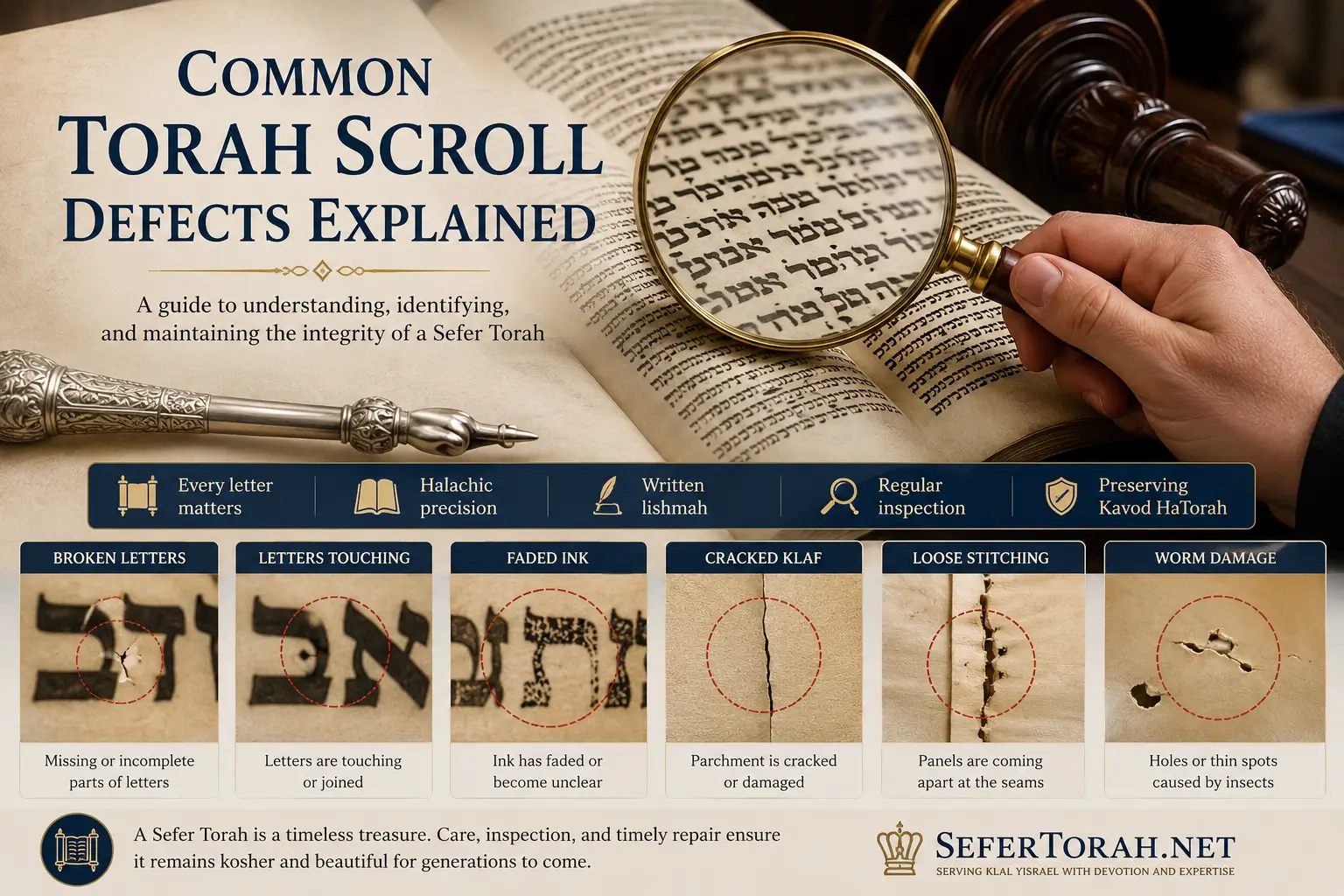
Among the most frequently encountered defects are letters that have developed cracks or missing sections. As ink naturally ages, tiny breaks may appear in portions of individual letters. If these interruptions alter the recognizable form of the letter, the Torah Scroll may become pasul until repaired.
Certain Hebrew letters have particularly precise construction requirements. Even a seemingly insignificant break can change one letter into another or create uncertainty regarding its identity. During a professional inspection, the sofer carefully evaluates whether each letter still meets Halachic standards for readability and form.
Letters Touching One Another
Hebrew letters within a Torah Scroll must remain clearly separated. When adjacent letters touch because of excess ink, ink spreading over time, or later deterioration, they may lose their independent identity.
This defect is known as devek or letter adhesion. While some cases can be corrected through careful restoration, others require more extensive work depending on the location of the affected letters and the condition of the surrounding parchment.
Faded or Flaking Ink
The black ink used in STa”M writing is prepared according to longstanding Halachic requirements. Although intended to remain durable for generations, ink may gradually fade or detach from the parchment due to age, environmental exposure, or repeated handling.
Minor fading does not necessarily invalidate a Torah Scroll. However, when letters lose sufficient clarity to affect legibility or proper letter formation, restoration by a qualified sofer becomes necessary. During restoration, new ink cannot simply be applied indiscriminately; repairs must follow precise Halachic procedures that preserve the integrity of the original writing.
Cracked or Damaged Parchment
The klaf itself may also develop defects over time. Small tears near the margins, creases from repeated rolling, or weakened parchment resulting from age can compromise the stability of the Torah Scroll.
Not every tear renders the scroll unfit for use. The location, size, and relationship to the written text determine whether repair is possible or whether more significant restoration is required. Experienced sofrim carefully evaluate each case individually before recommending appropriate treatment.
The Importance of Regular Torah Scroll Inspection
A Sefer Torah should never be assumed to remain kosher indefinitely simply because it was written by an accomplished Sofer STa”M. The Torah Scroll is a living sacred object that experiences continual use throughout the Jewish year. Each public reading, every occasion on which the scroll is rolled, lifted for Hagbah, dressed, or returned to the Aron Kodesh contributes to normal wear over time.
For this reason, many Halachic authorities recommend that Torah Scrolls be examined periodically by a qualified sofer. Regular bedikah allows minor issues—such as early ink deterioration or small defects in letter formation—to be identified before they develop into problems that require more extensive restoration.
Communities with Torah Scrolls that are used several times each week often schedule inspections more frequently than private collectors or institutions whose scrolls are used only on special occasions. Proper preventive care helps preserve both the physical condition and Halachic integrity of the scroll for future generations.
Modern Bedikah and Traditional Sofer Examination
Today’s Torah Scroll inspections combine centuries of traditional expertise with carefully developed technology. While computerized examination has become an important tool, it never replaces the trained judgment of an experienced Sofer STa”M.
Computer-Assisted Checking
Modern software can scan an entire Torah Scroll and identify potential concerns, including:
- Missing or duplicated letters
- Irregular spacing
- Letters that touch one another
- Inconsistent character formation
- Possible textual discrepancies
This technology significantly improves efficiency and helps detect issues that may be difficult to notice during a manual review.
Manual Halachic Inspection
Despite these technological advances, Halachic evaluation remains the responsibility of a qualified sofer.
Only an experienced sofer can determine:
- Whether a letter retains its required Halachic form.
- Whether a repair may be performed without compromising the Torah Scroll.
- Whether fading ink remains acceptable.
- Whether damaged parchment can be restored.
- Whether previous repairs comply with the laws of STa”M.
Computer analysis identifies potential concerns; the sofer determines their Halachic significance. The combination of traditional scholarship and modern inspection methods represents the highest standard of Torah Scroll care practiced today.
Can Every Torah Scroll Defect Be Repaired?
One of the most common misconceptions is that every defect automatically requires replacing an entire Torah Scroll. In reality, many issues can be corrected through careful restoration performed by an experienced Sofer STa”M.
Repair possibilities depend on several factors:
- The location of the defect.
- Whether the damage affects the written text.
- The condition of the surrounding parchment.
- The extent of ink deterioration.
- The original quality of the scroll.
Minor problems such as separated stitching, localized ink loss, or isolated letter corrections are often addressed during routine maintenance. More significant issues—such as extensive parchment damage, widespread deterioration, or numerous invalid letters—may require comprehensive restoration before the Torah Scroll can once again be used for public Torah reading.
Each Torah Scroll should therefore be evaluated individually rather than assuming that visible wear necessarily affects its kosher status.
Caring for a Torah Scroll to Prevent Future Defects
Although natural aging cannot be eliminated, proper care greatly reduces the likelihood of avoidable damage.
Recommended practices include:
- Store the Sefer Torah in a stable environment away from excessive humidity, heat, and direct sunlight.
- Ensure the scroll is rolled carefully to prevent unnecessary stress on the parchment and stitching.
- Handle the Torah with clean, dry hands and appropriate synagogue procedures during Torah readings.
- Use properly fitted Torah mantles, breastplates, and protective ornaments that do not place excessive pressure on the scroll.
- Schedule regular professional inspections instead of waiting until visible damage appears.
Consistent preventive care often preserves a Torah Scroll for many decades while minimizing the need for major restoration work.
Expert Torah Scroll Evaluation and Restoration
Whether you are responsible for a synagogue Torah Scroll, a private collection, or a newly acquired Sefer Torah, professional guidance is invaluable when questions arise regarding its condition.
At SeferTorah.Net, we assist congregations, schools, collectors, and Jewish communities in understanding the condition of their Torah Scrolls and identifying appropriate solutions. From evaluating common Torah Scroll defects to discussing restoration options and commissioning new Torah Scrolls, our team works closely with qualified STa”M professionals committed to preserving the sanctity, beauty, and Halachic integrity of every Sefer Torah.
If you are considering purchasing a new Torah Scroll, evaluating a used Torah Scroll, or seeking advice regarding Torah Scroll restoration, explore our Torah Scroll collection and contact our team for knowledgeable guidance based on your community’s traditions, practical needs, and long-term goals.
Frequently Asked Questions
1. What are the most common Torah Scroll defects?
The most common Torah Scroll defects include cracked or incomplete letters, letters touching one another (devek), faded or flaking ink, damaged parchment (klaf), loose stitching between panels (yeriot), and natural wear caused by age or frequent use. Not every defect renders a Sefer Torah pasul, but each should be evaluated by a qualified Sofer STa”M.
2. Can a Torah Scroll still be used if it has a minor defect?
That depends on the nature of the defect. Some cosmetic imperfections have no impact on the Torah Scroll’s Halachic status, while defects affecting the form of a letter, spacing, or readability may invalidate the scroll until properly repaired. Only a knowledgeable sofer can determine whether a defect affects its kosher status.
3. How often should a Torah Scroll be inspected?
A Torah Scroll used regularly in synagogue services should undergo periodic bedikah by a qualified Sofer STa”M. Many communities schedule inspections every few years, while scrolls used more frequently or exposed to challenging environmental conditions may benefit from more regular examinations.
4. Can faded ink be repaired?
Yes. In many cases, faded or deteriorating ink can be restored using Halachically appropriate methods. However, restoration must be performed by an experienced Sofer STa”M who understands the laws governing STa”M writing and repair. Improper touch-ups may compromise the Torah Scroll rather than preserve it.
5. What causes letters to touch in a Torah Scroll?
Letters may touch because of excess ink during the original writing, natural ink expansion over time, humidity, or deterioration of the parchment. Since every Hebrew letter must remain clearly distinct, touching letters often require professional correction.
6. Is computer checking enough to certify a Torah Scroll?
No. Computer-assisted bedikah b’machshev is an invaluable inspection tool that helps identify possible textual and spacing issues, but it cannot replace the judgment of a qualified Sofer STa”M. The accepted standard today combines computerized analysis with a comprehensive manual Halachic examination.
7. Can an older Torah Scroll usually be restored?
Many older Torah Scrolls can be successfully restored, depending on the condition of the parchment, ink, stitching, and overall structure of the scroll. Some require only routine corrections, while others may need more extensive restoration before returning to synagogue use. Each scroll should be evaluated individually rather than assuming restoration is—or is not—possible.
8. How can a synagogue help prevent Torah Scroll defects?
Proper handling, careful rolling, controlled storage conditions, appropriate Torah coverings, and regular professional inspections all contribute to preserving a Torah Scroll. Preventive maintenance is often the most effective way to reduce future restoration needs while protecting the sanctity of the Sefer Torah.
9. What should I do if I suspect my Torah Scroll has a defect?
Avoid making assumptions based on appearance alone. Contact a qualified Sofer STa”M for a professional inspection. Early evaluation often allows relatively minor issues to be corrected before they become more significant restoration projects.
Conclusion
Understanding Common Torah Scroll Defects Explained is essential for anyone entrusted with the care of a Sefer Torah. While natural aging and regular synagogue use inevitably affect every handwritten scroll, many defects can be identified early through routine inspection and corrected according to established Halachic principles.
Whether caring for a newly commissioned Sefer Torah or preserving one that has served generations of a congregation, regular bedikah, proper storage, and timely restoration help maintain both its physical condition and Halachic integrity.
At SeferTorah.Net, we are committed to helping synagogues, schools, collectors, and Jewish communities make informed decisions regarding Torah Scroll care. Whether you are seeking a new Sefer Torah, evaluating a used Torah Scroll, or exploring Torah Scroll restoration options, our team is available to provide knowledgeable guidance rooted in STa”M expertise and longstanding Jewish tradition.
Explore our Torah Scrolls collection and related synagogue resources to learn more about preserving and honoring one of Judaism’s most sacred treasures.