


Understanding Ketav Beis Yosef, Ketav Ari & Ketav Sefaradi

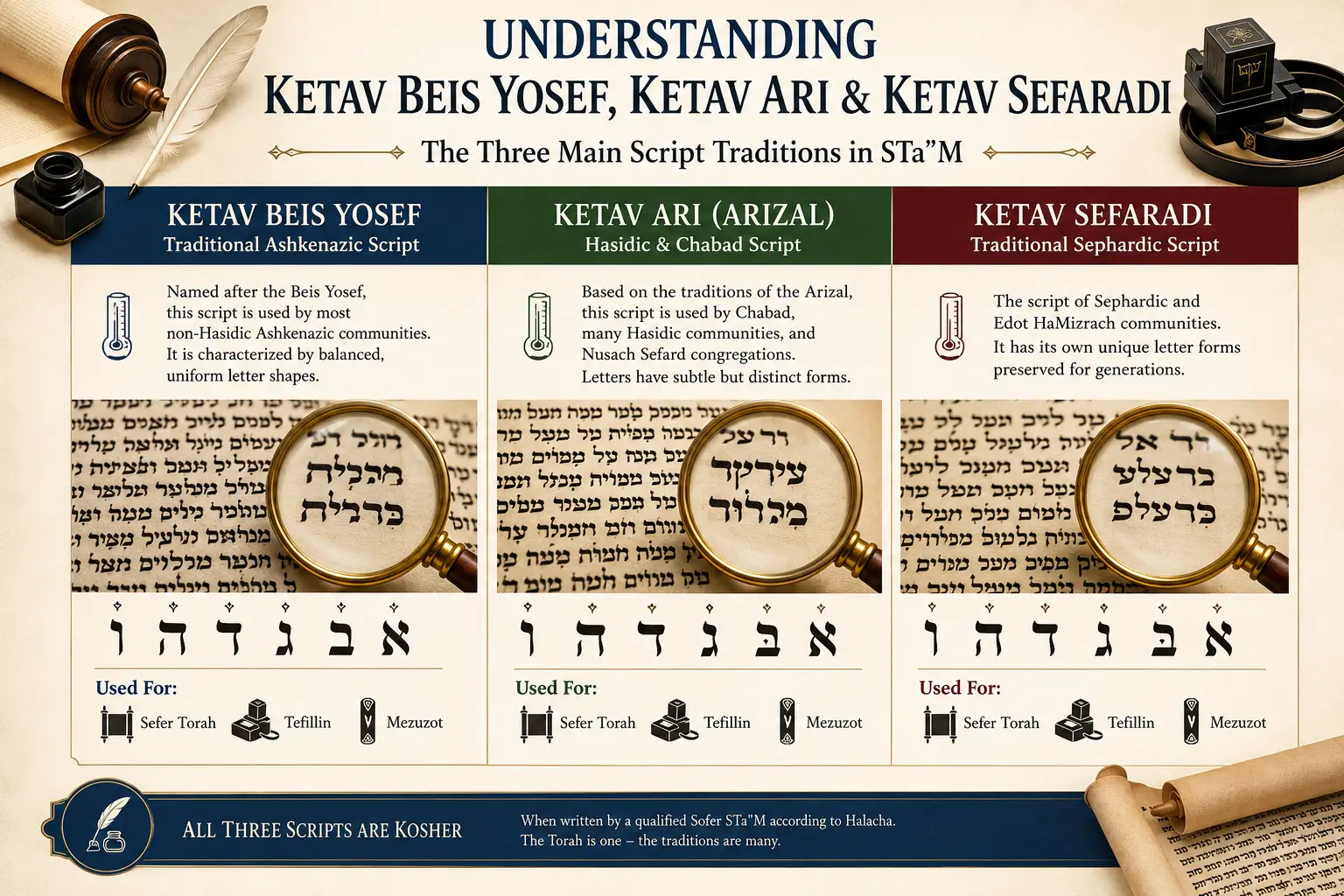
One of the first questions buyers encounter when purchasing a Sefer Torah, Tefillin, or Mezuzah is which ksav (scribal script) is appropriate for their community. While every kosher STa”M manuscript contains the same sacred Torah text, the appearance of the Hebrew letters can differ according to longstanding Jewish traditions. These differences are neither decorative nor stylistic preferences; they reflect centuries of accepted scribal practice, halachic interpretation, and communal minhag.
Understanding Ketav Beis Yosef, Ketav Ari & Ketav Sefaradi is essential for anyone commissioning a Torah Scroll, purchasing Tefillin or Mezuzot, or seeking to better understand the world of Jewish scribal arts. Each script carries its own history, distinctive letter formations, and accepted use among specific Jewish communities.
For observant Jews, selecting the correct ksav is more than a purchasing decision—it is an expression of continuity with one’s community and respect for the traditions passed from generation to generation.
In this guide, we will explain the historical development of these three major script traditions, the communities that use them, their practical differences, and how to determine which script is appropriate for your own synagogue, family, or personal observance.
What Does “Ketav” Mean in STa”M?
The Hebrew word Ketav simply means “script” or “writing style.” Within the world of STa”M—an acronym for Sifrei Torah, Tefillin, and Mezuzot—it refers to the accepted form in which every Hebrew letter is written by a qualified Sofer STa”M.
Contrary to what many first-time buyers assume, all kosher Torah Scrolls contain exactly the same Torah text. The distinction lies not in the words themselves, but in the precise way each letter is formed according to accepted halachic tradition.
Every sofer undergoes years of training to master the letter shapes, spacing, crowns (tagin), and detailed halachic requirements governing each script. Even subtle differences in the formation of certain letters can determine whether the writing follows Ketav Beis Yosef, Ketav Ari, or Ketav Sefaradi.
These traditions have developed through respected rabbinic authorities and have been preserved by generations of sofrim, ensuring consistency within Jewish communities around the world.
Why Different Script Traditions Exist
The existence of multiple kosher script traditions sometimes surprises those new to Judaica. However, Jewish history has always included diverse communities that faithfully preserved their own accepted customs while remaining fully committed to Halacha.
As Jewish communities spread across Europe, North Africa, the Middle East, and later throughout the world, local scribal traditions gradually developed under the guidance of leading rabbinic authorities. Over time, these traditions became standardized within each community.
Rather than representing competing versions of the Torah, these scripts demonstrate the remarkable continuity of Jewish scholarship. Every authentic ksav remains rooted in the same halachic principles governing the writing of sacred texts.
Today, the three principal traditions encountered when purchasing STa”M are:
Each continues to serve the communities that have preserved these traditions for generations.
Ketav Beis Yosef
The Traditional Ashkenazic Script
Ketav Beis Yosef is the script most commonly used by non-Hasidic Ashkenazic communities throughout Europe, North America, and many other parts of the Jewish world. It is named after the monumental halachic work Beis Yosef authored by Rabbi Yosef Karo, although the scribal tradition itself reflects the development of Ashkenazic STa”M practices over many centuries.
Its letter formations are characterized by carefully balanced proportions, well-defined crowns, and distinctive shapes that have become immediately recognizable to experienced sofrim.
Today, Ketav Beis Yosef remains the preferred choice for many:
- Orthodox Ashkenazic synagogues
- Lithuanian (Litvish) communities
- Yeshivot following Ashkenazic tradition
- Families maintaining longstanding European minhagim
Because many Torah Scrolls found in Ashkenazic congregations are written in this script, buyers commissioning a new Sefer Torah often continue this tradition to maintain consistency within their synagogue.
Ketav Ari (Arizal)
The Script of Hasidic and Chabad Communities
Ketav Ari, commonly known as the script of the Arizal, follows the teachings associated with Rabbi Yitzchak Luria and later became widely adopted across Hasidic Judaism. Today it is the standard script used by many Chabad communities, numerous Hasidic groups, and many congregations that follow Nusach Sefard.
Although closely related to Ketav Beis Yosef, Ketav Ari contains subtle yet significant differences in the formation of individual letters. These distinctions are carefully preserved by trained sofrim and recognized immediately by those familiar with STa”M.
For many communities, using Ketav Ari is not simply a matter of appearance. It reflects continuity with the spiritual and halachic traditions established by earlier generations and maintained through respected rabbinic leadership.
When purchasing Tefillin, many buyers specifically request Ketav Ari if it corresponds with their family minhag or the guidance of their Rav.
Internal Resource
If you are selecting a script for a new Sefer Torah, Tefillin, or Mezuzah, it is worthwhile to first explore the relevant collections on SeferTorah.Net. Our categories for Torah Scrolls, Tefillin Sets, Tefillin Parshiyot, and Mezuzot provide additional information on script traditions, craftsmanship, and STa”M standards, helping buyers make informed decisions based on their community’s accepted minhag rather than appearance alone.
Ketav Sefaradi
The Traditional Script of Sephardic Communities
Ketav Sefaradi is the traditional script used by Sephardic Jewish communities, particularly those tracing their heritage to the Middle East, North Africa, the Mediterranean region, and the Edot HaMizrach. While every kosher STa”M text contains the identical Torah passages, Ketav Sefaradi preserves its own distinctive letter forms and scribal traditions that have been faithfully maintained for centuries.
Communities from Morocco, Tunisia, Algeria, Syria, Iraq, Iran, Egypt, Turkey, Greece, and other Sephardic centers have historically commissioned Sifrei Torah, Tefillin, and Mezuzot according to this script. Today, it remains the accepted choice for many Sephardic congregations worldwide.
Like every accepted ksav, Ketav Sefaradi is governed by the laws of Halacha and written lishmah by qualified Sofrei STa”M. The differences between this script and the Ashkenazic traditions lie in the precise formation of specific letters rather than in the Torah text itself.
Comparing the Three Major STa”M Scripts
Although Ketav Beis Yosef, Ketav Ari, and Ketav Sefaradi are all fully kosher when written according to Halacha, each follows the accepted minhag of different Jewish communities.
| Script | Traditionally Used By | Common Applications |
|---|---|---|
| Ketav Beis Yosef | Non-Hasidic Ashkenazic communities | Torah Scrolls, Tefillin, Mezuzot |
| Ketav Ari | Chabad, Hasidic, many Nusach Sefard communities | Torah Scrolls, Tefillin, Mezuzot |
| Ketav Sefaradi | Sephardic and Edot HaMizrach communities | Torah Scrolls, Tefillin, Mezuzot |
It is important to understand that one script is not “more kosher” than another. Each represents an accepted scribal tradition transmitted through generations of rabbinic authorities and sofrim. The appropriate choice depends on community custom and the guidance of one’s Rav rather than personal preference alone.
How to Choose the Correct Ksav
For most buyers, selecting the appropriate script is straightforward because it follows family or synagogue tradition. Nevertheless, those purchasing STa”M for the first time often ask which script they should choose.
Consider the following questions:
- Which tradition does your synagogue follow?
- Which ksav has your family traditionally used?
- Does your Rav recommend a particular script?
- Are you purchasing for personal use, synagogue use, or as a Bar Mitzvah gift?
If you are replacing an existing Mezuzah, Tefillin, or commissioning a Sefer Torah, maintaining consistency with your community’s minhag is generally recommended.
Where uncertainty exists, consulting a knowledgeable Rav before making a final decision is always advisable.
Why the Choice of Sofer Matters More Than the Script
While buyers often focus on selecting the correct ksav, experienced STa”M professionals recognize that the qualifications of the Sofer STa”M are equally significant.
A kosher manuscript depends upon far more than letter style. Every sacred text must be written:
- Lishmah (for the sake of the mitzvah)
- On properly prepared kosher klaf
- With approved STa”M ink
- According to accepted halachic standards
- With meticulous attention to every letter
- By a sofer possessing both technical expertise and yirat shamayim
Many reputable sofrim also submit completed manuscripts to bedikah b’machshev (computer-assisted checking) in addition to careful manual inspection, helping identify spacing or letter-form issues that require correction before the manuscript is certified.
Explore STa”M Products at SeferTorah.Net
Whether you are purchasing your first Tefillin, commissioning a Sefer Torah, or selecting a kosher Mezuzah, understanding the different ksav traditions helps ensure your purchase reflects both your community’s minhag and accepted halachic practice.
At SeferTorah.Net, our collections include STa”M products prepared according to the traditions of Ashkenazic, Sephardic, and Chabad communities. If you are uncertain which script best matches your family’s custom or synagogue’s practice, our knowledgeable team can help explain the available options and guide you toward the appropriate choice.
You may also wish to explore our collections of:
- Torah Scrolls
- Tefillin Sets
- Tefillin Parshiyot
- Mezuzot
- Torah Ornaments
- STa”M Supplies
Frequently Asked Questions
What is the difference between Ketav Beis Yosef, Ketav Ari, and Ketav Sefaradi?
The primary difference lies in the traditional formation of certain Hebrew letters. Each script follows accepted halachic standards while preserving the minhag of different Jewish communities.
Which script is used by Ashkenazic communities?
Most non-Hasidic Ashkenazic communities traditionally use Ketav Beis Yosef for Torah Scrolls, Tefillin, and Mezuzot.
Which communities use Ketav Ari?
Ketav Ari is widely used by Chabad, Hasidic communities, and many congregations that follow Nusach Sefard.
Is Ketav Sefaradi only used for Torah Scrolls?
No. Ketav Sefaradi is used for all forms of STa”M, including Sefer Torah, Tefillin, and Mezuzot, according to Sephardic tradition.
Is one script more kosher than another?
No. All three scripts are fully kosher when written according to Halacha by a qualified Sofer STa”M. The correct choice depends on your community’s accepted minhag.
Can I choose any script I prefer?
While no prohibition exists in many situations, most rabbinic authorities recommend following the minhag of your family or synagogue and consulting your Rav when uncertain.
Are the Torah texts different in each script?
No. The Torah text itself remains identical. The differences relate only to the traditional appearance and formation of certain Hebrew letters.
Should I match my Tefillin and Mezuzah scripts?
Many observant Jews choose to maintain consistency with their community’s tradition across all STa”M items, although the appropriate decision should be guided by one’s Rav and established minhag.
How can I determine which script is right for me?
The best approach is to consider your family’s tradition, your synagogue’s practice, and the guidance of your Rav. If you remain uncertain, speaking with an experienced STa”M specialist can help clarify the appropriate choice.
Conclusion
Understanding Ketav Beis Yosef, Ketav Ari & Ketav Sefaradi allows buyers to appreciate the remarkable continuity of Jewish scribal tradition. Although each script reflects the heritage of different communities, all share the same purpose: preserving the sanctity of the Torah through meticulous adherence to Halacha and generations of expert STa”M craftsmanship.
Whether purchasing a Sefer Torah, Tefillin, or Mezuzah, the most important considerations remain choosing the script appropriate to your minhag and ensuring the sacred text has been prepared by a qualified Sofer STa”M according to accepted halachic standards. By understanding these traditions, you can make an informed decision that honors both your community’s heritage and the enduring sanctity of Jewish sacred texts.