


Kavod HaTorah Explained: The Meaning and Practice of Honoring the Torah

Kavod HaTorah Explained: The Meaning and Practice of Honoring the Torah
The Torah occupies a central place in Jewish religious life. Its teachings guide Jewish belief, practice, and communal identity, while the Sefer Torah itself is treated with profound reverence. This respect is expressed through prayer, Torah study, synagogue customs, careful handling of sacred scrolls, and the way Jewish communities maintain their religious institutions.
The Hebrew expression Kavod HaTorah means the honor or dignity accorded to the Torah. It is not limited to the physical scroll or the formal moments of a Torah service. It also encompasses respect for Torah learning, those who teach it, and the sacred responsibilities associated with preserving and transmitting Jewish tradition.
Understanding Kavod HaTorah helps explain why a Sefer Torah is stored in a designated place, why the congregation stands when it is carried, why its coverings and ornaments are treated carefully, and why the preparation of a kosher Torah scroll follows detailed halachic standards.
This guide explores the meaning, foundations, and practical expression of Kavod HaTorah, including the role of Torah ornaments and synagogue Judaica in honoring the Sefer Torah.
What Does Kavod HaTorah Mean?
Kavod means honor, dignity, or respect, while HaTorah refers to the Torah. Together, Kavod HaTorah describes the responsibility to recognize the Torah’s sacred status and demonstrate that recognition through conduct.
The concept has several connected dimensions:
- Respect for Torah itself: Recognizing the Torah as the foundation of Jewish religious life and observance.
- Respect for Torah study: Valuing the learning, teaching, and transmission of Torah knowledge.
- Respect for the Sefer Torah: Treating the handwritten scroll with the dignity required by Halacha.
- Respect for Torah scholars and teachers: Recognizing the responsibility and contribution of those who teach Torah.
- Respect for Torah institutions: Maintaining synagogues, study spaces, and sacred objects appropriately.
These dimensions are connected. A person cannot fully express respect for Torah merely through beautiful ceremonial objects while neglecting Torah study, proper conduct, or the responsibilities of Jewish communal life.
Kavod HaTorah is therefore both an attitude and a practical obligation. It influences how individuals behave in the presence of Torah, how synagogues conduct services, and how communities preserve their sacred objects.
The Halachic Foundations of Kavod HaTorah
The requirement to honor the Sefer Torah is discussed in classical Jewish sources. Shulchan Aruch, Yoreh De’ah 282, establishes detailed laws concerning respectful conduct in the presence of a Torah scroll.
The opening section emphasizes that a person must treat a Sefer Torah with great respect, designate an appropriate place for it, and maintain that place with dignity. It also describes conduct that is inappropriate in the scroll’s presence.
These laws demonstrate that respect for Torah is not simply a matter of personal preference or synagogue etiquette. It is rooted in Halacha.
Respecting the Sefer Torah in Its Presence
The halachic discussion includes several practical principles:
- A Sefer Torah should have a designated and respectful place.
- It should not be treated as an ordinary object or used as a convenient surface.
- Inappropriate conduct in its presence must be avoided.
- It should be handled and stored according to the relevant halachic requirements.
- Those who encounter a Torah scroll being carried observe the established requirement to stand.
The Rambam also discusses the appropriate conduct expected in the presence of a Sefer Torah in Hilchot Tefillin, Mezuzah, and Sefer Torah, Chapter 10.
The central idea is that the physical scroll represents something far greater than its parchment and ink. Its treatment reflects the honor due to the Torah it contains.
Standing When the Sefer Torah Is Carried
One of the most recognizable expressions of Kavod HaTorah takes place during synagogue services.
When a Sefer Torah is carried through the congregation, the community stands in its honor. The relevant discussion appears in Shulchan Aruch, Yoreh De’ah 282:2.
This practice gives visible expression to the Torah’s importance. It also teaches children and visitors that the Sefer Torah is treated differently from ordinary books and possessions.
The precise circumstances in which one must stand, and the customs followed when the Torah is stationary, are discussed by later halachic authorities. Congregants should follow the guidance of their community’s rabbi.
Kavod HaTorah During Torah Reading
The public reading of the Torah, known as Keriat HaTorah, is an important part of synagogue life. Its procedures reflect the honor given to the Sefer Torah and the words it contains.
The Torah is removed from the Aron Kodesh, brought to the Bimah, opened for reading, and returned to its designated place afterward. Each stage follows established customs and halachic practices.
The Aron Kodesh
The Aron Kodesh is the sacred ark in which Torah scrolls are kept in many synagogues. It is a central feature of the synagogue and is treated with particular dignity.
The ark’s design often reflects the community’s heritage through decorative woodwork, inscriptions, textiles, and other artistic details.
A Parochet, or Holy Ark curtain, is commonly placed in front of the ark. Its design and use contribute to the synagogue’s ceremonial setting.
Synagogue communities selecting a new curtain can explore the Parochets and Holy Ark Curtains collection.
The Torah Mantle
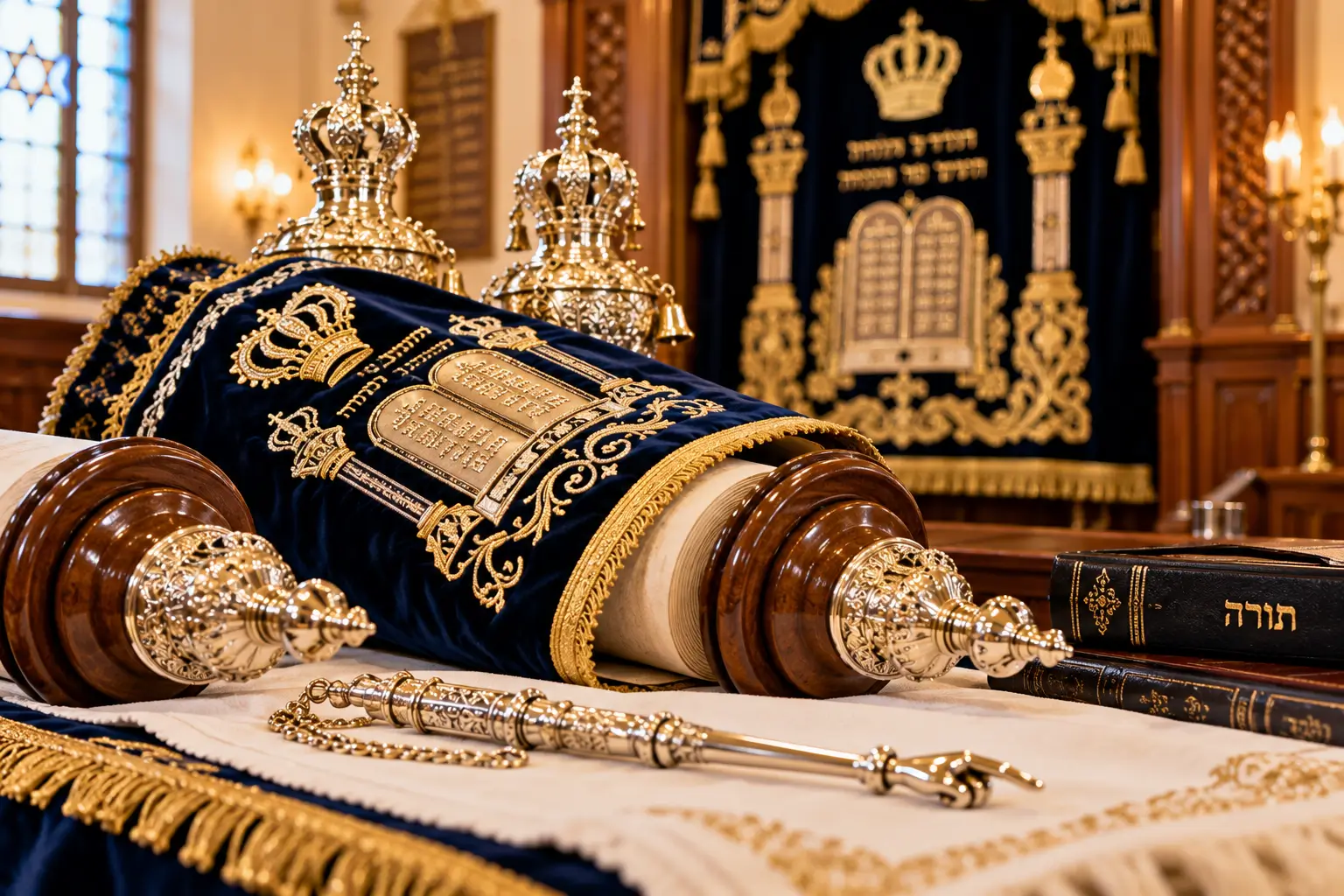
In communities that use a textile covering, the Sefer Torah is dressed in a mantle, often called a Me’il. The mantle protects the scroll and contributes to the dignity of its presentation.
Torah mantles may feature embroidery, Hebrew inscriptions, traditional motifs, and decorative elements associated with a synagogue or dedication.
SeferTorah.Net offers Hand-Embroidered Torah Mantles and Traditional Torah Mantles for communities exploring different styles.
When selecting a mantle, the dimensions and construction must be suitable for the particular scroll. The fabric, embroidery, and care requirements should also be considered.
Hidur Mitzvah: Beautifying the Performance of a Mitzvah
An important concept connected with Kavod HaTorah is Hidur Mitzvah. The expression refers to enhancing a mitzvah through appropriate beauty and care.
Jewish tradition recognizes that the performance of a mitzvah can be accompanied by beautiful and carefully prepared objects. This principle is reflected in the way communities select ritual accessories, maintain synagogue furnishings, and commission ceremonial Judaica.
However, Hidur Mitzvah should not be confused with extravagance. The purpose is to honor the mitzvah, not to make decoration more important than the religious act itself.
Torah Crowns and Rimonim
Torah crowns and Rimonim are among the recognizable ornaments associated with the Sefer Torah in communities that use them.
A Torah crown is placed above the scroll in certain traditions, while Rimonim are ornamental finials placed on the wooden rollers. Their designs may include bells, engraved patterns, floral motifs, inscriptions, and decorative metalwork.
These objects can reflect the history and artistic heritage of a synagogue. Their value lies not only in their appearance but also in their role within the community’s tradition.
When selecting ceremonial ornaments, synagogue leaders should consider the materials, construction, dimensions, and intended use.
Torah Breastplates and Yads
A Torah breastplate, sometimes called a Hoshen in Judaica contexts, is a decorative ornament associated with the front of a Torah mantle in communities that use this form.
A Yad, or Torah pointer, is used to follow the text during Torah reading. It helps the reader maintain their place without directly touching the parchment.
These accessories contribute to the ceremonial presentation and practical use of the Sefer Torah.
Explore the Torah Pointers and Yads category to see different designs and finishes. For additional synagogue Judaica, visit the SeferTorah.Net store.
The Role of the Sofer STa”M in Preserving Kavod HaTorah
A Sofer STa”M is a qualified scribe who writes sacred Jewish texts, including Sifrei Torah, Tefillin, and Mezuzot.
The work of a Sofer involves specialized knowledge of Hebrew letters, parchment, ink, writing techniques, and halachic requirements. A kosher Sefer Torah cannot be produced simply by copying Hebrew text. Its writing must comply with the relevant laws and accepted traditions.
The Importance of Accurate Torah Writing
The letters of a Sefer Torah must be written according to established halachic standards. Their forms, spacing, arrangement, and other requirements are subject to detailed rules.
The concept of Lishmah, performing an act with the appropriate religious intention, is also relevant to the preparation of sacred STa”M writing.
A Sefer Torah is therefore the result of careful scribal work, knowledge, and responsibility. Respecting the scroll includes recognizing the standards required for its production and ongoing maintenance.
Torah Scrolls and Community Traditions
Different Jewish communities preserve distinctive scribal and ceremonial traditions. These may influence the script, presentation, and accessories associated with a Sefer Torah.
For example, Ketav Beit Yosef is a recognized writing tradition used in many Ashkenazic communities. Other communities follow different established script traditions.
When commissioning or purchasing a Torah scroll, the appropriate script and requirements should be confirmed with a qualified Sofer and the community’s rabbinic authority.
Those interested in traditional Torah scrolls can explore the Ketav Beit Yosef Torah Scrolls category.
How Synagogues Can Express Kavod HaTorah
Kavod HaTorah is reflected in the everyday organization and conduct of a synagogue, not only during the Torah service.
Synagogue leadership has a responsibility to establish appropriate arrangements for storing, handling, and maintaining sacred objects. Congregants also contribute through respectful behavior and participation.
Practical ways to support Kavod HaTorah include:
- Maintain an appropriate Aron Kodesh: Ensure that Torah scrolls are stored in a suitable and secure environment.
- Follow established handling procedures: Train authorized individuals in the proper handling and transportation of Torah scrolls.
- Maintain Torah accessories: Inspect mantles, ornaments, and other accessories for damage and arrange appropriate repairs.
- Preserve synagogue customs: Follow the community’s accepted Minhag and rabbinic guidance.
- Teach younger generations: Explain the meaning of standing for the Torah and treating sacred objects respectfully.
- Encourage Torah learning: Make Torah study and education an integral part of communal life.
These practices help create an environment in which respect for Torah is understood and expressed by every generation.
Choosing Judaica That Reflects Kavod HaTorah
For synagogue leaders, donors, and families, selecting Judaica can be an opportunity to support the dignity of Torah observance.
The choice of an ornament, mantle, Parochet, or Torah pointer should begin with its intended purpose. A piece intended for regular synagogue use may have different practical requirements from an item selected for a dedication or special occasion.
Before purchasing, consider:
- Intended use: Is the item designed for a Torah scroll, synagogue furnishing, or ceremonial occasion?
- Dimensions: Does it fit the scroll, ark, or intended location?
- Materials: Are the materials appropriate for regular use and maintenance?
- Craftsmanship: Are the construction and decorative details suitable for the intended setting?
- Community custom: Does the design align with the synagogue’s Minhag?
- Maintenance: Are care instructions and repair options available?
Explore Synagogue Judaica at SeferTorah.Net
SeferTorah.Net offers Judaica and synagogue accessories for Jewish homes and communities. Whether you are selecting a Torah mantle, considering a ceremonial accessory, or looking for a Torah pointer, the available collections provide options to explore.
Browse the Torah Pointers collection for Yads used during Torah reading, or visit the SeferTorah.Net store to discover additional Judaica and synagogue accessories.
For a synagogue dedication, a new Torah project, or the maintenance of an existing collection, review product details carefully and seek guidance when specific halachic or community requirements apply.
Selecting appropriate Judaica is one practical way a community can express its commitment to preserving the dignity and beauty of Torah observance.
Frequently Asked Questions About Kavod HaTorah
1. What does Kavod HaTorah mean?
Kavod HaTorah means honoring or showing respect for the Torah. It includes respect for Torah study, Torah scholars, the Sefer Torah, and the institutions and practices through which Torah is preserved and taught. It is expressed through both personal conduct and established halachic practices.
2. What is the difference between Kavod HaTorah and Hidur Mitzvah?
Kavod HaTorah refers broadly to the honor and dignity given to Torah. Hidur Mitzvah refers to enhancing the performance of a mitzvah through appropriate beauty and care. Beautiful Torah ornaments may express both principles, but neither concept is limited to decorative objects.
3. Why do people stand when the Sefer Torah is carried?
Standing is an established halachic expression of respect for the Sefer Torah. Shulchan Aruch, Yoreh De’ah 282:2, discusses the obligation to stand when a Torah scroll is being carried. The relevant details and customs should be followed according to one’s community and rabbinic guidance.
4. Why is the Sefer Torah kept in an Aron Kodesh?
The Aron Kodesh is the designated sacred ark in which Torah scrolls are stored in many synagogues. Keeping the scroll in an appropriate place reflects the halachic requirement to treat it with dignity and maintain a respectful environment.
5. What is the purpose of a Torah mantle?
A Torah mantle, or Me’il, is a textile covering used to protect and adorn a Sefer Torah in communities that follow this practice. It may feature embroidery, inscriptions, and traditional decorative motifs. Its dimensions and construction should be suitable for the scroll.
6. How do Torah crowns and Rimonim express Kavod HaTorah?
Torah crowns and Rimonim are ceremonial ornaments used in various Jewish communities. They enhance the presentation of the Sefer Torah and reflect the community’s tradition of honoring it through appropriate beauty. Their selection and use should follow the relevant Minhag.
7. What role does a Sofer STa”M play in Kavod HaTorah?
A Sofer STa”M writes sacred texts according to detailed halachic requirements. The accurate preparation of a Sefer Torah, Tefillin, or Mezuzah requires specialized knowledge and care. Respecting this work is part of recognizing the standards necessary to preserve sacred Jewish texts.
8. Is Kavod HaTorah only relevant inside a synagogue?
No. Kavod HaTorah applies wherever a Sefer Torah is present and also extends to Torah study and teaching. Individuals and families demonstrate it through respectful conduct, appropriate storage, and commitment to Jewish learning.
9. What is the relationship between Torah ornaments and Hidur Mitzvah?
Torah ornaments can express Hidur Mitzvah by adding appropriate beauty to the presentation of a Sefer Torah. Crowns, Rimonim, breastplates, and mantles reflect this principle in communities that use them. Their beauty should serve the mitzvah rather than become an end in itself.
10. How can synagogue leaders promote Kavod HaTorah?
Synagogue leaders can promote Kavod HaTorah by maintaining suitable Torah storage, establishing responsible handling procedures, preserving community customs, maintaining ceremonial accessories, and encouraging Torah education. Teaching children and congregants the meaning behind synagogue practices helps sustain these values.
Conclusion
Kavod HaTorah is a foundational expression of the Jewish relationship with Torah. It encompasses respect for the Sefer Torah, dedication to Torah learning, recognition of Torah scholars, and responsibility for preserving the traditions through which Torah is transmitted.
In synagogue life, this respect is visible in the way the Torah is stored, carried, read, and adorned. Torah mantles, crowns, Rimonim, breastplates, and Yads contribute to the dignity of the ceremonial setting, while the work of qualified Sofrim helps preserve the integrity of sacred texts.
Ultimately, Kavod HaTorah is not measured by the appearance of a synagogue or the value of its ornaments alone. It is reflected in the care, knowledge, reverence, and commitment with which a community treats the Torah.
By combining proper halachic practice, meaningful Torah education, and thoughtful care of sacred Judaica, Jewish families and communities can help preserve this respect for generations to come.